helen@hbxinnuorollforming.com
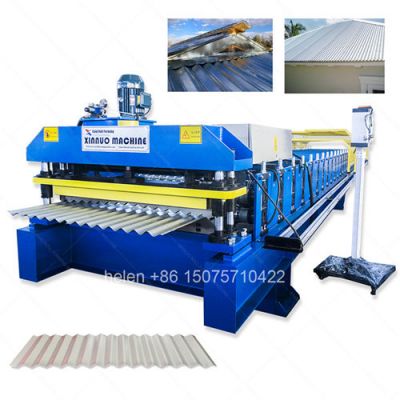
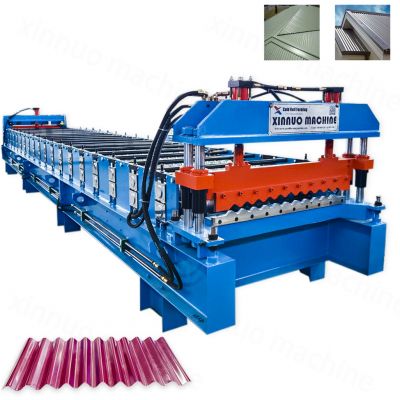
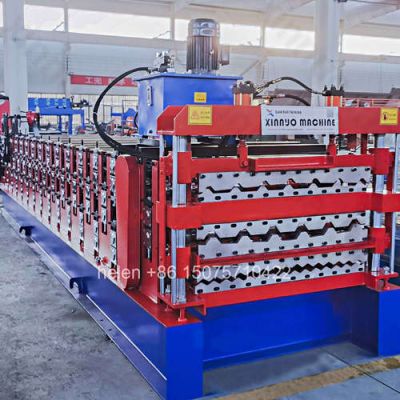
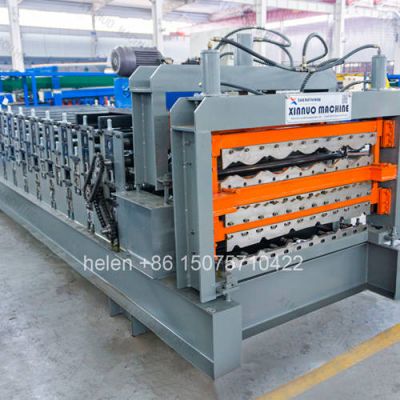
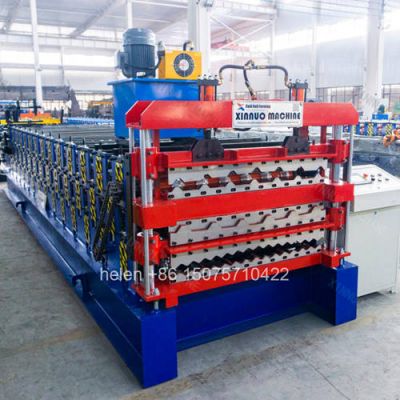
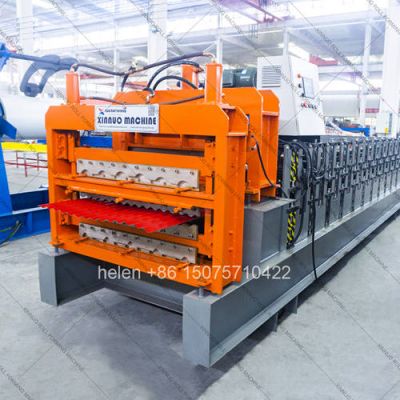
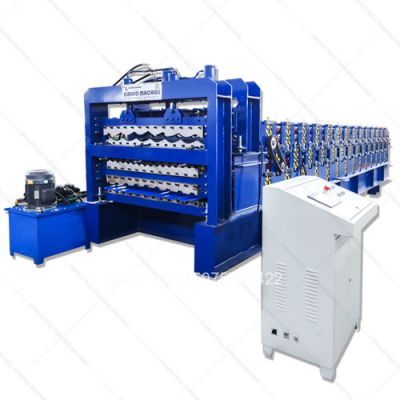
A three layer roll forming machine is the most advanced and versatile configuration in cold roll forming technology — integrating three independent sets of forming rollers stacked vertically within a single unified machine frame. By switching the material feed path between the three roller tiers, manufacturers can produce three different metal roofing or wall panel profiles from one compact machine platform. This represents the ultimate solution for roofing sheet manufacturers serving highly diverse markets or operating as multi-product building material distribution centers.
Common three-layer profile combinations include IBR trapezoidal + corrugated wave + glazed antique tile, arc wave + trapezoidal + glazed tile, and three different trapezoidal widths. The triple-deck architecture maximizes product variety within minimal floor space, making it ideal for building material showrooms, mega-distribution centers, and export-oriented manufacturers targeting three or more international markets simultaneously.
While the three-layer design offers unmatched versatility, it requires more sophisticated engineering than double-layer machines. The combined weight of three roller carriages demands a reinforced heavy-duty main frame, the drive system must handle torque loads from the most demanding profile, and the triple-tier alignment during commissioning requires experienced technicians. Typical commissioning time is 5-8 days, approximately 2-3 times longer than a standard double-layer machine.
| Comparison Factor | Double Layer Machine | Three Layer Machine |
|---|---|---|
| Number of Profiles | 2 different sheet profiles | 3 different sheet profiles |
| Machine Height | Standard double-tier frame height | Taller by approximately 300-500 mm to accommodate the third roller tier |
| Equipment Cost | ~65-75% of two single machines combined | ~55-65% of three single machines combined |
| Floor Space | ~20-35 m² (40-60% savings vs two singles) | ~25-40 m² (50-65% savings vs three singles) |
| Commissioning Time | 2-3 days standard | 5-8 days (approximately 2-3× standard double layer) |
| Operator Training | Single operator after basic training | One skilled operator; mastering all three profile switchovers requires extended training |
| Maintenance Complexity | Moderate — two roller tiers to service | Higher — three roller tiers, more bearings, chains, and alignment points |
| Best Use Case | Two-market coverage, dual-product line factories | Multi-market showrooms, mega-distributors, three-country export hubs |
| Combination | Upper Tier | Middle Tier | Lower Tier | Target Market |
|---|---|---|---|---|
| IBR + Corrugated + Glazed Tile | IBR trapezoidal | Corrugated wave | Glazed antique tile | Full-spectrum roofing distributor — covers industrial, economy, and premium decorative markets |
| Arc + Trapezoidal + Glazed Tile | Arc wave profile | Trapezoidal IBR | Glazed tile | Southeast Asia comprehensive market — arc for factories, trapezoidal for commercial, glazed for residential |
| IBR 686 + IBR 840 + IBR 1050 | IBR-686 narrow | IBR-840 mid | IBR-1050 wide | IBR-specialized manufacturer serving small to large building scales |
| Corrugated 665 + Corrugated 836 + Corrugated 990 | Corrugated-665 | Corrugated-836 | Corrugated-990 | Multi-country corrugated exporter — different widths for different national standards |
| Parameter | Standard Configuration |
|---|---|
| Main Frame | 400H or 450H heavy-duty welded H-section structural steel with triple-layer cross-ribbed reinforcement plates; designed to bear the combined weight and vibration of three roller carriages |
| Upper Tier Roller Stations | 14-18 rows, 45# forged steel, CNC precision machined, industrial hard chrome plated (HRC 58-62) |
| Middle Tier Roller Stations | 14-18 rows, same material and surface hardening specification as other tiers |
| Lower Tier Roller Stations | 14-18 rows, identical 45# forged steel and hard chrome plating specification |
| Roller Shaft Diameter | Φ80 mm solid steel, precision ground, supported by dual-row self-aligning bearings on all three tiers |
| Drive System | Heavy-duty duplex or triplex roller chain transmission; multi-position selector clutch for three-tier switching; hardened sprockets sized for maximum torque tier |
| Main Motor Power | 11-15 kW AC motor with variable frequency drive (VFD); oversized to handle peak forming loads across all three profiles |
| Hydraulic Station | 4.0-5.5 kW independent oil pump unit with oil cooling radiator and temperature monitoring |
| Forming Speed | 8-15 m/min (limited by the slowest profile among the three tiers; VFD adjustable) |
| Cutting System | Hydraulic post-cut guillotine shear; Cr12MoV tool steel blade set, vacuum quenched to HRC 60-62; ±1.5 mm accuracy |
| Control System | Industrial PLC with 7-inch or 10-inch color touchscreen HMI; three separate profile recipe banks (50 recipes per tier); multi-language interface; fault diagnostics per tier |
| Pitch Stamping (Glazed Tile Option) | Servo motor-driven independent pitch stamping mechanism on glazed tile tier; programmable pitch distance and step profile |
| Material Thickness | 0.3-0.8 mm (PPGI, PPGL, galvanized steel, aluminum-zinc alloy coil) |
| Coil Width Range | Up to 1250 mm (varies by profile tier and target effective width) |
| Profile Switchover | 5-15 minutes between any two tiers via manual diverter plate; no roller or die changes |
| Commissioning Duration | 5-8 days with experienced technician; three-tier roller alignment requires systematic sequential calibration |
| Machine Height Increase | Approximately 300-500 mm taller than equivalent double-layer machine due to third roller tier |
| Total Line Length | Approximately 20-25 meters including decoiler and run-out table |
| Machine Weight | Approximately 9-14 metric tons (varies by roller station count, frame grade, and tier combination) |
| Electrical Standard | 380V/50Hz/3-Phase (customizable to 220V/440V/480V/60Hz per destination) |
| Certifications | CE and ISO 9001 compliant manufacturing and quality assurance |
| # | Stage | Process Description |
|---|---|---|
| 1 | Coil Loading | Raw steel coil loaded onto hydraulic decoiler (5T or 8T); expanding mandrel secures and centers the coil for straight material feed |
| 2 | Tier Selection | Three-position manual diverter guide routes the coil strip into the upper, middle, or lower roller tier based on the target production profile |
| 3 | Edge Trimming | Integrated manual pre-cutter removes coil head defects before the first roller station for a clean forming start |
| 4 | Roll Forming | Coil strip passes through 14-18 progressive roller stations in the selected tier, incrementally shaped into IBR, corrugated, glazed tile, or arc profile cross-section |
| 5 | Pitch Stamping (If Applicable) | For glazed tile tier: synchronized servo or cam-driven stamping press creates stepped antique tile pattern at programmed pitch intervals |
| 6 | Length Measurement | Rotary encoder tracks linear material travel; PLC signals cut execution when preset sheet length is reached |
| 7 | Hydraulic Post-Cut | Flying guillotine shear executes clean, burr-free cut synchronized with the forming line speed |
| 8 | Panel Collection | Finished sheets discharged onto powered run-out conveyor; manual stacking or optional automatic pneumatic stacking arm |
Hebei Xinnuo is a professional cold roll forming machinery manufacturer with 20+ years of experience. We specialize in C/Z purlin machines, roof panel roll formers, floor deck machines, and custom profile solutions — exported to 50+ countries worldwide.