helen@hbxinnuorollforming.com
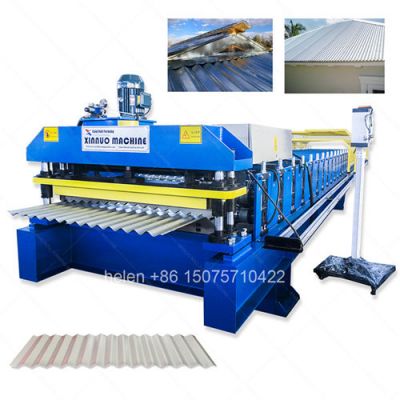
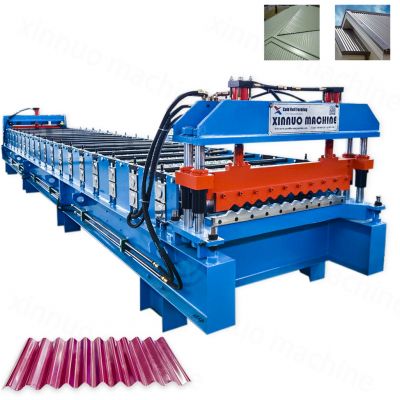
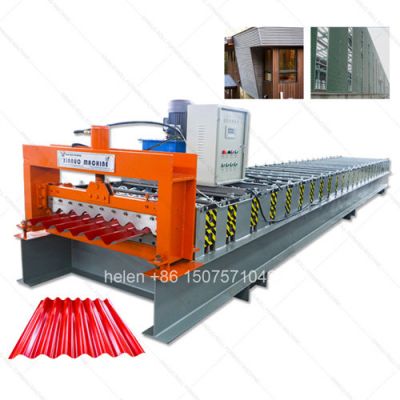
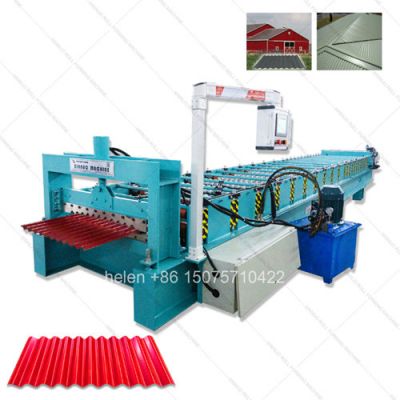
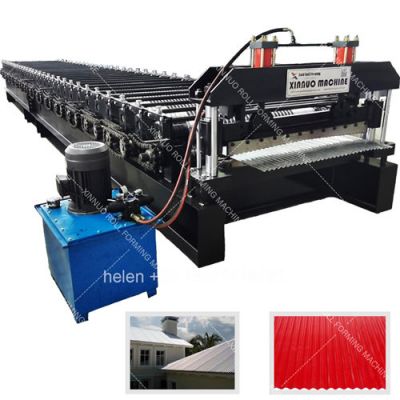
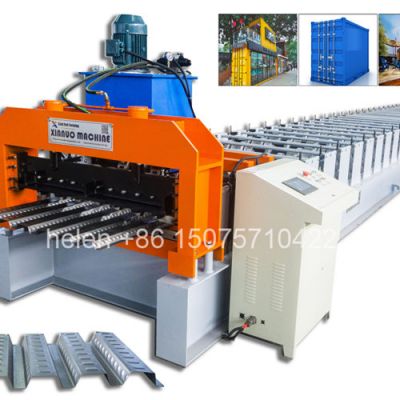
This IBR profile floor deck panel line rolls the Inverted Box Rib sheet used as a floor deck layer in Southern African construction. The panel is laid across joists or bearers and then covered with board, screed or a finish floor, so the deck stiffens the floor, spreads the load and lets the frame run with fewer bearers.
IBR stands for Inverted Box Rib. It is a pierce-fixed trapezoidal fluted sheet, and in South Africa, Zimbabwe, Zambia and Botswana it is the profile that fabricators, merchants and inspectors already recognise.
| Parameter | Value |
|---|---|
| Profile | IBR, Inverted Box Rib, trapezoidal fluted, pierce-fixed |
| Effective cover width | 686 mm standard; wide-span variants cover 762-828 mm |
| Ribs | Five trapezoidal ribs across the 686 mm cover |
| Rib pitch | About 171 mm |
| Rib height | About 36.5-37 mm |
| Steel thickness | 0.4-0.8 mm; floor work uses the upper end of the range |
| Materials | Galvanized, Aluzinc or pre-painted coil |
| Fixing | Screwed through the sheet into joists or bearers |
The sheet is not a slab. It is the deck layer of a built-up floor, and it works with the frame below and the board above.
| Build-up | Components | Effect |
|---|---|---|
| Board over IBR deck | IBR sheet fixed to joists, structural board on top | Flat walking surface, deck spreads load between joists |
| Screed over IBR deck | IBR sheet, then a thin screed or levelling layer | Solid floor feel, tight surface tolerance |
| Deck only | IBR sheet fixed to closely spaced bearers | Lightest and cheapest option for access and service platforms |
Because the deck spans between the bearers and carries load across them, a designer can usually use fewer or lighter bearers than a plank-only floor, which is the main reason the detail is common on mezzanine and loft floors in the region.
| Item | IBR floor deck layer | Concrete formwork deck |
|---|---|---|
| Rib height | About 37 mm | 50-153 mm |
| Concrete | None | Poured slab on top of the deck |
| Role in the floor | Deck layer that stiffens the floor and spreads load | Permanent formwork, and bottom reinforcement after curing |
| Where it sits | Between the joists and the board or screed | Below the slab |
| Fixing | Pierce-fixed through the sheet | Shear studs or through-deck fasteners to the beams |
| Site programme | No wet trade, walkable immediately | Pour plus curing period |
| Item | Specification |
|---|---|
| Profile | IBR 686 mm cover, five ribs |
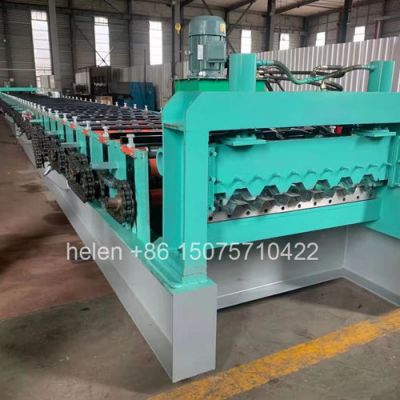
| Forming rows | 21 rows, the proven forming train for the 686 mm profile |
| Main frame | 350H or 400H H-beam |
| Mid plate | 75-80 mm |
| Motors | 5.5-7.5 kW, matched to the thickness range you sell |
| Transmission | Six-point double chain drive |
| Feed strip width | 925 mm for a 686 mm cover sheet |
| Forming rollers | Forged 45# steel, quench hardened, polished and chrome plated |
| Cutting | Cut-to-length shear with square ends and quantity count |
| Control | PLC with touch screen, length and quantity setting |
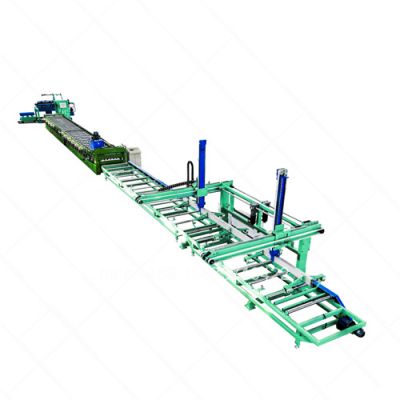
| Line length | Substantially shorter than a deep-rib concrete deck line, because 37 mm ribs need fewer passes |
| Section | Function |
|---|---|
| Decoiler | Carries the coil and feeds strip under steady tension |
| Feed guide | Aligns the strip and holds the cover width steady |
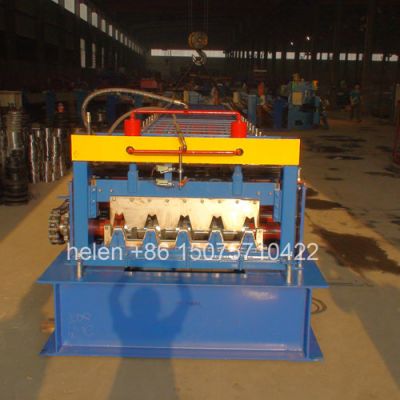
| Main forming unit | Rolls the five ribs to the 686 mm cover and 37 mm rib height |
| Shear | Cuts panels to the ordered length |
| Output table | Receives panels for inspection and bundling |
| Control cabinet | Length, quantity and speed setting |
| Item | Note |
|---|---|
| Material | Galvanized, Aluzinc or pre-painted coil |
| Thickness for floor work | Usually the upper end of the 0.4-0.8 mm range |
| Thickness for roofing and cladding | The lower end of the same range, on the same roll set |
| Coil inner diameter and weight | Confirmed at order stage so the decoiler is sized correctly |
| Coated coil | Non-marking roll arrangement available for pre-painted material |
| Question | Answer |
|---|---|
| Is the IBR sheet strong enough to act as a floor? | As a deck layer it works together with the joists and the board above. The span and loading must be confirmed by your engineer; we match the coil thickness and rib geometry to that design. |
| What thickness should I run? | Floor work normally takes the upper end of the 0.4-0.8 mm range, roofing the lower end. The frame and motor are sized for the thickest material you plan to sell. |
| Can the same line produce roofing IBR? | Yes. Same profile and same roll set. You change the coil thickness and the cut length, nothing else. |
| Can it make the wide-span variant? | The 762-828 mm wide-span variants are a different roll set. Tell us if you need both and we quote the second set or a second machine. |
| Does the panel need end laps or stiffening? | Laps and stiffening follow the fixing detail for your project. The machine delivers accurate cover width and rib height, which is what makes the laps close cleanly. |
Hebei Xinnuo is a professional cold roll forming machinery manufacturer with 20+ years of experience. We specialize in C/Z purlin machines, roof panel roll formers, floor deck machines, and custom profile solutions — exported to 50+ countries worldwide.