helen@hbxinnuorollforming.com
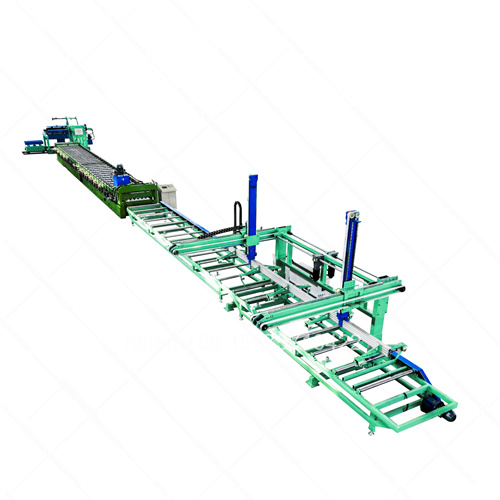
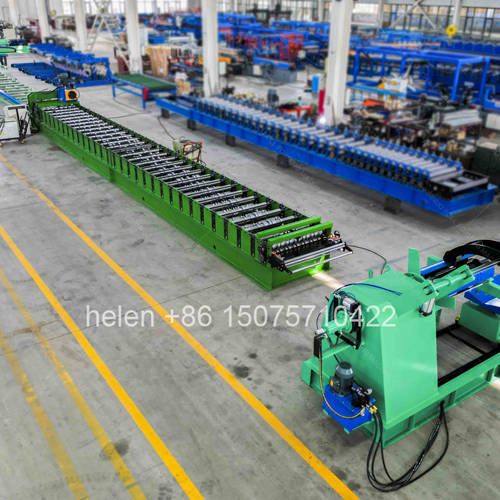
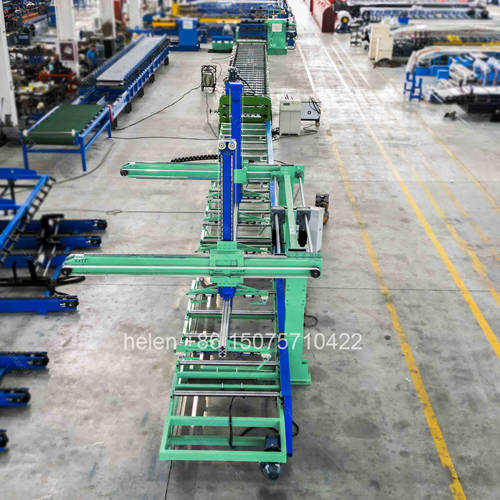
- IBR stands for Inverted Box Rib, a square fluted trapezoidal profile
- The 686 mm cover width variant dominates Southern African construction
- Five trapezoidal ribs at roughly 37 to 38 mm define the section
- Decking is used loosely in some markets to mean any profiled sheet
- Structural floor deck and IBR cladding are not the same product
- Profile class determines the machine tier, not the word decking
- Cover width, peak count, peak height and feed width set the tooling
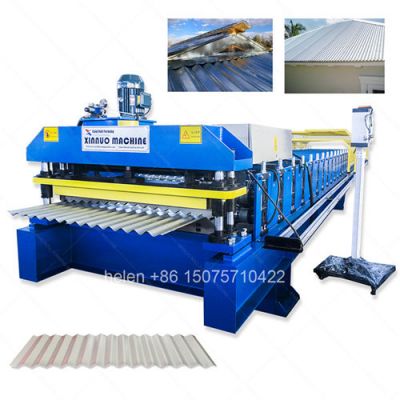
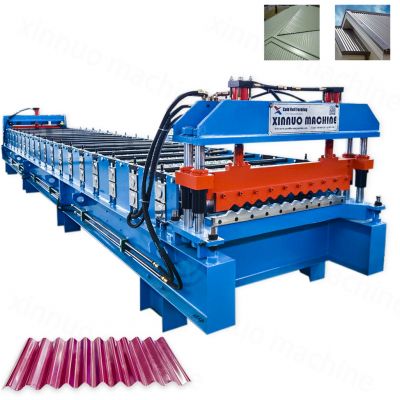
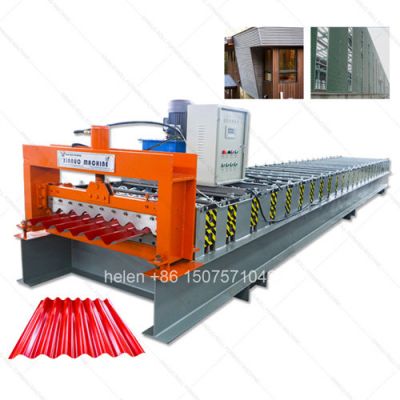
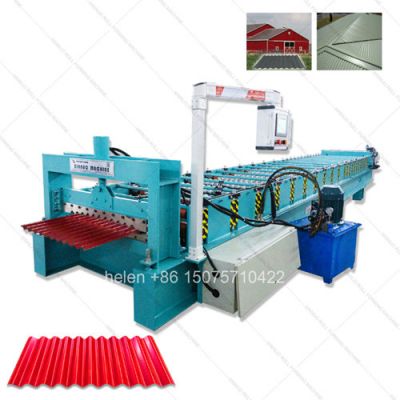
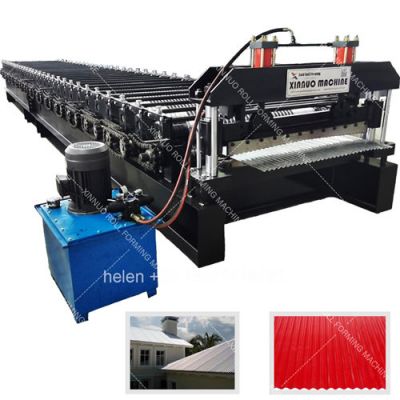
IBR is a specific profile, not a general term. The abbreviation stands for Inverted Box Rib, a square fluted trapezoidal sheet that entered the South African market in 1958 and became the default roofing and cladding profile across commercial, industrial and residential construction in the region. It is produced at a 686 mm effective cover width in its most common form, with five trapezoidal ribs at approximately 37 to 38 mm height, and at wider cover widths for markets and projects that prefer fewer laps per square metre.
The word decking appears alongside IBR in some markets as a loose synonym for profiled steel sheeting of any kind. That usage causes real specification errors, because structural floor deck — the deep-ribbed, embossed, composite deck used as permanent formwork for concrete slabs — is a fundamentally different product requiring a fundamentally different machine. This page defines what the IBR profile actually is, sets out its variants, explains where the decking terminology causes confusion and how to avoid it, compares IBR with corrugated sheeting, and sets out the machine tiers and options appropriate to producing IBR-class profiles.
| Attribute | Detail | Machine Consequence |
|---|---|---|
| Profile family | Angular trapezoidal fluting with a square or box-like rib form, giving the profile its characteristic bold appearance | Rib flanks are relatively steep, so material consumption per unit of rib height is high and the forming sequence must develop the rib progressively |
| Effective cover width | 686 mm in the standard variant, with wider variants produced for markets and projects requiring fewer laps | Roller length and shaft length sized to the cover width; the finished cover is fixed by the tooling |
| Rib count | Five trapezoidal ribs across the standard cover width | Five forming positions per pass; peak count is one of the four variables that define the tooling |
| Rib height | Approximately 37 to 38 mm, depending on manufacturer and the specification the profile is produced to | Sits in the mid range of cladding profile heights, well below structural floor deck and above shallow wall profiles |
| Primary application | Roofing and side cladding on commercial, industrial and residential buildings | The profile is valued for spanning capability, mass-to-strength ratio and appearance, which is why the section must be reproduced accurately rather than approximately |
| Regional dominance | Introduced to the South African market in 1958 and established since then as the most widely used sheet profile in the region | A machine serving Southern African markets is expected to produce this profile as its staple product |
| Material thickness | Produced across light gauges for cladding and heavier gauges for roofing at wider purlin spacings | Thickness range determines the machine tier; the profile must hold its section across the full thickness range ordered |
| Naming | The name is a description of the rib form rather than a proprietary designation, so sections described as IBR should always be confirmed against a drawing | Two suppliers producing IBR can differ in rib height, rib pitch, and lap detail; only the drawing is authoritative |
| Term | What It Actually Means | What It Does Not Mean |
|---|---|---|
| Decking, as used loosely | In several markets the word is applied to any profiled steel sheet used for roofing, cladding or flooring, including IBR | It does not distinguish between a cladding sheet and a structural load-bearing deck, which are different products with different machines |
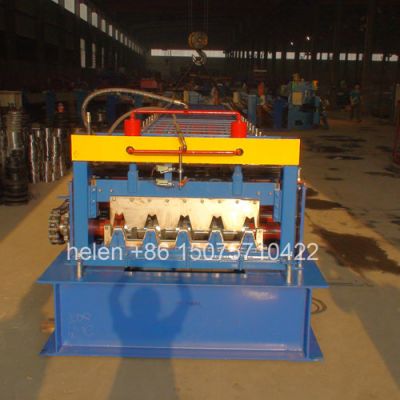
| Structural floor deck | Deep-ribbed, embossed steel sheet used as permanent formwork for concrete slabs and as tensile reinforcement afterwards | This is not an IBR profile. It has ribs several times deeper, embossments, a much longer forming train, and a heavier machine configuration |
| IBR sheeting | A specific trapezoidal cladding and roofing profile with the rib form and cover width described above | It is not designed to act as composite reinforcement in a concrete slab |
| Liner or soffit sheet | A thin profile used as an internal lining, primarily decorative and weather-shielding | Not a load-bearing element, and usually a lighter machine configuration than an IBR roofing profile |
| The practical rule | Establish from the drawing whether the section is intended to carry wet concrete load or to shed water | The name applied to the product locally does not tell the machine what tooling to fit. The section geometry does. |
Where a buyer's requirement is genuinely structural composite deck, an IBR-cladding machine will not produce it and a deck machine configured for the correct rib height and thickness is required. The two product families are served by different forming trains, different frame weights, different drive configurations, and different shear arrangements.
| Variant | Cover Width | Character and Application |
|---|---|---|
| Standard IBR | 686 mm | The default profile across Southern Africa. Five ribs, approximately 37 to 38 mm height, used as both roofing and side cladding on commercial, industrial and residential buildings. |
| Wide IBR | 890 mm | Preferred where projects call for wider coverage and fewer laps per square metre. Reduces the number of side laps, sheets, and fixing operations required to cover a given roof area. |
| Custom widths | 762 mm, 914 mm, 1000 mm and other figures | Produced to order for markets and projects with a different dimensional convention. Each width requires its own roller set and its own blank width. |
| Selected variant | Established from the drawing | Wider cover reduces lap count and material consumed in laps, but requires a wider and heavier roller set and a wider coil supply. |
| Aspect | IBR | Corrugated |
|---|---|---|
| Section form | Angular trapezoidal fluting with square or box-like ribs | Sinusoidal wave form without flat flanks |
| Cover width | 686 mm standard, with wider variants available | Different cover width convention, commonly in the 762 mm class |
| Rib height | Approximately 37 to 38 mm on the standard variant | Shallower wave height, commonly around 17 mm |
| Span capability | Substantially greater span between purlins at the same gauge, because the deeper angular rib contributes more stiffness | Lower span capability at the same gauge, requiring closer purlin spacing |
| Appearance | Bold, angular, and characteristic; often chosen for its visual character as well as performance | Traditional wave appearance |
| Machine difference | Angular ribs require steep flank forming and a forming sequence that develops the corner radii correctly | Smooth sinusoidal forming with continuous curvature across the wave |
| Tooling | Roller profile specific to the angular section, and not interchangeable with a corrugated set | Roller profile specific to the wave form |
| Tier | Forming Rows | Frame | Shaft | Power | Chain | Suited To |
|---|---|---|---|---|---|---|
| Economy | 9 – 12 | 250 – 300 channel | Φ65 – 70 mm | 3 – 4 kW | 6 fen single | Light cladding and lining profiles in light gauge, low volume production |
| Standard | 12 – 16 | 300 – 350H | Φ70 – 80 mm | 4 – 5.5 kW | 6 fen double | The baseline configuration for mainstream cladding profiles, including five-rib types |
| Heavy | 16 – 22 | 350H | Φ75 – 85 mm | 5.5 – 7.5 kW | 6 fen double or 1 inch | Heavier gauges and profiles formed at higher production volumes |
| High speed | 18 – 22 | 350 – 400H | Φ80 – 90 mm | 7.5 kW and above | 1 inch double | Volume producers where output rate is the governing requirement |
| Archway | 22 – 24 | 400 – 500H archway | Φ85 – 100 mm | Hydraulic motor | Gearbox or 1 inch double | Premium installations where smoothness, stability and finish quality justify the higher tier |
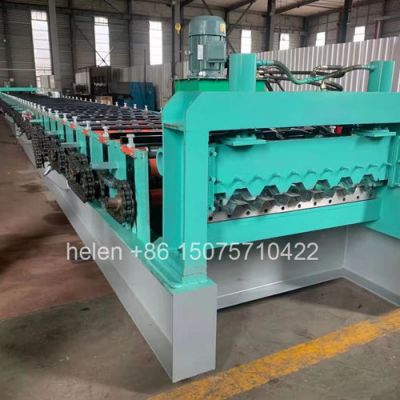
For the mainstream five-rib cladding profiles, a configuration in the region of 14 to 16 forming rows on a 350H frame with a Φ75 to 80 mm shaft, a 4 to 5.5 kW motor and a double 6 fen chain represents the usual starting point, with feed width between roughly 1000 and 1220 mm depending on the profile. Configurations move up or down from there according to peak count, thickness range and the production volume the buyer needs.
| Option | What It Adds |
|---|---|
| Edge forming wheel | An attachment that forms a small turned-up lip along one edge of the panel, improving weather sealing at the lap. Commonly specified on export profiles for markets where the detail is expected. |
| Inline arching section | Curves the panel after forming, for curved roof applications and arched structures. Turns a flat sheet line into a curved panel line without a separate operation. |
| Reverse press arrangement | Forms the profile in the opposite orientation where an installation configuration requires the sheet presented the other way up. |
| Higher speed configuration | Larger motor, heavier shaft and a faster drive arrangement to raise output where the machine is the production bottleneck. |
| Archway frame construction | Heavier frame construction with hydraulic drive, selected where surface finish, vibration, and long-term stability are the priorities. |
| Interchangeable tooling | Where two profile widths are both required, an additional roller set allows the same frame to produce a second section, subject to the blank width and load being compatible. |
| Cut-to-length control | Programmable length with sheet count control, so panels are cut to the order requirement rather than to a stock length. |
| Information | Why It Determines the Machine |
|---|---|
| Profile drawing or section details | The authoritative source for rib form, rib pitch, corner radii and lap detail. Two sections both described as IBR can differ materially. |
| Cover width variant | 686 mm, 890 mm, or a custom figure. Determines roller length, shaft length and the blank width required. |
| Peak count and peak height | Two of the four variables that define profile tooling and one of the inputs that determines forming row count. |
| Feed width and coil specification | Establishes what coil to buy and what the decoiler and entry guide must accommodate. Feed width is a separate figure from cover width and is always larger. |
| Material thickness range | Sets the tier. The maximum thickness the machine will be asked to run should be stated, not the typical one. |
| Coating type | Determines the guide and wheel provision required to protect the surface through forming, which matters on pre-painted cladding. |
| Required output rate | Decides whether a standard, high-speed or archway tier is justified. |
| Required panel lengths | Affects the run-out and discharge arrangement and the cut control specification. |
| Number of profiles required | Determines whether a single machine, interchangeable tooling, or two machines is the correct answer. |
| Whether the section is structural | If the sheet is intended to act as composite floor deck rather than as cladding, a different machine family applies entirely. |
| Parameter | Standard Range |
|---|---|
| Target profile | IBR class square fluted trapezoidal cladding and roofing section, produced to the buyer's drawing or matched against a standard section |
| Cover width | 686 mm standard; 890 mm wide variant; custom widths including 762 mm, 914 mm and 1000 mm by order |
| Rib count | Five trapezoidal ribs on the 686 mm variant |
| Rib height | Approximately 37 – 38 mm on the standard variant |
| Feed width | Established from the profile drawing; typically in the 1000 – 1220 mm range for mainstream cladding profiles and always greater than the cover width |
| Forming rows | 9 – 24 rows depending on tier, from economy light cladding machines through to archway construction |
| Frame | 250 – 300 channel on the economy tier through 350H and 400 – 500H archway on the upper tiers |
| Shaft | Φ65 – 80 mm standard, up to Φ85 – 100 mm on heavy and archway configurations |
| Forming wheels | 45# forged steel, quenched to HRC 45 – 50, finish turned, keyed, polished and chrome plated |
| Motor configuration | 3 – 5.5 kW on economy and standard tiers, 7.5 kW and above on high-speed, hydraulic motor on the archway tier |
| Transmission | 6 fen single or double standard, 1 inch double on high-speed and heavy configurations |
| Shear | Hydraulic post-cut shear, with blade arrangement and hardness specified to the material |
| Cut length tolerance | ±1.5 mm |
| Forming speed | 10 – 30 m/min depending on tier, profile and gauge |
| Control system | PLC with colour touchscreen HMI, programmable cut length, sheet count control and stored recipe banks |
| Options | Edge forming wheel, inline arching section, reverse press arrangement, interchangeable tooling for a second profile width |
| Electrical supply | 380 V / 50 Hz / 3-phase standard; alternative voltages and frequencies by destination |
| Certification | CE marking and ISO 9001:2015 compliant manufacturing, with destination-market documentation arranged as required |
Coil loading on the decoiler, strip entry through the guide, progressive forming across the roll train where the angular rib is developed through successive passes, optional edge forming or inline arching where fitted, length measurement, hydraulic cutting, and discharge to the run-out position follow the established sequence, with the section geometry set by the roller tooling produced to the buyer's profile drawing.
Hebei Xinnuo is a professional cold roll forming machinery manufacturer with 20+ years of experience. We specialize in C/Z purlin machines, roof panel roll formers, floor deck machines, and custom profile solutions — exported to 50+ countries worldwide.