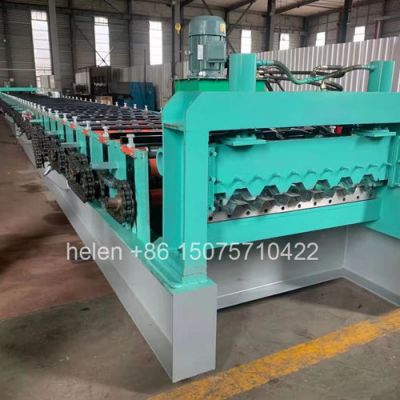
helen@hbxinnuorollforming.com
- Н75 is a load-bearing profile designation, not a general-purpose sheet
- The H75-750 section is 750 mm working width at 75 mm rib height
- Coil feed width for this section runs to 1250 mm
- Material typically spans 0.55 to 1.0 mm galvanized steel
- EAEU market entry requires conformity documentation in Russian
- A 27-row configuration has been delivered to St. Petersburg
- Cold-climate operation and coil storage shape the specification
The Н75 designation specifies a load-bearing profiled sheet rather than a general cladding product. In the Russian and wider EAEU market, Н75-750 is one of the standard structural deck sections: 75 mm rib height, 750 mm working width, formed from 1250 mm coil. It is used as permanent formwork and as tensile reinforcement in composite floor slabs on steel-framed buildings, which places it in the same functional category as the open deck profiles used elsewhere in the world but tied to a specific section geometry and a specific set of national standards.
This page addresses what a Russia H 75 deck roll forming machine has to satisfy: what the Н75 designation actually means and how the profile is referenced under GOST practice, what the standard Н75-750 section requires from the machine, where the section is used and what that implies, how steel grade and coating practice in the region affect forming, what machine configuration has been proven on this section for a Russian delivery, what conformity documentation is required to place the machine into service in the EAEU, and how Russian operating conditions and logistics affect the specification.
| Element | Meaning | Consequence for the Machine |
|---|---|---|
| Н | Несущий — load-bearing. Distinguishes a structural deck profile intended to carry load from a wall or roofing cladding profile. | The section must be formed to dimensional tolerances suitable for structural use, not merely to a visually acceptable finish. Rib uniformity across the panel width becomes a functional requirement. |
| 75 | Profile height in millimetres. The rib is 75 mm deep. | Deep-rib forming. Requires a long forming train, bearing-mounted oversized wheels in the rear rows, and reinforcement at the high-load rows. |
| 750 | Working width in millimetres. The finished panel covers 750 mm; the overall blank width is wider than the cover. | Fixed roll tooling to the section drawing, with the roller profile setting the cover width rather than any operator adjustment. |
| GOST designation practice | Profiled sheets are designated with the profile type, the dimensions, and the steel grade and coating, following the standard for bent steel sheet profiles with trapezoidal corrugations. | The buyer's section reference should be matched against the profile drawing before manufacture, since the same nominal size can differ in rib geometry between specifications. |
| Coil blank width | For the 750 mm working width section the blank coil width is 1250 mm. | Decoiler working width, entry guide range, and coil procurement all follow from this figure. |
| Section Parameter | Typical Н75-750 Value | Machine Requirement |
|---|---|---|
| Working width | 750 mm | Roll length and shaft length sized to the section; the finished cover width is set by the roller profile |
| Overall blank width | Approximately 800 mm | Confirms the material consumed by ribs and side laps; the difference between overall and working width is not waste but formed geometry |
| Coil blank width | 1250 mm | Decoiler capacity and entry guide range set to accommodate 1250 mm coil as standard for this section |
| Profile height | 75 mm | Positioned in the deep-rib class: 22 to 27 forming rows, with the higher figure used where material thickness sits at the top of the range |
| Material thickness | 0.55 – 1.0 mm | Sits inside the standard configuration envelope, since the standard heavy-duty specification covers material up to 1.2 mm and beyond |
| Steel grade | Structural grades to GOST practice, commonly Ст3пс and equivalents | Grade affects forming load and springback. Higher-strength material at 75 mm rib height benefits from the reinforcement and gear drive provision |
| Surface | Galvanized or coated structural sheet | Bearing-mounted rear wheels and a clean entry guide protect the coating through 75 mm of rib forming |
| Embossment | Dimples pressed into the rib faces for concrete grip | A dedicated embossing row with a clutch arrangement, since the dimple wheels are larger in diameter than adjacent forming wheels |
| Application | Why a Deep Rib Section Fits | What It Demands of the Machine |
|---|---|---|
| Composite floor slabs on steel frames | The deep rib provides the section depth needed for stiffness over the span before the concrete cures | Consistent rib height and uniform formation across the panel width, since stiffness depends on the actual formed section |
| Long-span floor plates | Greater rib depth increases the second moment of area, allowing longer spans without additional propping | Dimensional consistency along the panel, since a variation in rib height affects the whole span performance |
| Industrial and warehouse floors | The section carries construction loading and then contributes to the finished slab | Durable tooling and stable forming, because the machine runs long production campaigns for large floor areas |
| Multi-storey frame construction | Deck acts as permanent formwork, removing conventional shuttering from the programme | Reliable output rate and consistent panel quality, because the deck delivery schedule governs the concrete programme |
| Projects specifying a national section | The engineer specifies a recognised section designation rather than a generic profile | Roll tooling produced to the specified section drawing, verified against the buyer's own section reference before manufacture |
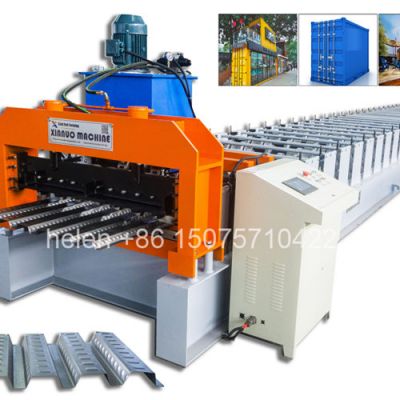
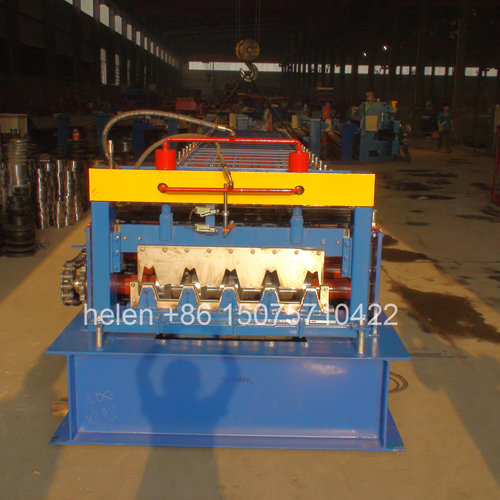
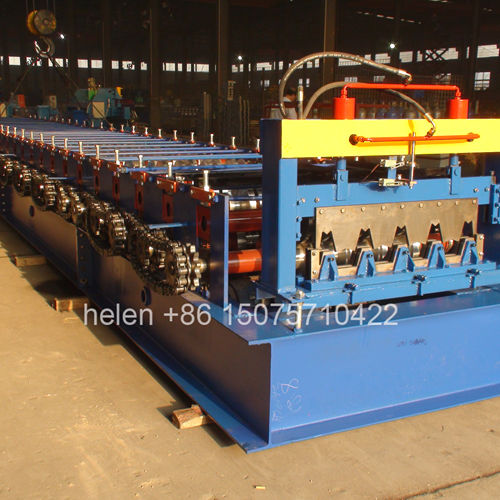
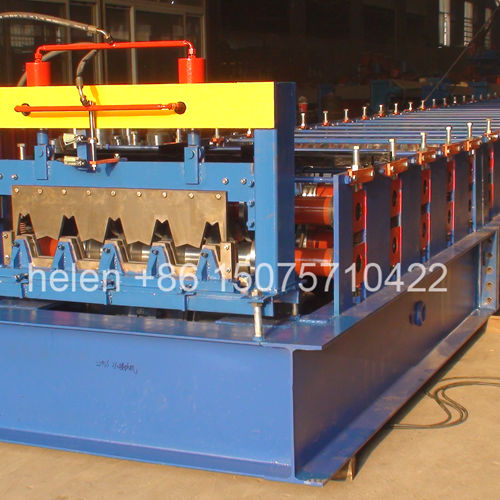
A 750 mm working width profile at approximately 75 mm rib height, formed from 1250 mm coil, has been produced on a 27-row configuration supplied to St. Petersburg. That reference is directly relevant to Н75-750 work because it is the same working width, the same coil blank width, and effectively the same rib height class.
| Parameter | Configuration |
|---|---|
| Working width / rib height | 750 mm working width at approximately 74 – 75 mm rib height |
| Coil blank width | 1250 mm |
| Forming rows | 27 rows, consistent with the deep-rib requirement of 22 to 27 rows for this height class |
| Frame | 450H welded H-section with a 18 – 20 mm mid plate |
| Shaft | Φ95 mm round bar, rough turned then precision ground |
| Motor configuration | 2 × 11 kW dual motor |
| Chain | 2 inch roller chain |
| Reducer mounting | Built-in configuration, giving a more compact machine footprint |
| Shear | Dual-cylinder floor-level shear with balanced cutting force and gravity-assisted panel discharge |
| Reference delivery | St. Petersburg, Russia — 2014 |
For Н75-750 at the upper end of its thickness range the same profile may be specified at 2 × 15 kW with a 2.5 inch chain, which is the heavy tier of the configuration ladder. The correct point on that ladder is determined by the maximum thickness the machine is expected to run, not by the average.
| Requirement | What It Means for the Machine |
|---|---|
| Machinery safety technical regulation | Machinery and equipment placed on the EAEU market is subject to the machinery safety technical regulation, with conformity demonstrated through certification or declaration depending on the equipment's risk category. |
| Low-voltage equipment regulation | Electrical equipment within defined voltage ranges is covered by a separate technical regulation, so the control system and electrical components carry their own conformity basis. |
| Electromagnetic compatibility regulation | Applies to equipment that may cause or be affected by electromagnetic disturbance, which includes a machine with a variable frequency drive. |
| EAC marking | The conformity mark applied to equipment lawfully placed on the EAEU market. It indicates conformity with the applicable technical regulations rather than with a single standard. |
| Documentation in Russian | Accompanying documentation — manual, safety information, and conformity documentation — must be provided in Russian. This is a documentation requirement, not a translation courtesy. |
| Technical file | Drawings, component information, and test evidence held as the basis of conformity, available for review. |
| Declaration of conformity | A formal document identifying the machine, the applicable regulations, and the standards applied, supplied with the machine rather than on request. |
| Buyer-side responsibility | The route to market conformity — which regulations apply, and whether certification or declaration is the correct instrument — should be confirmed by the buyer or their customs agent for the specific machine and destination before the order is placed. |
| Condition | Consideration |
|---|---|
| Coil stored in unheated space | Steel and coating at sub-zero temperature behave differently in forming. Where coil is stored cold and formed promptly, the forming load and the risk of coating damage at the bends are both affected. Bringing coil into the production area ahead of use is the usual mitigation. |
| Condensation on cold steel | Coil moved from a cold store into a warm, humid production area attracts condensation, which shows as staining and in the worst case as corrosion between wraps. This is a storage and scheduling issue rather than a machine issue, but it presents as a material defect at the machine. |
| Hydraulic oil viscosity | Oil viscosity rises as temperature falls, which affects the shear and any hydraulic function at start-up. The correct oil grade for the operating temperature range should be specified at the order stage. |
| Lubricant selection | Chain, gear, and bearing lubricants are temperature-dependent. The grade appropriate for the workshop's actual temperature range matters more than a general-purpose recommendation. |
| Electrical supply | The standard supply of 380 V / 50 Hz / 3-phase matches the machine's standard specification, which removes a common source of configuration variation. |
| Building temperature variation | Large seasonal swings between summer and winter affect machine alignment only marginally, but they do affect lubricant behaviour, hydraulic performance, and operator comfort at the entry and discharge ends. |
| Plant operating cycle | Where production runs seasonally rather than continuously, the machine may stand for extended periods. Long idle periods between campaigns affect lubricant condition and moisture ingress in the control cabinet, so a restart procedure is worth documenting. |
| Consideration | Practical Effect |
|---|---|
| Line length and shipping | A line of approximately 22 m overall, with a forming unit of about 14.5 m, ships in sections and is assembled on site. The site must be able to receive and handle the largest individual section. |
| Foundation and floor loading | Both decks and the frame impose high point loads at the machine feet. Floor capacity and foundation provision should be established before shipment, not on arrival. |
| Spare parts lead time | Parts dispatched from China to a Russian site by sea freight take weeks. The correct response is a full first-year parts kit supplied with the machine, covering bearings, chain, sprockets, blades, seals, hoses, and filters. |
| Blade supply | Supplied with a spare blade set so that the worn set can be reground while production continues on the spare, which removes a dependent wait on freight. |
| Electrical documentation | Schematics are essential for local fault finding, since electrical faults are the hardest to diagnose without a known-good reference and a technician is rarely available at short notice. |
| Operator training | Training at commissioning, with written and video material retained on site, so that new operators can be trained without waiting for a revisit. |
| Documentation language | Russian-language operating and safety documentation, which is required for the machine to be placed into service and is also what the operators will actually use. |
| Parameter | Standard Range |
|---|---|
| Target section | Н75 type load-bearing deck profile, 750 mm working width at 75 mm rib height, produced to the buyer's section drawing |
| Coil blank width | 1250 mm for the 750 mm working width section |
| Overall blank width | Approximately 800 mm, reflecting the material consumed by ribs and side laps |
| Material thickness | 0.55 – 1.0 mm for the standard Н75-750 section; machine capacity extends beyond this to 1.5 mm on heavy profiles |
| Material | Galvanized and coated structural steel sheet to GOST practice |
| Forming rows | 22 – 27 rows for the 75 mm rib height class, with 27 rows used at the heavier end of the thickness range |
| Frame | 450H welded H-section with 10 mm flange thickness and a 18 – 25 mm mid plate |
| Shaft | Φ95 mm round bar standard for this section; Φ90 – 115 mm across the range |
| Forming wheels | 45# forged steel, quenched to HRC 45 – 50, finish turned, keyed, polished, and chrome plated |
| Embossment row | Dedicated dimple wheel row with a clutch arrangement that releases drive once material has passed |
| Rear forming rows | Bearing-mounted oversized wheels across approximately the rear ten rows |
| Reinforcement provision | Reinforcement bars at the embossing row, main drive, rib-forming rows, and sizing rows |
| Gear drives | Fitted at the embossing row, ahead of the bearing-mounted wheel section, and at the exit rows |
| Transmission | 2 inch external roller chain standard; 2.5 inch where the heavy configuration is specified |
| Motor configuration | 2 × 11 kW standard for this section; 2 × 15 kW for the upper thickness range |
| Reducer mounting | Built-in or external, specified at order |
| Shear | Dual-cylinder hydraulic shear at floor level for balanced force and gravity-assisted panel discharge |
| Blade options | Three-blade for the cleanest edge with approximately 10 mm trim waste, or two-blade for zero waste with negligible edge deformation |
| Forming speed | 8 – 18 m/min depending on profile depth and material thickness |
| Cut length tolerance | ±1.5 mm |
| Control system | PLC with colour touchscreen HMI, sheet count control, and stored recipe banks |
| Line length | Approximately 22 m overall, comprising a forming unit of about 14.5 m, a control section of about 3 m, and an output bracket of about 3 m |
| Forming unit width | Approximately 2,750 mm, with approximately 6,500 mm at the decoiler side |
| Electrical supply | 380 V / 50 Hz / 3-phase, matching the standard demand of the destination market |
| Documentation | Machine manual, electrical schematic, hydraulic schematic, section drawing, parts list, blade specification, and test run record; Russian-language operating and conformity documentation available by destination |
| Certification | CE marking and ISO 9001:2015 compliant manufacturing, with EAEU conformity documentation arranged for the destination market |
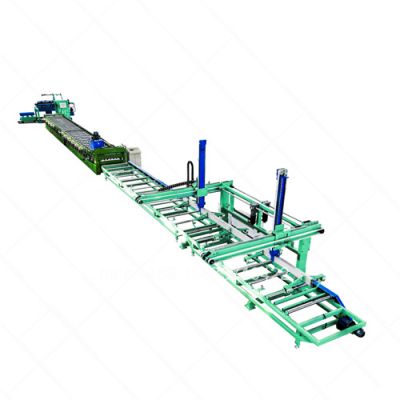
Coil loading on the decoiler, strip entry through the guide, progressive forming across the roll train with embossment at the dimple row, sizing over the final passes, length measurement, dual-cylinder cutting at floor level, and gravity discharge to the stacking position follow the established sequence, with the Н75-750 section geometry set by the roller tooling produced to the buyer's section drawing.
Hebei Xinnuo is a professional cold roll forming machinery manufacturer with 20+ years of experience. We specialize in C/Z purlin machines, roof panel roll formers, floor deck machines, and custom profile solutions — exported to 50+ countries worldwide.