helen@hbxinnuorollforming.com
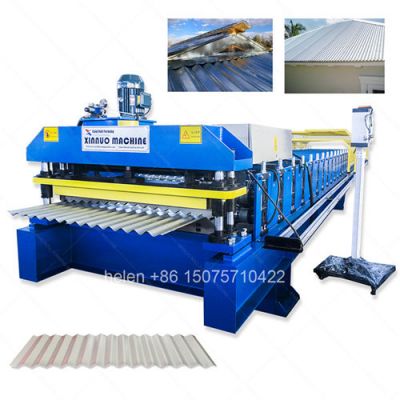
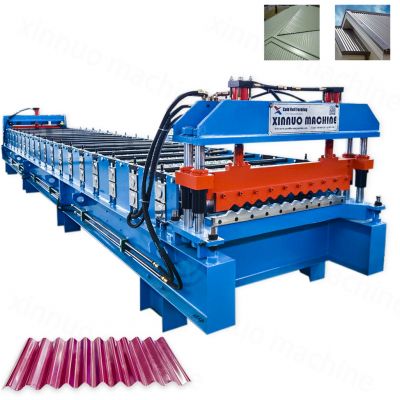
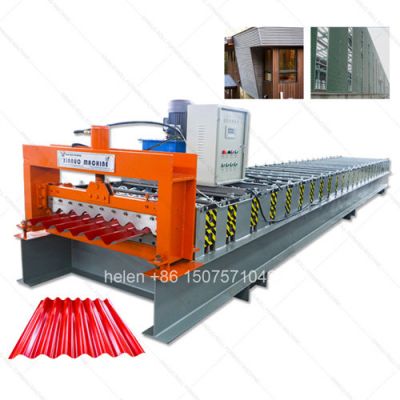
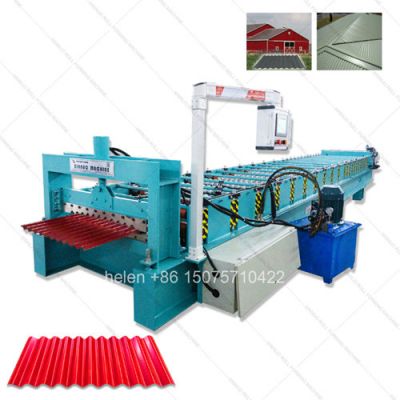
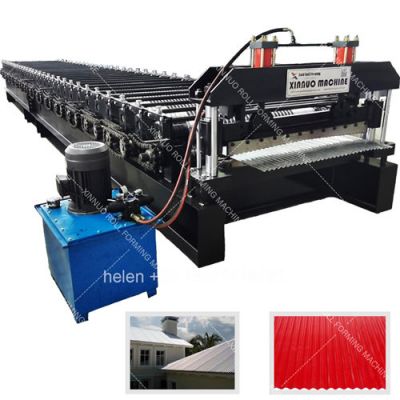
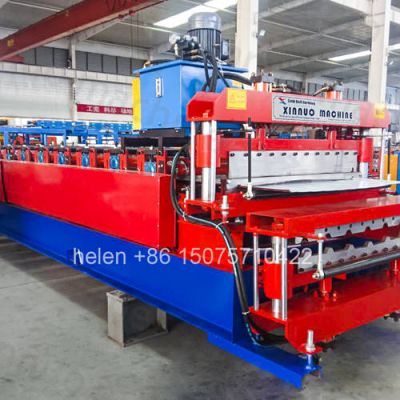
This double layer machine carries an IBR roller set and a bottom sheet roller set in a single frame. Switching the feed path lets one line produce the outer IBR sheet and the lower liner sheet of a double-skin roof, so a producer can supply a complete roof build-up from one machine instead of two.
| Layer | Profile | Role in the build-up |
|---|---|---|
| Upper layer | IBR profile, Inverted Box Rib | Outer weathering sheet, five ribs across a 686 mm cover, rib height about 37 mm |
| Lower layer | Bottom sheet profile | Lower liner or base sheet of the roof build-up, formed to the customer drawing |
Both layers are cut to length by the same shear and counted by the same control system, so an order for outer and inner sheets can be produced in two runs rather than on two machines.
| Build-up | Outer layer | Lower layer | Where it is used |
|---|---|---|---|
| Double-skin roof | IBR sheet | Liner sheet, often a shallow wave or corrugated profile | Industrial and commercial roofs needing an inner ceiling surface |
| Insulated roof | IBR sheet | Flat or shallow bottom sheet forming the underside of the panel | Insulated roof and wall panels |
| Roofline plus liner | IBR sheet | Bottom profile matching the purlin spacing | Projects where the inner sheet is specified separately from the outer |
Pairing these two on one frame works because the outer sheet carries the weather and the lower sheet carries the ceiling or insulation, so they are rarely required in the same quantity at the same moment. The combination suits a producer serving both the roofing and the internal lining side of the same market.
| Combination | Rows | Feed width | Frame and drive | Record |
|---|---|---|---|---|
| 5-peak 686 IBR layer with an 11-wave 762 arc layer | 21 and 13 | 925 mm shared | 350H frame, 75-80 mm mid plate, 5.5-7.5 kW, six-point double chain | DB163 and DB176 |
| 5-peak 686 IBR layer with a 14-wave 850 arc layer | 21 and 20 | 1000 mm | 400H frame, 75 mm mid plate, 7.5 kW, six-point double chain | DB098 |
| 5-peak 820 wide-span IBR layer with a 12-wave 836 arc layer | 15 and 13 | 914-1000 mm | Per drawing | DB162 |
Several of these machines are recorded against South African customers, where the 686 mm five-rib sheet is the profile the market already specifies.
| Rule | What it means here |
|---|---|
| Row count difference | The IBR layer needs around 21 rows at a 686 mm cover. The bottom sheet layer is shallower and needs fewer, so the gap is designed to stay within about six rows. |
| Feed width | The two proven combinations above share a single feed width, which is why they run from one decoiler and one entry guide. |
| Frame class | The frame is set by the heavier layer, which is normally the IBR layer, one class above the equivalent single layer machine. |
| Chain | One transmission drives both layers, so the chain is sized for the higher torque layer. |
| Machine height | Two roller stacks make the body taller than a single profile machine. Confirm headroom over the line before ordering. |
| Item | Specification |
|---|---|
| Layers | Two roller sets stacked in one frame |
| IBR layer | 686 mm cover, five trapezoidal ribs, rib height about 37 mm |
| Bottom sheet layer | Formed to the customer drawing |
| Forming rows | Set per layer, typically around 21 for the IBR layer |
| Frame | 350H to 400H H-beam, set by the heavier layer |
| Mid plate | 75-80 mm |
| Transmission | Six-point double chain |
| Motor | 5.5-7.5 kW, matched to the coil thickness range |
| Cutting | Cut-to-length shear shared by both layers, with quantity count |
| Control | PLC with touch screen, one stored setting per profile |
| Feed strip width | Shared, commonly 925-1000 mm for the combinations above |
| Question | Answer |
|---|---|
| Can both sheets be produced at the same time? | No. One layer runs at a time. If you need outer and inner sheets in continuous parallel production, two single machines are the correct answer. |
| Do I have to use an arc profile as the bottom sheet? | No. The bottom layer is formed to your drawing. The arc layer in the table above is simply the combination that appears most often in our records alongside the 686 mm IBR layer. |
| Will the IBR layer match the local 686 mm standard? | Yes. The roller set is cut to the declared cover width, and the sample panel is measured and recorded before shipment. |
| Is a wide-span IBR version available? | Yes. A 5-peak 820 mm wide-span IBR layer has been built alongside a 12-wave 836 mm arc layer. It is a different roller set and is quoted separately. |
| How much floor space does it save? | Roughly 40-60 percent compared with two single machines, and the cost is typically about 65-75 percent of the two-machine total. |
Hebei Xinnuo is a professional cold roll forming machinery manufacturer with 20+ years of experience. We specialize in C/Z purlin machines, roof panel roll formers, floor deck machines, and custom profile solutions — exported to 50+ countries worldwide.