helen@hbxinnuorollforming.com
- Machine tier should follow production scale, not profile difficulty
- Annual tonnage and sheet length demand decide the configuration
- Forming speed is only useful once changeover and downtime are deducted
- Labour per line depends on tier and on the handling arrangement
- High-speed machines are wasted on intermittent, mixed-length work
- A second machine beats a larger one where volumes really justify it
- Specifying too small shows up as permanent overtime, not as a shortage
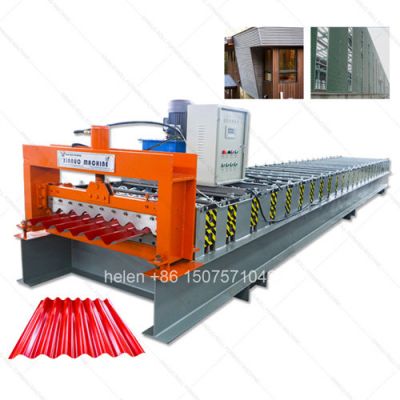
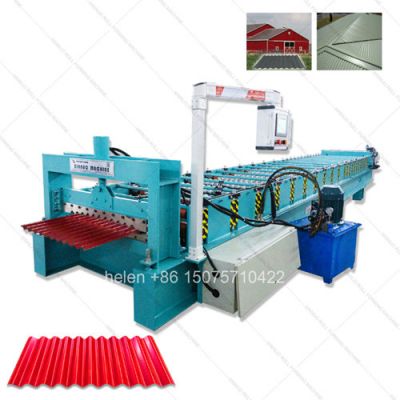
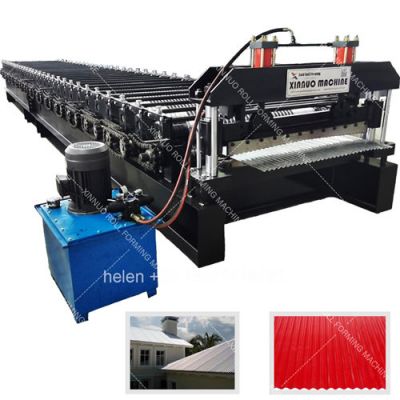
Producers buying an IBR profile deck roll former face a decision that looks technical and is actually commercial: which configuration tier to buy. The five tiers available for this class of profile differ in forming rows, frame weight, shaft diameter, motor rating, and drive arrangement, and each of those differences exists to serve a different production scale. Choosing below the scale of the business produces a machine that can never quite meet demand. Choosing above it ties capital up in capability that is never used, and can even produce worse results on short, mixed-length work than a simpler machine would.
This page sets out how production scale determines the correct tier: the three questions that actually decide the answer, the scale bands and the configuration each one requires, a method for working out your own output requirement rather than accepting a supplier's assertion, what genuinely changes between tiers in day-to-day operation, when a second machine is a better answer than a larger one, and what it costs commercially to specify either too small or too large.
| Question | What the Answer Reveals | How It Changes the Configuration |
|---|---|---|
| How much material will pass through the machine in a year? | The real scale of the requirement, expressed in tonnes or in covered area rather than in order count | Sets the row count, motor rating and drive arrangement. This is the primary determinant of which tier is correct. |
| What is the thickness range to be served? | Whether the machine must cover light cladding only, or light cladding through heavier roofing gauges | A wide gauge range moves the configuration up a tier even when annual volume is modest, because the machine must form the heaviest gauge reliably. |
| What lengths and what order pattern? | Whether the work is dominated by long sheets in repeated lengths or by a mixture of short lengths and frequent changes | Affects the run-out provision, the handling arrangement, and whether a higher forming speed can actually be used. Speed is of limited value where changeover dominates. |
| How many hours per week does the line run? | The available production time against which capacity must be measured | A single-shift operation needing the same output as a double-shift operation requires a materially higher-capacity machine, or an acceptance of overtime. |
| Who handles the finished sheets? | Whether the downstream constraint is the machine or the labour available to clear and pack output | Affects whether the constraint sits at forming or at discharge — and whether a faster machine would actually deliver more delivered metres. |
| Tier | Rows | Frame | Shaft | Power | Chain | Production Scale It Serves |
|---|---|---|---|---|---|---|
| Economy | 9 – 12 | 250 – 300 channel | Φ65 – 70 mm | 3 – 4 kW | 6 fen single | Intermittent production, a single narrow gauge band, and light cladding or lining work where the machine is not the business's principal asset |
| Standard | 12 – 16 | 300 – 350H | Φ70 – 80 mm | 4 – 5.5 kW | 6 fen double | Regular single-shift production of mainstream cladding and roofing, the most common starting configuration |
| Heavy | 16 – 22 | 350H | Φ75 – 85 mm | 5.5 – 7.5 kW | 6 fen double or 1 inch | Continuous production across a wide gauge range including heavier roofing gauges, with the machine as a primary production asset |
| High speed | 18 – 22 | 350 – 400H | Φ80 – 90 mm | 7.5 kW+ | 1 inch double | Volume roofing production running extended shifts, where output per hour is a governing commercial measure |
| Archway | 22 – 24 | 400 – 500H archway | Φ85 – 100 mm | Hydraulic motor | Gearbox or 1 inch double | High-volume premium production where surface finish, smoothness, minimal vibration and long-term stability matter as much as rate |
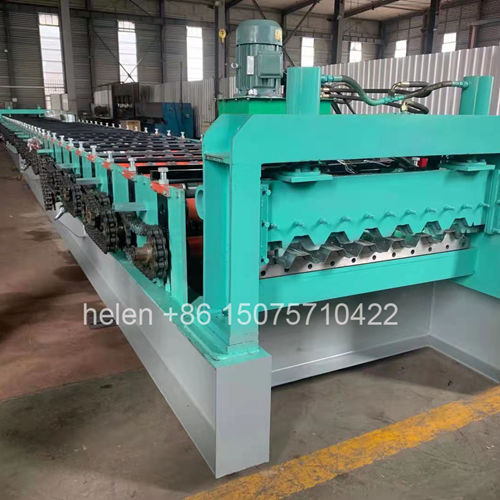
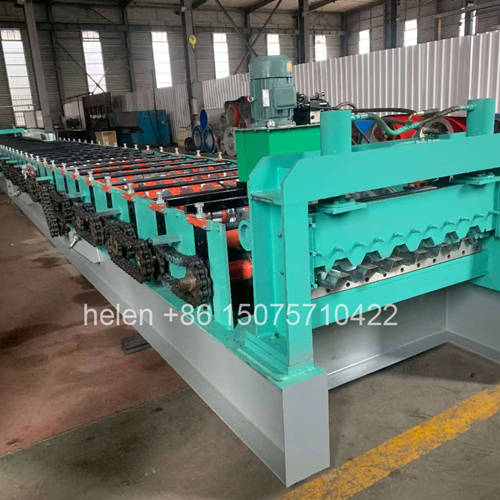
For a five-rib cladding profile the mainstream starting configuration is around 14 to 16 forming rows on a 350H frame with a Φ75 to 80 mm shaft, a 4 to 5.5 kW motor and a double 6 fen chain, with feed width typically between about 1000 and 1220 mm depending on the profile. Movement up or down from that baseline should be driven by the scale bands above rather than by the profile name, since the same profile can be produced on several tiers with different commercial consequences.
The correct tier cannot be established from a supplier's assertion about speed. Forming speed in metres per minute is the least useful single figure in machine selection, because it describes the machine in its best possible condition and ignores everything that stops it. The following sequence produces a figure that reflects reality.
| Step | Calculation | Why This Step Matters |
|---|---|---|
| 1 | Establish the annual requirement in covered area | Expressed in square metres of floor or roof covered, not in tonnes of steel and not in number of orders. This is what the market actually consumes. |
| 2 | Convert to annual running metres using the cover width | Covered area divided by cover width gives running metres of panel. This is the figure the machine produces. |
| 3 | Convert to tonnes using the blank width and thickness | Running metres multiplied by blank width, thickness and steel density gives the material tonnage, which is what coil ordering and cost depend on. |
| 4 | Establish available production hours per year | Shifts, hours per shift, working days, and an allowance for holidays and seasonal patterns. |
| 5 | Deduct changeover, setup and maintenance time | An allowance for coil changes, profile or length changes, and planned maintenance. Taking this seriously is the single largest source of realism in the calculation. |
| 6 | Deduct an availability allowance | Even a well-maintained line is not productive for every remaining minute. Ignoring this produces a requirement no machine can meet. |
| 7 | Divide running metres by effective production hours | Produces the required output in running metres per effective hour, which can then be compared against the forming speed a candidate tier can realistically sustain. |
| 8 | Apply a growth allowance | Machines are bought for several years. A requirement calculated on today's volume with no headroom leads directly to early replacement. |
| Illustrative Assumption | Value Used | Comment |
|---|---|---|
| Shift pattern | Single shift, five days | Stated for illustration only. The calculation must use the buyer's own pattern. |
| Gross hours per week | Around 40 | Before any deductions. |
| Changeover and setup allowance | Deducted before any output figure is used | Where order patterns are mixed, this deduction is large and is the main reason a high-speed tier may not be justified. |
| Availability allowance | Deducted again after setup | Reflects realistic running time rather than a theoretical maximum. |
| Long sheet handling | Considered as a separate constraint | Where sheets are long and handled manually, the discharge rate can cap output below the forming rate regardless of tier. |
| Tier | Output Character | Operating Demand | Finish Quality | Maintenance Character |
|---|---|---|---|---|
| Economy | Modest rate, suitable for intermittent runs | Simple to operate and forgiving of irregular working | Adequate for non-visible and utility work | Low component count, straightforward service |
| Standard | Sufficient for regular single-shift production | Requires consistent setup discipline | Good for mainstream visible cladding | Conventional maintenance, parts readily obtained |
| Heavy | Sustained output across a broad gauge range | Rewards consistent shift operation and planned maintenance | Good across both light and heavy ends of the range | Heavier components, longer intervals, higher individual part cost |
| High speed | High rate where run lengths are long | Punishes unplanned stoppages because the cost of each lost minute is higher | Good to very good with maintained tooling | Requires a planned maintenance regime rather than reactive repair |
| Archway | High rate with superior consistency | Best operated as a dedicated production asset with defined scheduling | Best surface finish and consistency in the range | Higher specification components, specialist maintenance expectations |
| Condition | Recommendation |
|---|---|
| Two distinct products each running in volume | Two machines. Both products can be produced simultaneously, and neither is lost to changeover. A single larger machine cannot produce two profiles at once at any tier. |
| One product in volume, one occasional | One appropriate machine for the volume product, with interchangeable tooling or a second roller set for the occasional one. |
| Demand is seasonal and peaks sharply | Assess whether a smaller machine plus planned seasonal overtime beats a larger machine idle for part of the year. Capital cost is incurred all year; capacity is only needed for part of it. |
| The constraint is downstream handling, not forming | A faster machine will not help. Address the discharge and packing arrangement first, since machine output is capped by whatever clears the panels away. |
| Growth is expected but not yet present | Buy at the scale needed now with headroom designed in. Buying several tiers above requirement ties capital up for years in capability that earns nothing until the volume arrives. |
| Delivery reliability is the commercial differentiator | Two machines provide redundancy. A producer who cannot deliver because the single line is down loses the customer, not merely the order. |
| Specifying Too Small | Specifying Too Large |
|---|---|
| The shortfall becomes a permanent operating condition rather than an occasional problem, absorbed through overtime, refused orders, and slipping delivery dates. | Capital is committed to capability that does not generate revenue until volume grows into it. |
| Heavier gauges are attempted on a machine not configured for them, producing jams, distortion and tooling damage rather than additional output. | Maintenance cost and consumable consumption are incurred on a higher specification than the work requires. |
| Replacement arrives sooner than planned, and the initial purchase is effectively written off early. | Where changeover dominates the schedule, the added speed is never realised because the line is rarely running continuously for long. |
| Quality problems at the light end of the range appear because the frame and drive lack the rigidity to hold the section across the full gauge band. | Operating a high-tier machine on short, mixed work can produce outcomes no better than a simpler machine, with higher overhead. |
| Information | Why It Fixes the Answer |
|---|---|
| Profile drawing and cover width variant | 686 mm standard, 890 mm wide variant, or a custom figure. Determines tooling, blank width and the forming load per pass. |
| Full thickness range | Both the lightest and heaviest gauge to be run, since the light end governs forming quality and the heavy end governs machine strength. |
| Annual volume in covered area | The primary scale input. Should be stated as area, and converted to running metres and tonnage during the calculation. |
| Order pattern and typical run length | Determines how much of the available time is lost to changeover, and therefore how much of a high-speed machine's rate is actually usable. |
| Shift pattern and working calendar | Available hours are the denominator of the capacity calculation. |
| Maximum and typical sheet length | Drives run-out provision and determines whether handling caps output below the forming rate. |
| Coil specification and supply | Blank width and coil size follow from the profile; local coil availability affects achievable scheduling. |
| Coating type | Determines the wheel, guide and handling provision required to protect the surface at the chosen tier. |
| Labour available per shift | Establishes whether the constraint is at the machine or downstream, which decides whether more machine capacity is worth buying. |
| Growth expectation over the investment period | The allowance applied to the calculated requirement so the machine is still adequate at the end of its expected service life, not only at the start of it. |
| Parameter | Standard Range |
|---|---|
| Target profile | IBR class square fluted trapezoidal roofing and cladding section, produced to the buyer's drawing or matched against a standard section |
| Cover width | 686 mm standard with five ribs; 890 mm wide variant; custom widths including 762, 914 and 1000 mm by order |
| Rib height | Approximately 37 – 38 mm on the standard variant |
| Feed width | Established from the drawing; generally 1000 – 1220 mm for mainstream cladding profiles |
| Machine tiers | Economy 9 – 12 rows, standard 12 – 16, heavy 16 – 22, high speed 18 – 22, archway 22 – 24 |
| Frame | 250 – 300 channel economy; 300 – 350H standard; 350H heavy; 350 – 400H high speed; 400 – 500H archway |
| Shaft | Φ65 – 70 mm economy; Φ70 – 80 mm standard; Φ75 – 85 mm heavy; Φ80 – 90 mm high speed; Φ85 – 100 mm archway |
| Motor configuration | 3 – 4 kW economy; 4 – 5.5 kW standard; 5.5 – 7.5 kW heavy; 7.5 kW and above high speed; hydraulic motor archway |
| Transmission | 6 fen single economy; 6 fen double standard; 6 fen double or 1 inch heavy; 1 inch double high speed; gearbox or 1 inch double archway |
| Forming wheels | 45# forged steel, quenched to HRC 45 – 50, finish turned, keyed, polished and chrome plated |
| Forming speed | 10 – 30 m/min depending on tier, profile and gauge; the usable figure is the rate sustained after changeover and downtime are deducted |
| Shear | Hydraulic post-cut shear with blade arrangement and hardness specified to the material |
| Cut length tolerance | ±1.5 mm across the full range of sheet lengths produced |
| Run-out provision | Sized to the longest sheet produced; a downstream constraint on long-sheet work regardless of tier |
| Control system | PLC with colour touchscreen HMI, programmable cut length, sheet count control and stored recipe banks |
| Options | Edge forming wheel, inline arching section, reverse press arrangement, interchangeable tooling for a second profile width |
| Electrical supply | 380 V / 50 Hz / 3-phase standard; alternative voltages and frequencies by destination |
| Certification | CE marking and ISO 9001:2015 compliant manufacturing, with destination-market documentation arranged as required |
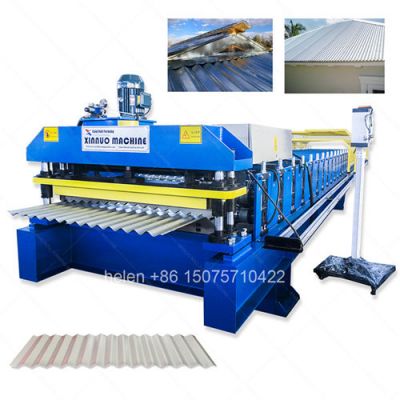
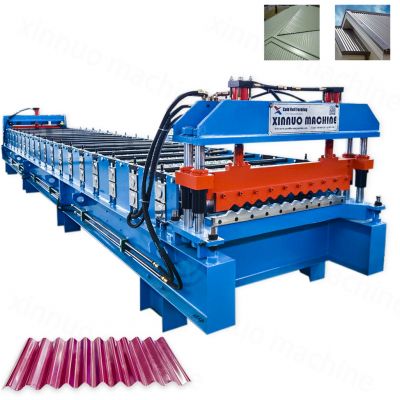
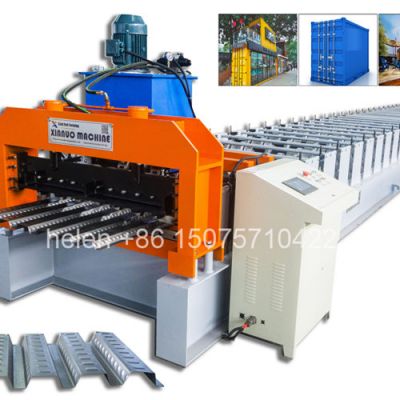
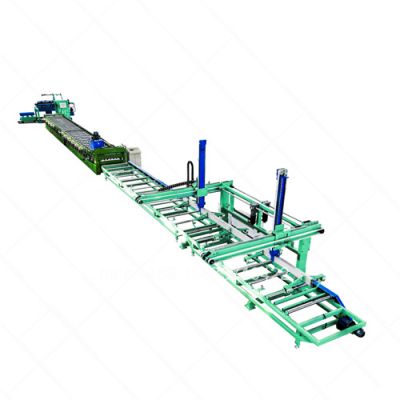
Coil loading on the decoiler, strip entry through the guide, progressive forming across the roll train where the angular rib is developed through successive passes, optional edge forming or inline arching where fitted, length measurement, hydraulic cutting, and discharge to the run-out position follow the established sequence, with the profile geometry set by the roller tooling and the tier set by the production scale the line has to serve.
Hebei Xinnuo is a professional cold roll forming machinery manufacturer with 20+ years of experience. We specialize in C/Z purlin machines, roof panel roll formers, floor deck machines, and custom profile solutions — exported to 50+ countries worldwide.