helen@hbxinnuorollforming.com
- Published load tables assume a specific formed section, not a nominal one
- Span between purlins is governed by strength and deflection together
- Deeper angular ribs carry more span at the same gauge than wave profiles
- The lightest gauge specified sets the machine's real forming limit
- Roofing demand is for full slope length sheets without end laps
- Long sheets determine run-out support, handling, and transport provision
- Section accuracy therefore has a structural consequence, not a cosmetic one
An IBR profile is specified on the basis of a load table. The engineer selects a gauge and a purlin spacing by reading the span capability of a particular section at that thickness, checking both strength and deflection. What that load table implicitly assumes is that the section as installed matches the section as calculated — the same rib height, the same rib pitch, the same flank geometry, the same cover width. A machine that forms an approximation of the section invalidates the assumption the design was based on.
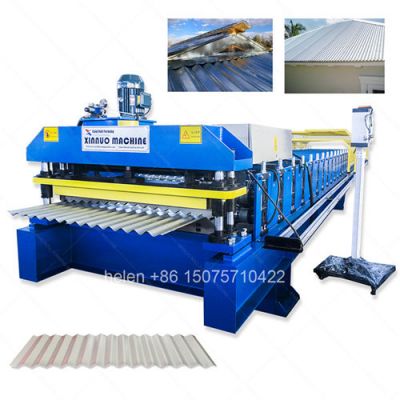
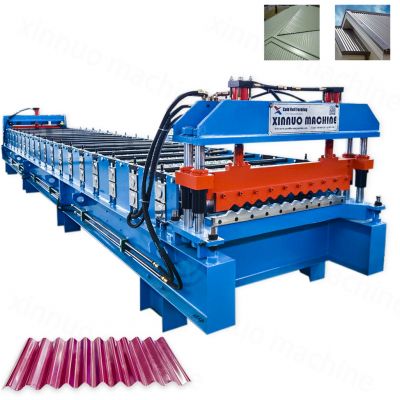
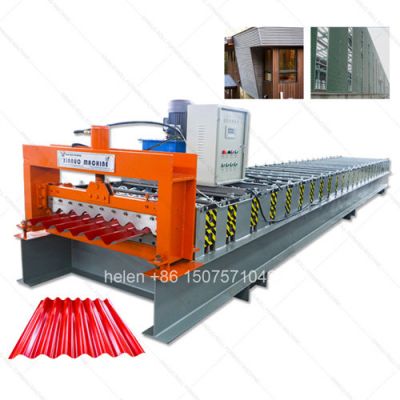
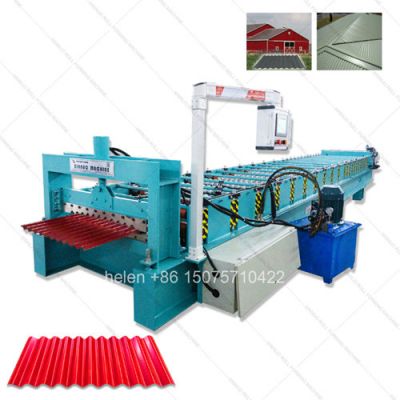
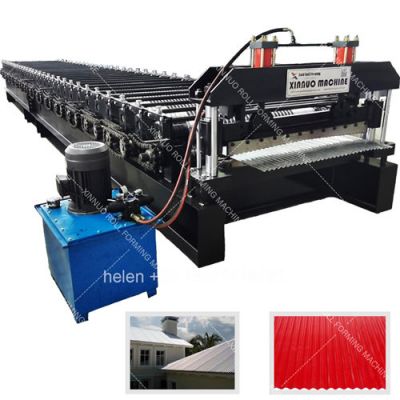
This page covers the building-side requirements that determine what an IBR profile steel deck roll forming machine has to deliver: how gauge, purlin spacing and span interact, why the lightest gauge actually sold determines the machine's real forming limit rather than the average, how the thickness range maps onto machine configuration, what changes as the range widens, and why long sheet production — full roof slope length in a single piece — imposes requirements on the run-out, handling and cutting arrangements that a machine specified only on forming capability will miss.
| Thickness Band | Typical Purlin Spacing | Span Character | What the Machine Must Deliver |
|---|---|---|---|
| Lightest cladding gauge | Close purlin spacing, typically around a metre | Restricted span capability, with deflection usually governing rather than strength | Accurate forming at the lightest gauge, where the material is least tolerant of roller misalignment and where thin stock distorts easily |
| Standard roofing gauge | Wider spacing than light cladding, and typically around 1.5 times the spacing achievable with a sinusoidal corrugated profile at the same thickness | Deeper angular ribs contribute substantially more stiffness per unit thickness than a wave form | Consistent rib height and flank geometry, because the span benefit comes entirely from the shape of the rib |
| Heavier roofing gauge | Wider spacing again, with the exact figure taken from the section's load table | Strength and deflection both improve, allowing longer spans and fewer purlins | A configuration with sufficient frame rigidity, shaft diameter and drive force to form the heavier material without distortion |
| Structural liner applications | Determined by the structural design rather than by the cladding span table | The sheet contributes to the building's structural performance | Section accuracy to a structural standard, since the section properties assumed in the design must actually be produced |
The governing criteria for a cladding or roofing span are strength and deflection, and deflection commonly controls at the lighter gauges. Both are functions of the section properties, which are functions of the formed geometry. That is the link between a load table on a data sheet and the roller profile inside the machine.
| Effect | Why It Matters More Than the Heaviest Gauge |
|---|---|
| Thin material distorts readily | Light gauge steel has minimal resistance to local deformation. Roller misalignment, excessive pressure at one station, or an over-aggressive shape change at a single pass shows up as buckling, waviness, or a rolled edge on thin stock far more readily than on heavier material. |
| The same machine must span the range | Roll gaps, guiding, and forming sequence are set for the machine as built. It must handle the lightest gauge the producer sells as well as the heaviest, and the light end is where surface and shape defects appear. |
| Roller condition shows up first at the light end | Wheel wear or surface damage that is invisible at 0.7 mm can mark or distort 0.4 mm stock. Surface quality problems on light gauge are often the earliest signal of tooling condition. |
| Light gauge dominates volume in many markets | Where most sold tonnage is at the lighter end, the machine spends most of its life operating in the condition that is hardest to form, not the one that is easiest. |
| Deflection governs the design at light gauges | Because deflection controls the purlin spacing at light gauges, the section properties matter most exactly where the machine is most likely to produce a slightly distorted section. |
| Tier | Rows | Frame | Shaft | Power | Chain | Appropriate Range |
|---|---|---|---|---|---|---|
| Economy | 9 – 12 | 250 – 300 channel | Φ65 – 70 mm | 3 – 4 kW | 6 fen single | Light cladding and lining in a single narrow gauge band |
| Standard | 12 – 16 | 300 – 350H | Φ70 – 80 mm | 4 – 5.5 kW | 6 fen double | The mainstream roofing and cladding range across commonly sold gauges |
| Heavy | 16 – 22 | 350H | Φ75 – 85 mm | 5.5 – 7.5 kW | 6 fen double or 1 inch | Wide thickness range including the heavier roofing gauges, and structural liner work |
| High speed | 18 – 22 | 350 – 400H | Φ80 – 90 mm | 7.5 kW and above | 1 inch double | Volume production where output rate governs, across a full gauge range |
| Archway | 22 – 24 | 400 – 500H archway | Φ85 – 100 mm | Hydraulic motor | Gearbox or 1 inch double | Premium installations where finish quality and stability across the whole range are the priority |
For a five-rib cladding profile, a configuration in the region of 14 to 16 forming rows on a 350H frame with a Φ75 to 80 mm shaft, a 4 to 5.5 kW motor and a double 6 fen chain is the usual starting point, with feed width generally between about 1000 and 1220 mm depending on the profile. Where the producer needs to serve both light cladding and heavier roofing gauges from one machine, the configuration moves up the tiers, and it is the breadth of the gauge range rather than the profile itself that drives that movement.
| Element | Effect of Serving a Wider Gauge Range From One Machine |
|---|---|
| Frame rigidity | Heavier frame construction is required so that the roll gap holds under the highest forming load in the range, which is what protects the section at the light end from being affected by deflection at the heavy end. |
| Shaft diameter | Larger shafts reduce deflection. This benefits the whole range, not only the thickest material. |
| Drive force | Larger motor and heavier chain provide sufficient feed force at the heaviest gauge without over-driving the lightest. |
| Forming sequence | More forming rows allow a smaller shape change per pass, which suits both ends of the range: thin material is not over-worked, and thick material is not forced. |
| Guiding and entry setup | Wider tolerance on the entry guide is needed because coil thickness and width vary with the gauge being run. |
| Speed range | The machine must be able to run slower at the heavy end and faster at the light end, which makes variable speed control a practical requirement rather than a convenience. |
| Cutting setup | Blade clearance suits a thickness; a wide gauge range means clearance must be checked at material change rather than set once. |
Roofing demand is for sheets cut to the full length of the roof slope so that there are no end laps. This is a different production requirement from cladding work, where shorter lengths are common, and it places demands on parts of the line that a machine specified purely on forming capability may not address.
| Requirement | Provision Needed |
|---|---|
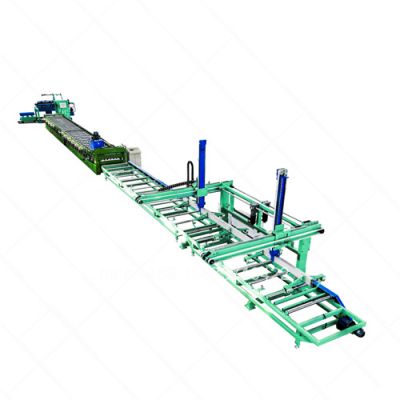
| Support for the full sheet length | The run-out arrangement must support the longest sheet produced without the sheet flexing, striking an obstruction, or being allowed to hang free and take a permanent set. |
| Length measurement accuracy | On a long sheet, a small proportional error becomes a consequential dimensional discrepancy. Cut length control must hold accuracy across the full length, not merely on short panels. |
| Squareness at the cut end | Long sheets amplify any out-of-square condition, making the sheet difficult to align at the eaves and at the lap. Squareness matters more as length increases. |
| Cutting arrangement | The shear must cut the full formed width cleanly, and the blade condition must be maintained, since a dull blade on a long sheet burrs the whole panel end. |
| Handling provision | A long sheet cannot be handled by one person, and it cannot be dragged. Defined handling arrangements protect both the coating and the operators. |
| Stacking and pack control | Long sheets must be stacked with support along their length, interleaved where the material is coated, and handled as a pack rather than sheet by sheet. |
| Transport planning | Sheet length drives the transport method and vehicle selection. Producing lengths the transport cannot carry is a production success and a delivery failure. |
| Site access | Long sheets must reach the roof without being bent around corners, which is a delivery constraint that determines the maximum useful sheet length for a given project. |
| Source of Damage | Where It Occurs and How It Is Prevented |
|---|---|
| Forming marks | Caused by wheel surface condition or excessive contact pressure. Prevented by correct roller finish and by maintaining the wheels rather than by accepting the marking. |
| Guide marking | Entry and side guides contacting the strip. Guide material and finish matter, and build-up on the guides should be cleaned rather than allowed to accumulate. |
| Cut-end damage | Blade condition and clearance. A burred end is a handling hazard as well as a corrosion initiation point on coated stock. |
| Handling damage | Sheets dragged across one another or lifted without adequate support. This is the most common and the most avoidable source of visible damage. |
| Stacking pressure marks | Stacks built without interleaving on coated material. The marking appears after the pack has been completed and is discovered at delivery. |
| Transport abrasion | Inadequate packing and restraint. Damage in transit is attributed to the supplier even when the sheets were produced to specification. |
| Information | Why It Determines the Answer |
|---|---|
| Profile drawing and section properties | The machine must reproduce the section the load table was calculated for. Rib height, rib pitch, flank geometry and cover width all read from the drawing. |
| Cover width variant | 686 mm standard, 890 mm wide variant, or a custom figure. Sets roller length, shaft length and blank width. |
| Full thickness range, lightest and heaviest | The light end governs forming quality and the heavy end governs machine strength. Both must be stated, not the typical gauge. |
| Purlin spacings to be served | Indicates what the market expects the profile to span, which in turn indicates the gauges that must be offered and therefore formed accurately. |
| Maximum sheet length required | Drives the run-out support, length measurement accuracy, and the handling and stacking arrangements. |
| Feed width and coil specification | Establishes decoiler and guide requirements, and the coil size to be purchased. |
| Coating type and finish | Determines wheel, guide and handling provision needed to protect the surface. |
| Required output rate | Decides whether the standard, high speed or archway tier is justified. |
| Roofing, cladding, or both | Roofing demand implies long sheets; cladding demand implies a wider mix of shorter lengths. The two together define the length range the line must handle. |
| Whether any section is structural | A sheet contributing structurally requires section accuracy to a structural standard, and if it is composite floor deck rather than cladding, a different machine family applies entirely. |
| Parameter | Standard Range |
|---|---|
| Target profile | IBR class square fluted trapezoidal roofing and cladding section, produced to the buyer's drawing or matched against a standard section |
| Cover width | 686 mm standard with five ribs; 890 mm wide variant; custom widths including 762, 914 and 1000 mm by order |
| Rib height | Approximately 37 – 38 mm on the standard variant |
| Feed width | Established from the drawing; generally 1000 – 1220 mm for mainstream cladding profiles, always greater than the cover width |
| Material thickness | Light cladding gauges through heavier roofing gauges; the full range stated at order to set the tier correctly |
| Forming rows | 9 – 24 rows depending on tier and on the breadth of the thickness range to be covered |
| Frame | 300 – 350H on the standard tier; 350H on heavy; 400 – 500H archway at the top of the range |
| Shaft | Φ70 – 80 mm standard, Φ75 – 85 mm heavy, up to Φ85 – 100 mm archway |
| Forming wheels | 45# forged steel, quenched to HRC 45 – 50, finish turned, keyed, polished and chrome plated |
| Motor configuration | 4 – 5.5 kW standard, 5.5 – 7.5 kW heavy, 7.5 kW and above high speed, hydraulic motor on the archway tier |
| Transmission | 6 fen double standard, 6 fen double or 1 inch heavy, 1 inch double on high-speed and archway configurations |
| Speed control | Variable frequency drive, since the correct speed differs between the light and heavy ends of a wide gauge range |
| Shear | Hydraulic post-cut shear with blade clearance checked at material change and blade condition maintained |
| Cut length tolerance | ±1.5 mm, held across the full range of sheet lengths produced |
| Forming speed | 10 – 30 m/min depending on tier, profile and gauge |
| Run-out provision | Sized to support the longest sheet produced without flexing or obstruction |
| Control system | PLC with colour touchscreen HMI, programmable cut length across the full length range, sheet count control and stored recipe banks |
| Options | Edge forming wheel for lap sealing, inline arching section, reverse press arrangement, interchangeable tooling for a second profile width |
| Electrical supply | 380 V / 50 Hz / 3-phase standard; alternative voltages and frequencies by destination |
| Certification | CE marking and ISO 9001:2015 compliant manufacturing, with destination-market documentation arranged as required |
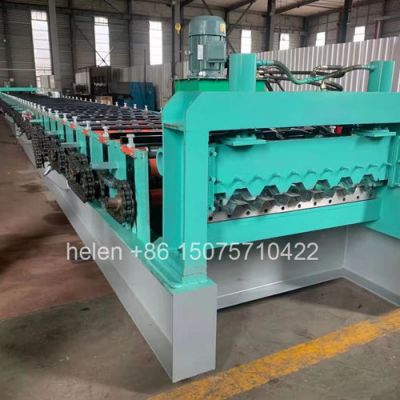
Coil loading on the decoiler, strip entry through the guide, progressive forming across the roll train where the angular rib is developed through successive passes, optional edge forming or inline arching where fitted, length measurement across the full sheet length, hydraulic cutting, and discharge to the run-out position follow the established sequence, with the section geometry set by roller tooling produced to the buyer's profile drawing and the thickness range confirmed at order.
Hebei Xinnuo is a professional cold roll forming machinery manufacturer with 20+ years of experience. We specialize in C/Z purlin machines, roof panel roll formers, floor deck machines, and custom profile solutions — exported to 50+ countries worldwide.