helen@hbxinnuorollforming.com
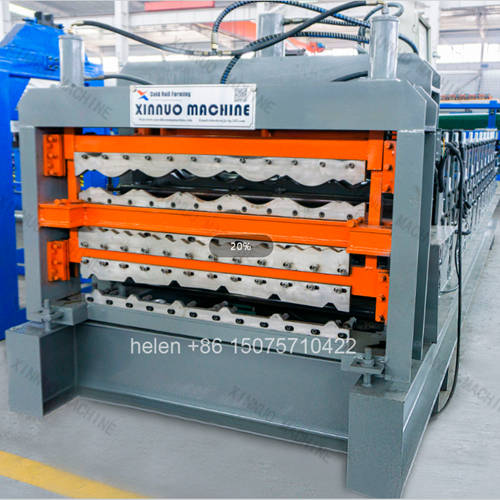
- Three decks support a sellable catalogue far larger than three items
- Product range expands through gauge, length, colour, and accessory variation
- Each product line serves a different customer segment and price position
- Catalogue design should follow proven local demand, not tooling convenience
- Quoting discipline prevents margin erosion across overlapping product lines
- Product mix shifts with season, so all three lines need active selling
- Demonstration and sample material convert enquiries into confirmed orders
A machine with three forming decks offers three production capabilities, but it does not automatically offer three saleable products. The difference between owning the capability and having a catalogue that sells comes down to how the product range is structured: which profiles are offered in which gauges, at which lengths, in which colours, with which accessories, and at what price position against competing suppliers. Manufacturers who define this deliberately sell more from the same machine than manufacturers who produce whatever an enquiry happens to request.
This page addresses catalogue structure and go-to-market planning for a machine producing glazed tile, IBR, and glazed pre-painted sheet products. It covers how the sellable range is built from the three decks, how price positions are assigned across segments, how to quote without eroding margin across overlapping lines, how the product mix should shift with season, and what sales material and samples actually convert enquiries into orders.
| Catalogue Dimension | How It Multiplies the Range | Planning Guidance |
|---|---|---|
| Profile | Three base product families from three decks | The irreducible core of the catalogue. Everything else is variation on these three. |
| Gauge | Two or three practical gauges per profile | Offer a light gauge for economy work and a heavier gauge for structural or long-span applications. The heavier gauge justifies a higher price per square metre and improves margin. |
| Sheet length | Effectively unlimited within transport constraints | Length costs nothing to change on the machine, so cut-to-length service is a genuine differentiator. Emphasise it in the catalogue rather than treating it as a special order. |
| Colour | Multiplied by the number of colours stocked | Stock three to six colours that dominate local demand rather than offering an unlimited palette. Each additional colour adds inventory without necessarily adding sales. |
| Finish | Glazed, matt, and gloss variations where the coating allows | Finish is a differentiator primarily on the glazed tile line, where appearance is the reason for purchase. |
| Accessories | Ridge caps, barge boards, flashing, and trims in matching coil | Produced from coil already on hand for the main order. Converts a sheet supply into a complete roof package and raises the average order value. |
| Export specification variants | Multiplied by the number of destination markets served | Where the tooling serves more than one national width standard, each standard becomes a separate catalogue line with its own pricing. |
| Price Position | Product Line | Customer Expectation | Margin Characteristic |
|---|---|---|---|
| Economy | Light gauge functional sheeting | Lowest price in the market; purchase driven almost entirely by cost | Thin margin per square metre, sustained only by volume and by minimising changeovers |
| Standard | IBR trapezoidal and standard glazed sheet in regular gauges | Reliable quality at competitive price; the bulk of most order books | Balanced margin; the product line that funds the business |
| Premium | Glazed tile in heavier gauge and higher-performance coating | Appearance is the purchase reason; price sensitivity is lower | Highest margin per square metre; the line most worth actively promoting |
| Specification | Project-specific profiles, colours, or lengths | Compliance with an architect's or engineer's specified requirement | Premium pricing justified by conformity and availability rather than by volume |
| Complete package | Sheets plus matching accessories supplied together | Single-source supply and guaranteed colour match across the roof | Highest average order value; accessories carry stronger relative margin than sheets |
| Customer Segment | Product Bought | Buying Behaviour | How to Sell to Them |
|---|---|---|---|
| Residential homeowner | Glazed tile or standard profiled sheet in a preferred colour | Small quantity, appearance-led, influenced by neighbours and contractors | Colour samples and a visible display; the decision is visual rather than technical |
| Roofing contractor | Mixed profiles depending on project type | Repeat buyer, values availability and delivery reliability over lowest price | Reliable stock of common profiles and rapid cut-to-length service; contractors pay for certainty |
| Commercial developer | IBR and wide profiled sheet in quantity | Project-based, specification-driven, quality and conformity matter | Test reports, conformity documentation, and demonstrated consistency across batches |
| Agricultural buyer | Economy functional sheeting in long lengths | Price-driven, buys in volume, low concern for appearance | Long-length capability and competitive pricing on the economy line |
| Building materials merchant | Standard profiles in common lengths and colours | Resells onward; requires consistent supply and dependable specification | Consistency between batches and reliable restocking; merchants sell on their own reputation |
| Export buyer or importer | Container quantities in a specified national standard | Volume-driven, specification-specific, documentation dependent | Conformity documentation, consistent colour batches, and reliable loading and shipping |
| Risk | Discipline Required |
|---|---|
| Underpricing the premium line | Glazed tile carries higher material cost and slower production because of the stamping cycle. Quoting it at the same rate as standard sheet erodes the margin that justifies the deck. |
| Ignoring setup time on small orders | A small order in an unusual colour consumes the same changeover time as a large one. Quoting must account for changeover cost, or small orders should be aggregated into scheduled production batches. |
| Free concession on cut length | Cut-to-length is cheap to provide but has real value to a contractor. Pricing it as standard removes a differentiator that could otherwise be charged for. |
| Accessories priced as an afterthought | Accessories carry stronger relative margin than sheets and complete the package. They should be quoted proactively, not only when the customer asks. |
| Gauge substitution without repricing | A heavier gauge costs more in material and delivers more structural value. Substituting without adjusting price gives away margin silently. |
| Export pricing without landed cost basis | Quoting export orders on the same basis as domestic ones ignores freight, documentation, and packing additions. |
| Price consistency across channels | Contractors, merchants, and export buyers buying the same product at materially different prices invites pressure from the customer who pays more. |
| Condition | Catalogue Response | Production Response |
|---|---|---|
| Demand concentrated on one line | Continue holding the other two lines in the catalogue, since availability is what keeps enquiries arriving | Run the dominant line in longer campaigns and schedule the others into planned batches |
| Seasonal shift in preference | Shift promotional emphasis and stock holding toward the seasonal line rather than withdrawing the others | Sequence production by the current season's profile to minimise changeovers |
| Competitive pressure on one line | Compete on the line where margin remains viable and allow share to be lost where it does not | Reduce campaign length on the pressured line and increase output on the stronger ones |
| New colour or gauge demand emerges | Add the variant where it can be supplied from existing tooling rather than new tooling | Confirm the coil specification before committing to a catalogue addition |
| Premium line underperforms | Review whether the market has premium demand at all, rather than discounting the premium product to standard prices | Discounting a premium line below its cost position destroys the reason for owning the deck |
| Export market opens | Confirm the destination standard and add it as a distinct catalogue entry with its own specification | Verify that the tooling and coil widths available can meet the destination standard before quoting |
| Asset | Purpose |
|---|---|
| Physical colour and profile samples | Appearance-led buyers decide by looking. Physical samples convert far better than photographs for glazed tile products specifically. |
| Full-scale panel display | A roof section showing the product as installed, including fixings and overlaps, answers the questions buyers actually ask. |
| Technical data sheet per profile | Effective width, gauge options, span guidance, and fixing recommendations, so contractors can specify without calling back. |
| Packaging photograph | Demonstrates the handling and transport protection measures, addressing a concern that many buyers have after a previous bad experience. |
| Conformity and test documentation | Required for commercial, tender, and export sales, and increasingly expected even for smaller orders. |
| Cut-to-length and lead time statement | Communicates the service advantage that the machine genuinely delivers, which competitors without the same capability cannot match. |
| Accessory range listing | Encourages the customer to buy a complete package rather than sheets alone, raising average order value. |
| Parameter | Standard Range |
|---|---|
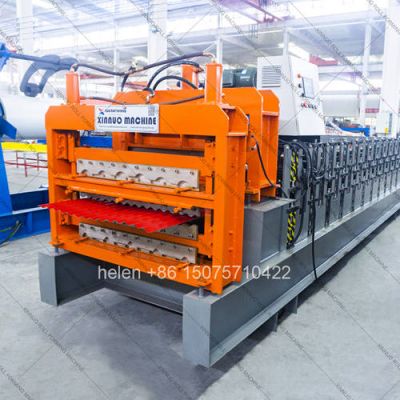
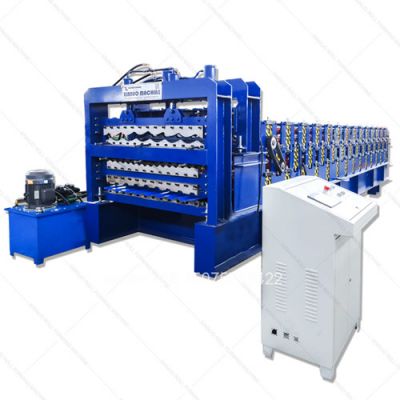
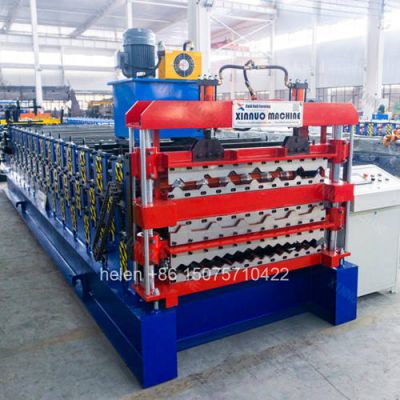
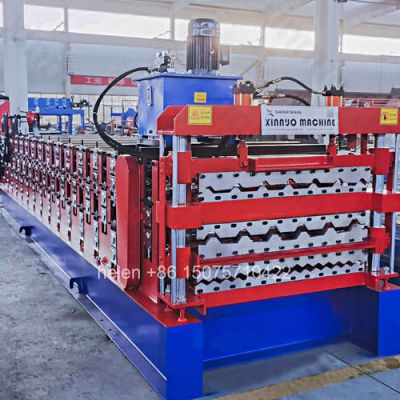
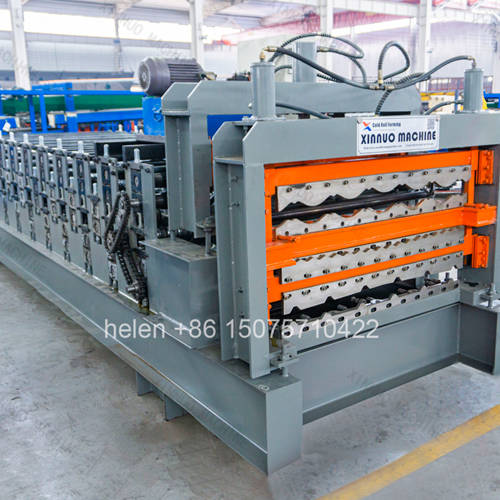
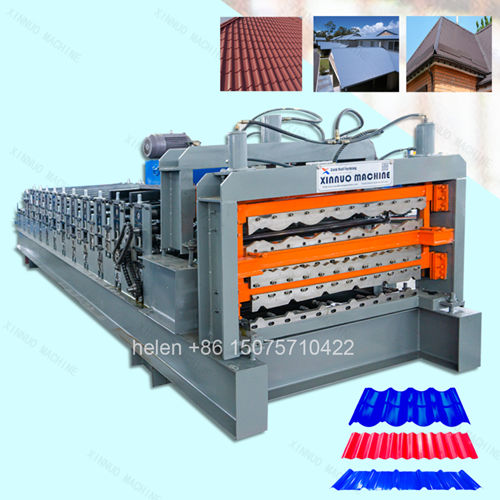
| Machine configuration | Multiple forming decks stacked vertically in one frame with a multi position selector arrangement |
| Deck combinations offered | Glazed tile with pitch stamping, IBR trapezoidal, and pre-painted glazed sheet, or other market-specific pairings |
| Main frame grade | 300H to 450H welded H-section steel selected against the number of decks and combined carriage weight |
| Forming rows per deck | 11 – 18 rows depending on profile family and rib depth |
| Roller material | 45# forged carbon steel, CNC turned, ground, hard chrome plated to HRC 58 – 62 |
| Shaft | Φ75 mm or Φ80 mm solid steel, centerless ground, dual-row self-aligning bearings |
| Transmission | Duplex roller chain with hardened sprockets and multi position selector |
| Main motor | 5.5 kW to 11 kW or above depending on deck count and forming load, with variable frequency drive |
| Hydraulic station | Independent power pack with air-cooled oil radiator |
| Forming speed | 8 – 20 m/min depending on profile and gauge; the pitch-stamping deck sets the effective ceiling |
| Material capability | PPGI, PPGL, galvanized, aluminium-zinc coated, and pre-painted aluminium coil; 0.30 – 0.80 mm |
| Cutting system | Hydraulic post-cut shear, Cr12MoV blades at HRC 60 – 62 |
| Cut length tolerance | ±1.5 mm |
| Control system | PLC with colour touchscreen HMI and independent recipe banks per deck |
| Deck changeover time | Approximately 5 – 15 minutes between any two decks |
| Electrical supply | 380 V / 50 Hz / 3-phase standard; alternative voltages and frequencies by destination |
| Certification | CE marking and ISO 9001:2015 compliant manufacturing |
Coil loading, deck selection at the entry guide, roll forming on the selected deck, glazed tile pitch stamping where that deck is active, length measurement, hydraulic cutting, and discharge to the run-out table follow the established sequence, with deck changeover completed in minutes and no disturbance to the roller sets on the inactive decks.
Hebei Xinnuo is a professional cold roll forming machinery manufacturer with 20+ years of experience. We specialize in C/Z purlin machines, roof panel roll formers, floor deck machines, and custom profile solutions — exported to 50+ countries worldwide.