helen@hbxinnuorollforming.com
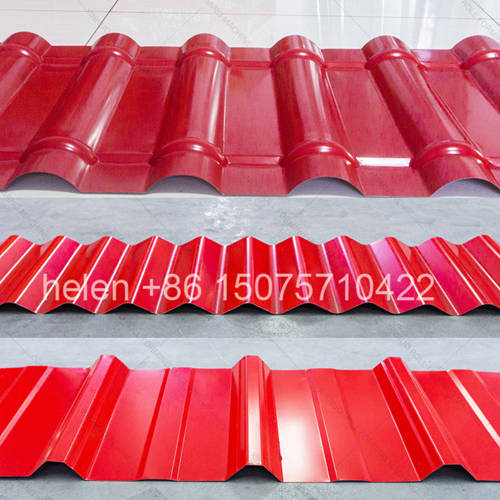
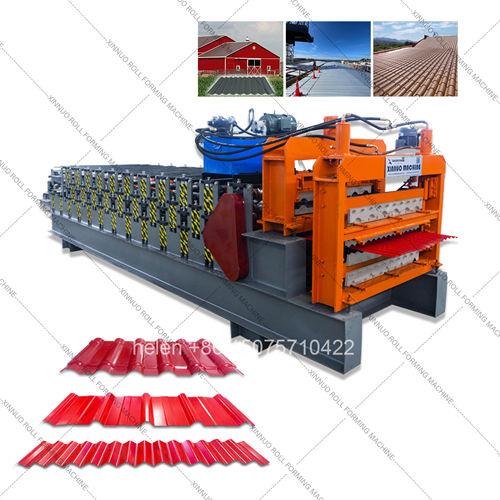
- Purchase price is only one figure; future re-tooling cost matters equally
- Some changes are straightforward later; others must be decided at order
- Adding a deck after delivery costs far more than ordering it initially
- Frame grade and machine height cannot be changed once built
- Profile standards, tile patterns, and stamping type can usually be changed
- Retrofit cost includes downtime as well as parts, engineering, and freight
- Residual value depends on how broadly the tooling combination can be sold
Buyers negotiate hard on the initial price of a three layer glazed tile and metal roof machine, then discover two or three years later that a change they need — a different profile standard, an additional tile pattern, a stamping upgrade — costs more than the original negotiation saved. The reason is structural rather than commercial. Some elements of a roll forming machine can be changed later at reasonable cost, and some cannot be changed at all. Knowing which is which before the order is placed determines whether the machine remains adaptable through its service life or becomes an asset locked to the market conditions that existed on the day it was purchased.
This page works through the economics of change: what can be retrofitted, what must be decided at order stage, what each type of change costs relative to the original purchase, and how to compare a staged investment approach against a single larger commitment. It complements the initial price analysis by addressing the cost that falls later rather than the cost that falls now.
| Change | Feasible Later? | Constraint or Requirement |
|---|---|---|
| Frame grade increase | No | The frame is the structure itself. If it was built at 350H, it cannot become 400H. This must be decided at order stage and is the single most consequential irreversible choice. |
| Machine height | No | Determined by the number of decks and the carriage spacing at the time of build. Adding a deck to a two deck frame of insufficient height requires a new frame. |
| Adding a third deck | Usually not economic | Technically possible only where the frame, drive, and height were specified with capacity for it. Even then, retrofitting costs substantially more than ordering three decks up front, and involves disassembly, realignment, and downtime. |
| Profile standard change | Yes | Requires a new roller set for the affected deck. Feasible, but the cost of a full roller set is a significant fraction of the cost of the deck itself. |
| Additional glazed tile pattern | Yes | Requires a new stamping die and, depending on the pattern, possibly a revised roller set. The most common and most justifiable retrofit. |
| Stamping drive upgrade, cam to servo | Yes, with conditions | Requires a servo motor, drive unit, control system update, and possibly a revised stamping mechanism. Feasible on most machines but easier if anticipated at order stage. |
| Motor power increase | Yes, with conditions | Replacement motor is straightforward; the gearbox, chain specification, and electrical supply may also require change, which multiplies the cost. |
| Automatic stacking addition | Yes | Bolt-on equipment with its own control integration. Simple to add at any time and often the most easily justified later upgrade. |
| Decoiler replacement | Yes | A stand-alone unit. Upgrading capacity or expansion method involves replacing the unit rather than modifying it. |
| Feed width change | No, beyond tooling design | Determined by the roller widths, shaft lengths, and frame opening. Wider profiles need wider rollers and therefore different tooling, not a modified machine. |
| Control system functionality | Yes | Recipes, diagnostics, and interface features can generally be extended through controller programming rather than hardware change. |
| Item | Ordered With the Machine | Added Later | Reason for the Difference |
|---|---|---|---|
| Third forming deck | Incremental cost of one deck within an existing build | Materially higher | Retrofit requires disassembly of the machine, realignment of all decks against a new reference, separate shipping, and a second commissioning visit |
| Additional glazed tile pattern die | Lower | Higher | Die production carries a fixed setup cost that is absorbed within a larger order but charged in full on a stand-alone tooling job |
| Servo stamping instead of cam | Differential between the two mechanisms | Differential plus removal and rework | Converting an installed cam mechanism involves dismantling and refitting that ordering the servo version avoids entirely |
| Spare blade set and critical spares | Bundled at order | Purchased individually during a breakdown | Parts bought urgently carry no bundling benefit and often incur expedited freight |
| Extended run-out conveyor | Sized correctly at order | Replacement unit plus disposal | A short conveyor cannot be extended cheaply; it is generally replaced rather than modified |
| Additional training on a new pattern | Included in commissioning | Separate training visit or remote session | Commissioning is the cheapest moment to train, because the technician is already on site |
| Production downtime | None | Real and often uncosted | A retrofit stops production on the affected line for days, which is frequently the largest single element of the retrofit cost |
| Change | Relative Cost | When It Is Worth Doing |
|---|---|---|
| Re-chrome existing rollers | Low | When chrome is worn but the roller geometry remains within specification. The cheapest way to extend roller life and available two to three times before replacement is required. |
| Add automatic stacking | Low to moderate | When manual sheet collection has become the limiting factor on output. Frequently the highest-return upgrade available on an installed machine. |
| Add a glazed tile pattern die | Moderate | When a second tile pattern can be sold into an existing customer base. Converts a single-pattern tile deck into a two-pattern one. |
| Replace a profile roller set | Moderate to high | When the market profile standard changes, or when a new market requires a different effective width. Effectively re-purposes the deck. |
| Upgrade cam stamping to servo | Higher | When the number of tile patterns sold makes programmable pitch essential. More economical if the machine was ordered with the servo option originally. |
| Replace the main motor with higher rating | Higher | When the material range widens to include gauges the original motor cannot form continuously. May require gearbox and chain review as well. |
| Add a complete forming deck | Highest | Only where the frame and height were specified with capacity for it, and only where the third profile faces proven demand. Rarely economic compared with ordering correctly at the outset. |
| # | Question | Why the Answer Is Irreversible |
|---|---|---|
| 1 | Is the frame grade specified with any headroom? | The frame cannot be strengthened later. Specifying one grade above the minimum requirement preserves future option value. |
| 2 | Is the machine height specified with capacity for an additional deck? | Height determines whether a third deck could ever be accommodated on the same frame. |
| 3 | Is the drive sized against a profile set that might expand? | The drive is sized against the heaviest deck. If a heavier profile may be added later, the drive must be specified for it now. |
| 4 | Is the selector arrangement extensible? | A two position selector cannot serve three decks. The third position must be foreseen at build stage. |
| 5 | Is the control system provisioned for additional decks? | Recipe banks, input and output capacity, and diagnostics must be able to accommodate an additional deck without controller replacement. |
| 6 | Which profile standards might the market adopt? | Feed width and effective width determine the roller design. A change in the market standard later means replacing a roller set, not adjusting a setting. |
| 7 | How many tile patterns will be sold? | Determines whether cam stamping is adequate or whether servo stamping with multiple die sets should be ordered from the start. |
| 8 | Is spare parts documentation complete with part numbers? | Numbered parts allow reordering and re-tooling over the machine's life without depending on the original supplier's records being maintained. |
| Approach | Financial Characteristic | Where It Fits |
|---|---|---|
| Order three decks at the outset | Lowest total cost and lowest cost per profile; highest single capital commitment and the longest period before revenue begins | Where all three profiles face proven demand and capital is available without constraining other investments |
| Order two decks now, anticipate the third | Lower initial commitment; the third deck is added later at a cost penalty, but the machine was built to accept it | Where demand for the third profile is likely but not yet proven, and where the frame and height can be specified with capacity |
| Order two decks with no third deck provision | Lowest initial cost, but the third deck can only be added by acquiring a separate machine | Where the market genuinely supports only two profiles and the capital saved is better deployed elsewhere |
| Order one deck and expand by adding machines | Highest cost per profile and greatest total floor space, but lowest risk concentration and easiest maintenance | Where continuous simultaneous output on every profile is required and capital is not the binding constraint |
| Factor | Effect on Value at Resale |
|---|---|
| Breadth of the tooling combination | Tooling that produces profiles demanded in many markets holds value considerably better than a combination serving one narrow regional standard |
| Machine weight and height | Very tall or very heavy machines are harder to transport and install, narrowing the buyer pool |
| Frame grade | A heavier frame retains more perceived value because it is understood to have greater dimensional stability |
| Maintenance and service records | A documented maintenance history and recorded reference settings support the asking price far more than the machine's age alone |
| Documentation completeness | Wiring schematics, hydraulic diagrams, spare parts catalogue, and controller backups are necessary for a second owner to operate and maintain the machine |
| Roller condition and re-plating history | Logged roller diameter measurements demonstrate whether re-plating cycles remain available |
| Control system currency | An obsolete controller with no available spare parts reduces value substantially for a prospective buyer |
| Stamping mechanism type | Servo-driven programmable stamping generally retains value better than a fixed cam arrangement |
| Parameter | Standard Range |
|---|---|
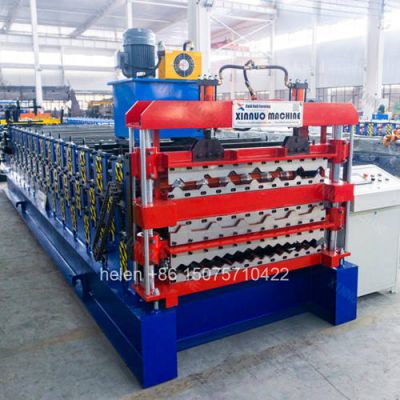
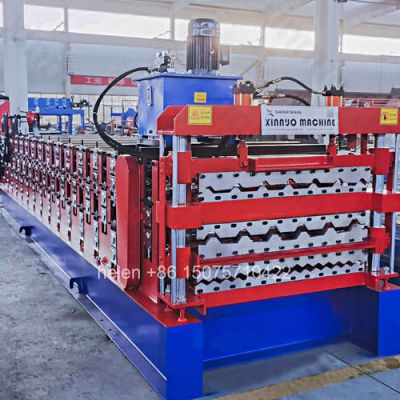
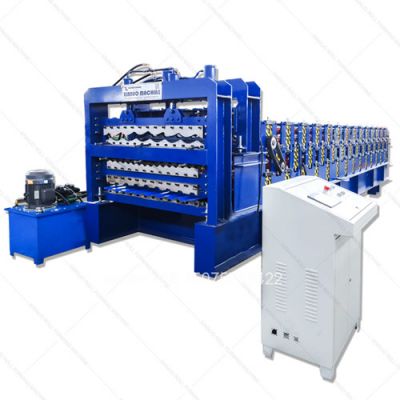
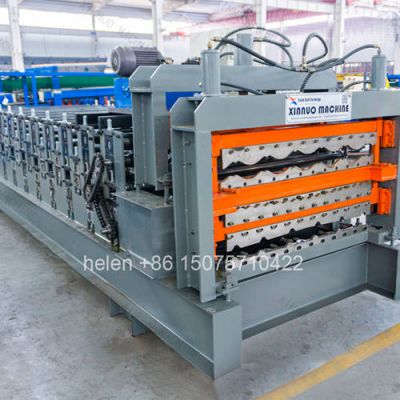
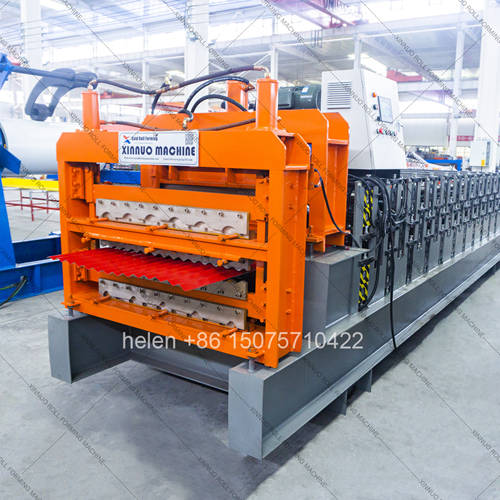
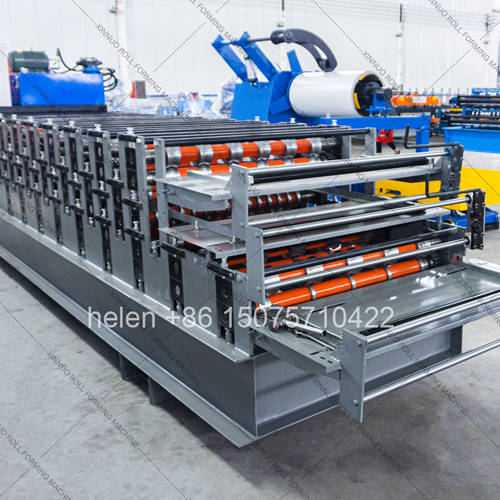
| Machine configuration | Three forming decks stacked vertically in one frame with a three position selector arrangement |
| Typical deck combination | Glazed tile with pitch stamping, plus two metal roof profiles such as trapezoidal and corrugated wave |
| Main frame grade | 400H or 450H welded H-section steel as standard for three deck architecture |
| Forming rows across three decks | Balanced arrangements with a comparable row count per deck are the most stable and avoid speed divergence between tiers |
| Roller material | 45# forged carbon steel, CNC turned, ground, hard chrome plated to HRC 58 – 62 |
| Shaft | Φ80 mm solid steel, centerless ground, dual-row self-aligning bearings |
| Transmission | Duplex or triplex roller chain with hardened sprockets and three position selector |
| Main motor | 11 kW or above, with variable frequency drive |
| Hydraulic station | Independent power pack with air-cooled oil radiator |
| Machine height | Approximately 300 – 500 mm taller than the equivalent double layer machine |
| Machine weight | Approximately 9 – 14 tonnes depending on frame grade, row counts, and combination |
| Forming speed | 8 – 15 m/min; the pitch-stamping deck sets the effective ceiling |
| Material capability | PPGI, PPGL, galvanized, aluminium-zinc coated, and pre-painted aluminium coil; 0.30 – 0.80 mm |
| Cutting system | Hydraulic post-cut shear, Cr12MoV blades at HRC 60 – 62 |
| Cut length tolerance | ±1.5 mm |
| Control system | PLC with colour touchscreen HMI and independent recipe banks per deck |
| Deck changeover time | Approximately 5 – 15 minutes between any two decks |
| Commissioning period | Approximately five to eight days |
| Electrical supply | 380 V / 50 Hz / 3-phase standard; alternative voltages and frequencies by destination |
| Certification | CE marking and ISO 9001:2015 compliant manufacturing |
Coil loading, deck selection at the entry guide, roll forming on the selected deck, glazed tile pitch stamping where that deck is active, length measurement, hydraulic cutting, and discharge to the run-out table follow the established sequence, with deck changeover completed in minutes and no disturbance to the roller sets on the inactive decks.
Hebei Xinnuo is a professional cold roll forming machinery manufacturer with 20+ years of experience. We specialize in C/Z purlin machines, roof panel roll formers, floor deck machines, and custom profile solutions — exported to 50+ countries worldwide.