helen@hbxinnuorollforming.com
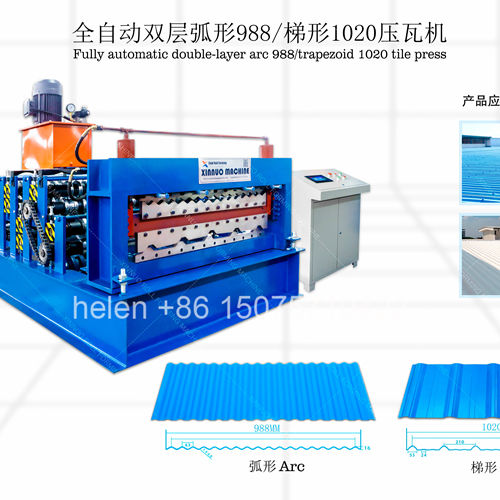
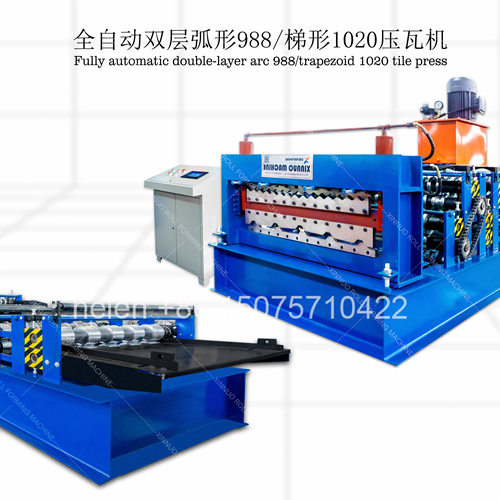
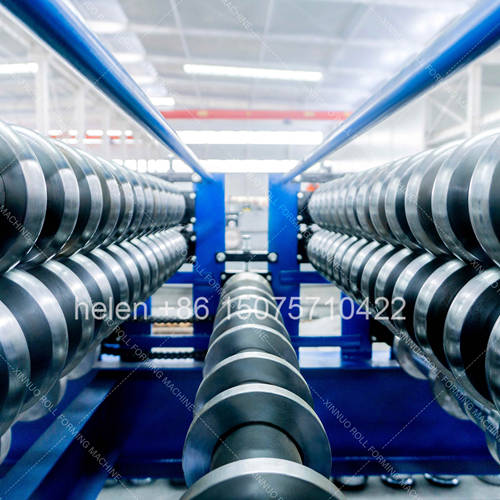
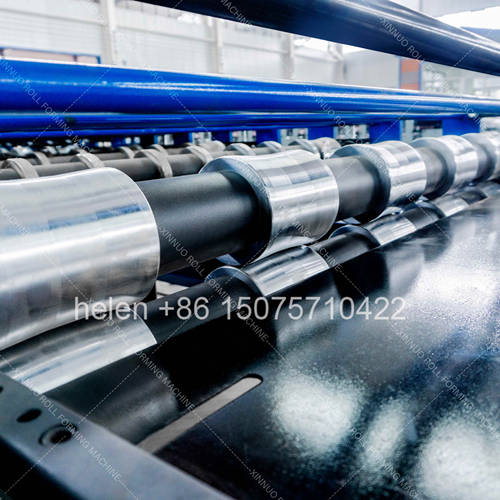
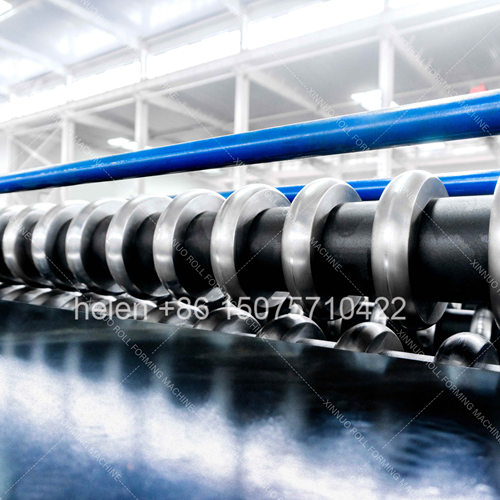
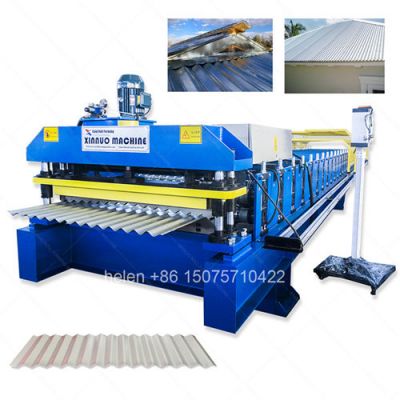
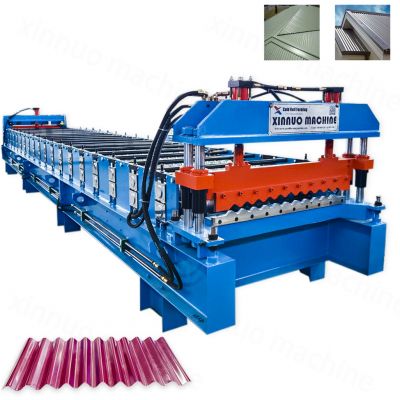
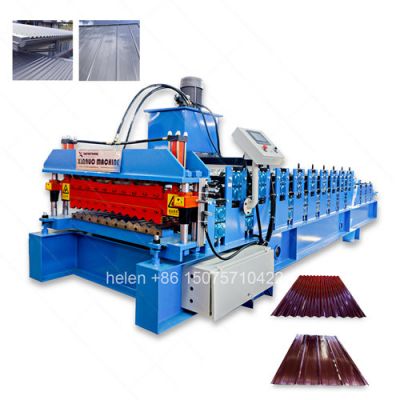
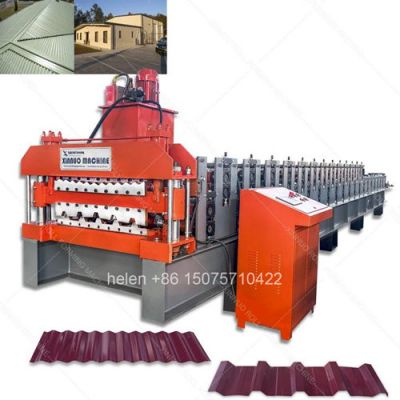
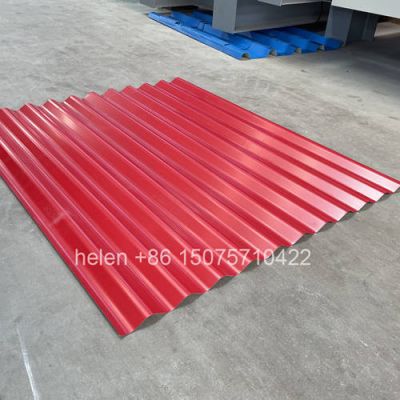
Dual deck roll former produces IBR and corrugated roofing sheets alternately
Heavy steel frame with two vertically stacked independent roller assemblies
Shared main drive with chain transmission powers both forming decks
Flying hydraulic shear cuts panels to length without line stoppage
PLC touch panel stores multiple length and batch production recipes
Entry diverter plate switches material path between decks in minutes
Processes galvanized pre-painted and aluzinc coils from 0.25mm thickness
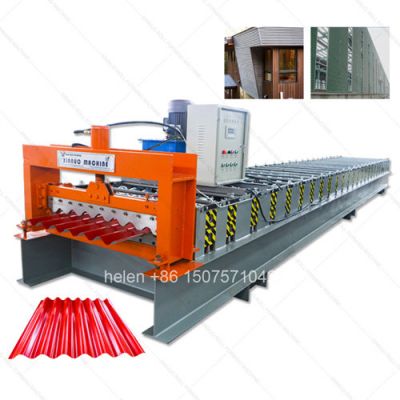
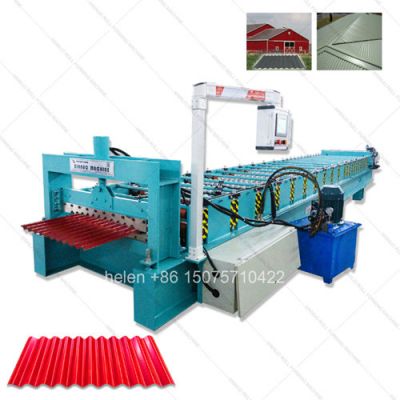
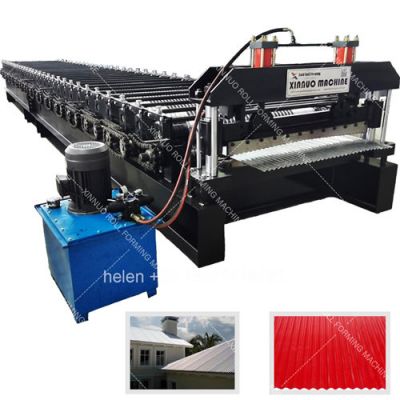
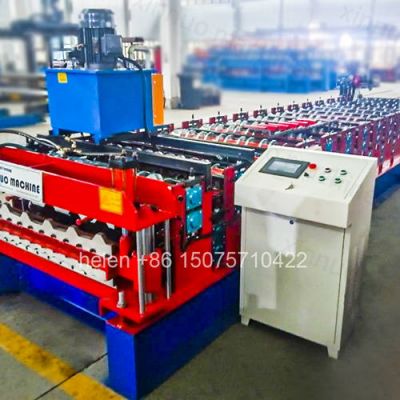
This specialized double layer roll former consolidates two roofing profile production capabilities into a single machine footprint. Rather than purchasing and housing separate IBR and corrugated forming lines, manufacturers install one unit that switches between the two profiles on demand. The machine employs a stacked roller architecture: the upper roller deck is tooled for IBR trapezoidal panel geometry while the lower deck is configured for standard corrugated wave sheet production. A shared drive system, common hydraulic cutting unit, and unified PLC controller minimize component duplication while delivering full independent forming precision for each profile type.
The backbone of the roll former is a monolithic welded steel frame constructed from heavy-channel longitudinal members and cross-braced H-beam uprights. This structure is thermally stress-relieved in a furnace after welding, then precision-machined at bearing mounting surfaces to ensure perfect shaft parallelism across all roller stations. A single industrial AC motor rated at 5.5kW or 7.5kW drives a reduction gearbox with dual output shafts, each driving a dedicated heavy-duty roller chain loop that powers one complete forming deck. The chain tension on each deck is independently adjustable via idler sprockets, and all chain runs are fully enclosed in bolt-on steel guard covers with inspection windows.
| Configuration Element | IBR Deck Specification | Corrugated Deck Specification |
|---|---|---|
| Station Count | 14 to 18 progressive roller pairs | 13 to 16 progressive roller pairs |
| Station Spacing | 250mm–300mm between roller centers | 250mm–300mm between roller centers |
| First Station Function | Flat entry guide and material centering | Flat entry guide and material centering |
| Middle Stations Function | Incremental rib bending with side-flange forming | Progressive wave curvature development |
| Final Station Function | Profile calibration and springback compensation | Final wave contour setting and edge straightening |
| Roller Gap Adjustment | Screw-down mechanism on each station, 0.05mm resolution | Screw-down mechanism on each station, 0.05mm resolution |
| Parameter | Standard Range and Notes |
|---|---|
| Effective Coverage | 762 / 840 / 925 / 1050 / 1100mm (select one per machine) |
| Rib Count per Sheet | 4, 5, or 6 ribs |
| Rib Crown Height | 28mm to 43mm measured from valley floor |
| Rib Internal Width | 50mm–65mm at rib base |
| Side Overlap Type | Simple overlap / anti-capillary grooved overlap (optional) |
| Feed Coil Width Required | 1000mm–1250mm flat strip before forming |
| Parameter | Standard Range and Notes |
|---|---|
| Effective Coverage | 660 / 750 / 800 / 900 / 1000mm (select one per machine) |
| Wave Count per Sheet | 5 waves to 11 waves |
| Wave Amplitude | 6mm–9mm (half of wave depth, crest to neutral axis) |
| Wave Period | 76.2mm (3-inch) industry standard |
| End Overlap Requirement | Minimum 150mm longitudinal end lap for weather seal |
| Feed Coil Width Required | 914mm–1220mm flat strip before forming |
| System | Component | Specification |
|---|---|---|
| Main Drive | Electric Motor | 5.5kW / 7.5kW AC induction, 4-pole, IP54 enclosure |
| Gearbox | Worm-type speed reducer, ratio 1:40 or 1:59, oil-bath lubricated | |
| Speed Control | VFD inverter with 0–50Hz output, panel-mounted potentiometer | |
| Hydraulic Cutting | Pump Motor | 4.0kW 4-pole motor, direct-coupled to gear pump |
| Hydraulic Cylinder | Double-acting, bore Φ100mm, stroke 150mm, 21MPa rated | |
| Shear Blade | Cr12MoV die steel, quenched and double-tempered, HRC 60–64 | |
| PLC Control | Controller | Siemens / Delta / Mitsubishi PLC with relay output module |
| Operator Panel | 7-inch color touchscreen, recipe storage for 20+ product presets |
| Coil Material | Thickness Range | Yield Strength | Typical Application |
|---|---|---|---|
| Hot-dip Galvanized Steel (GI) | 0.25–0.80mm | 235–350 MPa | General roofing, walls, agricultural sheds |
| Pre-painted Galvanized (PPGI) | 0.30–0.70mm | 235–350 MPa | Residential and commercial colored roofing |
| Aluzinc / Galvalume (AZ150) | 0.30–0.70mm | 300–400 MPa | Coastal, high-humidity, corrosive environments |
| Cold-Rolled Steel Strip | 0.25–0.60mm | 200–350 MPa | Economy panels for interior partitions |
| Aluminum Sheet (1100/3003) | 0.40–0.80mm | 100–180 MPa | Lightweight roofing, chemical plant cladding |
| Component | Model / Capacity | Key Feature |
|---|---|---|
| Hydraulic Decoiler | 5-ton or 8-ton capacity, manual or hydraulic expansion mandrel | Brake disc or pneumatic band brake for controlled tension pay-off |
| Entry Guide Table | Adjustable width guide rails with side rollers | Integrated manual guillotine pre-shear for coil-end trimming |
| Main Roll Former | Double layer, upper IBR + lower corrugated roller decks | Pivoting diverter plate selects active forming path |
| Hydraulic Shear Unit | Flying post-cut, carriage-mounted blade assembly | Cut-on-the-fly without stopping the production line |
| Control Cabinet | IP54 rated steel enclosure with ventilation fan | PLC + VFD + relays + circuit breakers in single cabinet |
| Run-out Table | 3m–5m length, free-roller conveyor | Height-adjustable legs for ergonomic sheet collection |
| Step | Operation | Description |
|---|---|---|
| 1 | Coil Mounting | Steel coil is placed onto the decoiler mandrel; hydraulic jaws expand inside the coil bore to grip securely. Mandrel brake is set for controlled resistance. |
| 2 | Strip Threading | Coil leading edge is guided through entry side rollers, trimmed square by the manual pre-shear blade, then fed into the selected roller deck entrance. |
| 3 | Path Selection | Operator positions the diverter plate to route the strip either upward into the IBR deck or downward into the corrugated deck. Changeover takes approximately 10 minutes. |
| 4 | Progressive Forming | The flat strip passes through each successive roller pair, bending incrementally. By the exit station, the metal has assumed the complete IBR rib shape or full corrugated wave pattern. |
| 5 | Length Tracking | A rotary pulse encoder on the last forming shaft continuously measures linear output. The PLC compares the running count against the preset length value entered on the touchscreen. |
| 6 | Flying Shear Cut | When the preset length is reached, the PLC commands the shear carriage to clamp and move with the sheet. The hydraulic cylinder drives the blade through the profile, then both carriage and blade retract. |
| 7 | Panel Stacking | The separated sheet slides onto the run-out table rollers. The operator lifts the finished panel from the table and adds it to the product stack for bundling and dispatch. |
| Evaluation Criterion | Two Dedicated Roll Formers | One Double Layer Roll Former |
|---|---|---|
| Total Equipment Investment | 100% (two machines, two decoilers, two cutters) | Approx. 65–75% of total hardware cost |
| Floor Space Occupied | Approx. 44–70 m² | Approx. 20–35 m² |
| Shipping & Logistics | Two container loads, double freight charges | Single container, ~45% freight cost reduction |
| Installation Complexity | Two separate installations and alignments | One installation; two roller decks calibrated together |
| Daily Throughput Mode | Simultaneous production of both profiles possible | Sequential batch production, alternating between profiles |
| Energy Consumption | Two motors running, two hydraulic pump cycles | One motor, one pump; lower electricity cost per shift |
| Maintenance & Spares | Two independent maintenance plans and spare sets | One maintenance plan, reduced spare inventory |
Prior to packaging, every completed roll former undergoes a multi-stage inspection protocol. First, all roller gaps are measured with feeler gauges at each station and compared against the engineering tolerance sheet. Second, the machine runs dry (without material) at full speed for a minimum of four hours while technicians monitor bearing temperatures, chain tension, and vibration levels using infrared thermometers and manual inspection. Third, a live material trial is conducted using actual galvanized coil stock at the rated thickness: the operator produces 50 consecutive IBR sheets and 50 consecutive corrugated sheets, measuring the length, rib geometry, wave pitch, and cut edge quality of every 10th sheet with calibrated digital instruments. Only machines that pass all three stages with zero deviations beyond published tolerances are cleared for export crating.
The main roll former body is wrapped in heavy-gauge VCI (volatile corrosion inhibitor) anti-rust film, cushioned with foam padding at all protruding points, and secured to a reinforced fumigated plywood pallet or steel skid with bolted tie-downs. The decoiler, run-out table, hydraulic station, and control cabinet are packed in separate marked wooden crates. Loose items including tool kits, spare parts, and documentation are placed in a dedicated small crate with a packing list taped inside the lid. Typical production lead time is 25–35 working days from order confirmation and deposit receipt. Standard warranty is 12 months from the date of shipment; an optional extended warranty of 24 months may be purchased. A starter spare parts kit containing one full shear blade set, 20 connecting chain links, 2 proximity sensors, 2 emergency stop switches, and one set of hydraulic seals is included at no additional charge with every machine.
| Option | Description and Advantage |
|---|---|
| Servo Motor Feed System | Replaces standard AC motor and VFD with precision servo drive for programmable acceleration curves, higher length accuracy, and reduced energy consumption during idle periods |
| Automatic Sheet Stacker | Mechanical or pneumatic stacking arm that lifts cut sheets from the run-out table and places them in aligned stacks on a pallet, eliminating manual handling labor |
| Powered Coil Loading Trolley | Rail-guided electric cart with hydraulic lift table that transports coils from storage to the decoiler and positions them on the mandrel; handles coils up to 10 tons |
| 4G Remote Diagnostics Module | Cellular-connected IoT gateway that transmits operating hours, production counts, fault codes, and maintenance alerts to a web dashboard or mobile application |
| Corrosion-Resistant Roller Set | Rollers manufactured from 304 or 316L stainless steel instead of 45# carbon steel for processing materials in food-grade, pharmaceutical, or high-salinity environments |
| Profile Embossing Station | Additional roller station that imprints a brand logo, production date code, or diamond pattern into the panel surface during forming |
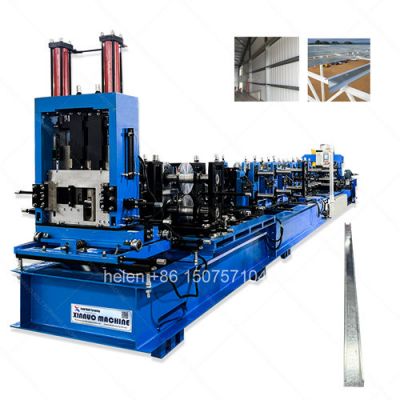
Hebei Xinnuo is a professional cold roll forming machinery manufacturer with 20+ years of experience. We specialize in C/Z purlin machines, roof panel roll formers, floor deck machines, and custom profile solutions — exported to 50+ countries worldwide.