helen@hbxinnuorollforming.com
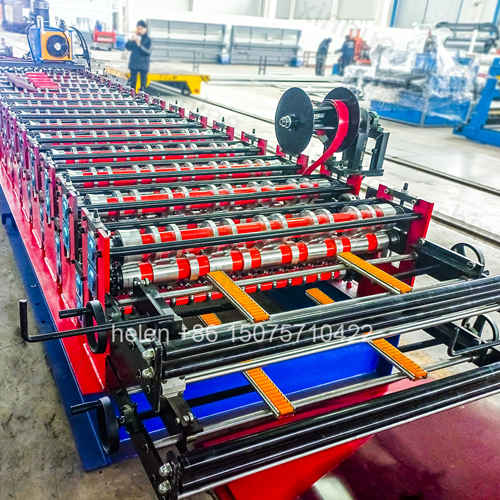
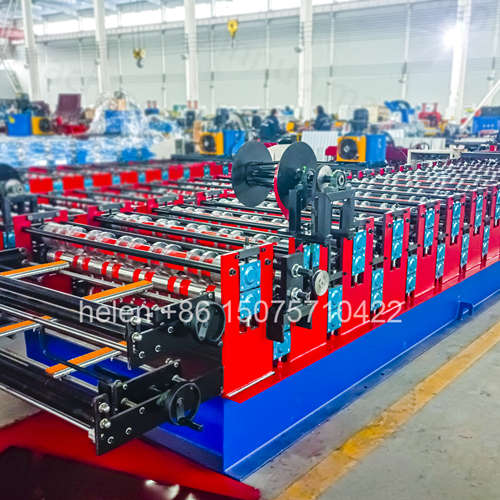
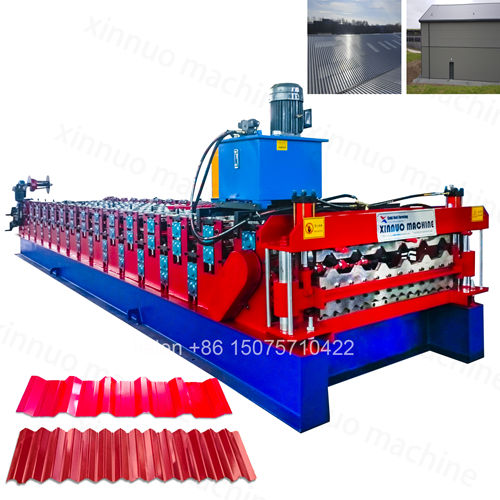
- Upper and lower forming tiers deliver two roofing profiles from one frame
- Switch profiles by adjusting the entry guide path, not the tooling
- Handles pre-painted galvanized coil from 0.30 mm to 0.80 mm thickness
- Rotary encoder and PLC hold cut length within 1.5 mm accuracy
- Hard chrome rollers protect painted coil surfaces through every forming pass
- Independent recipe banks store length, quantity, and speed per tier
- Output reaches 8 to 20 metres per minute depending on configuration
A roofing sheet manufacturer does not buy a machine to own a machine. The purchase is justified by sheets sold, square metres delivered, and margin retained. That makes output capacity, material yield, and product range the three numbers that matter most when evaluating a double layer roofing sheet roll forming machine — and they are also the three numbers least often supplied in a machine quotation. This page works through each of them, so the equipment decision can be made against the actual production economics of a roofing business rather than against a specification sheet alone.
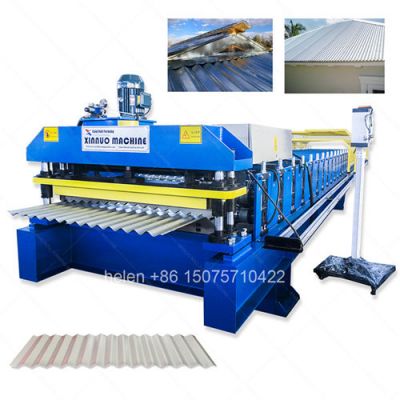
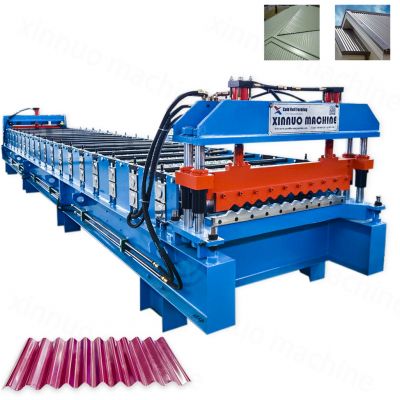
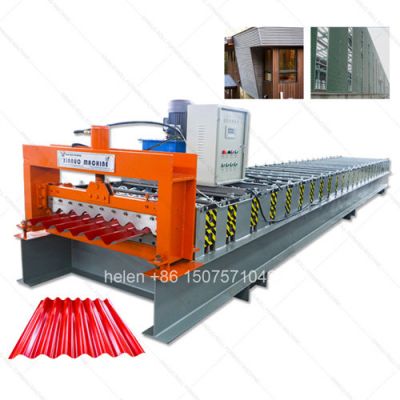
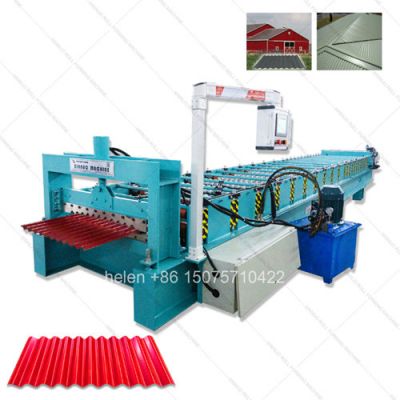
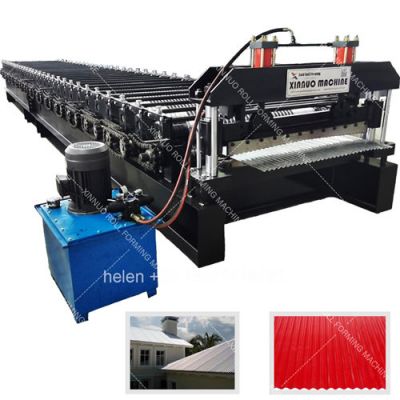
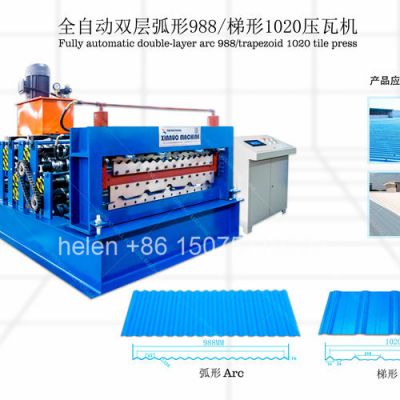
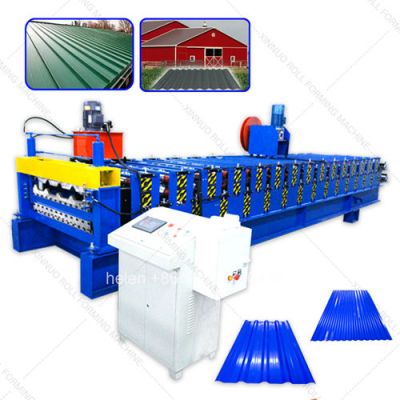
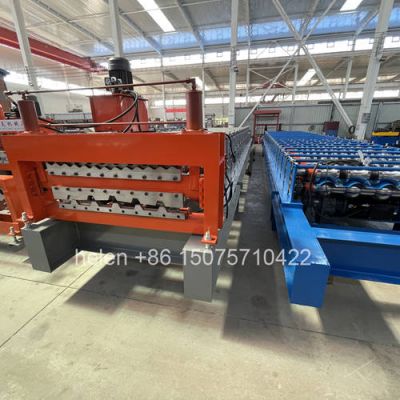
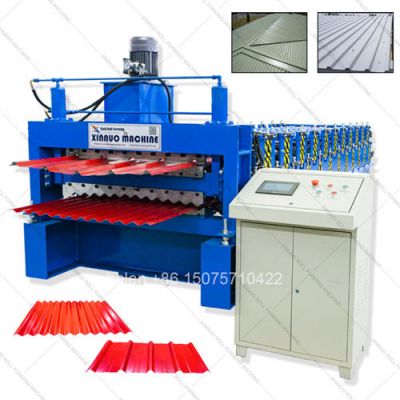
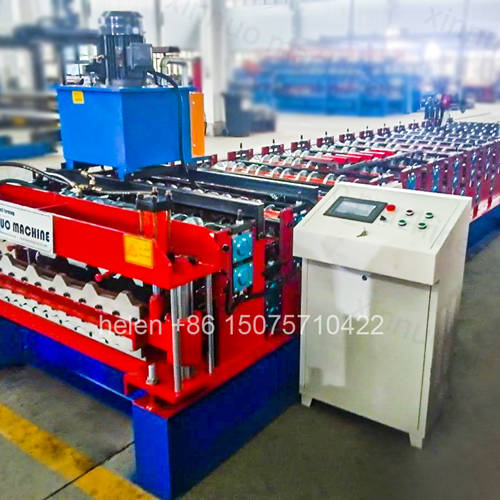
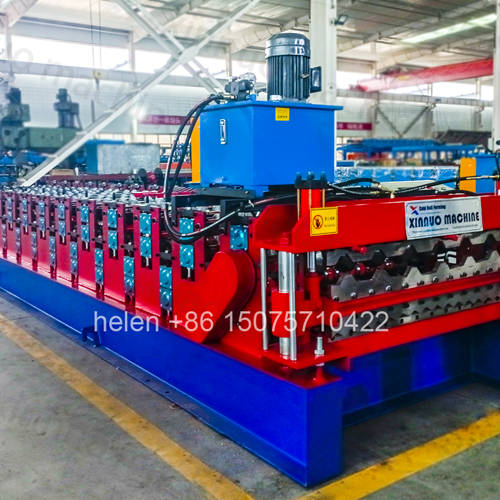
The machine itself follows a well-established architecture: two complete roller forming carriages mounted one above the other inside a single welded structural frame, served by one drive motor through a selector clutch, one hydraulic cutting station, and one control system. Material is directed into the upper or lower carriage by adjusting the entry guide path. No rollers are removed between production runs, and no dies are substituted. What changes the commercial outcome is not the architecture but how well the frame, the drive train, and the roller tooling are matched to the specific profiles and output levels the buyer intends to run.
Published forming speed figures describe the machine at ideal conditions. Real output depends on four additional factors: the proportion of shift time the machine is actually running, the length of the sheets being produced, the profile being formed, and the changeover time consumed between production runs. The table below separates the variables from the result.
| Output Variable | Typical Range | How It Affects the Final Figure |
|---|---|---|
| Forming speed | 8 – 20 m/min | Set by profile complexity and material gauge. Shallow corrugated profiles run faster than deep-rib trapezoidal. Thicker material requires lower speed to maintain profile definition. |
| Effective running time | 65 – 85% of shift | Accounts for coil changes, profile changeovers, cut-length adjustments, sheet removal, and routine interruptions. New operators typically start nearer 65% and improve with experience. |
| Sheet length produced | 1.8 – 12 m | Longer sheets reduce the relative impact of each cut cycle and of sheet handling between cuts, so output per running hour rises as sheet length increases. |
| Profile being formed | Trapezoidal, corrugated, arc, glazed tile | Continuous roller profiles support higher sustained speed than profiles requiring intermittent pitch stamping, which impose a cyclical pause on the line. |
| Changeover frequency | 0 – 4 times per shift | Each profile changeover consumes 5 to 15 minutes of non-productive time. Frequent switching between tiers for small orders materially reduces daily square-metre output. |
An illustrative calculation makes the relationship concrete. Assume a 0.45 mm pre-painted galvanized coil, an 840 mm effective width trapezoidal profile, 3.6 m standard sheet length, 15 m/min forming speed, an 8-hour shift, and 75% effective running time. Running time is therefore 6 hours, or 360 minutes, producing 5,400 linear metres of sheet. Divided by 3.6 m per sheet, that is approximately 1,500 sheets per shift. Multiplying by the 0.84 m profile width gives roughly 4,500 square metres per shift. Reducing effective running time to 65% lowers the same calculation to approximately 3,900 square metres — a difference of roughly 600 square metres per shift, or around 13%, attributable purely to operational discipline rather than to the machine itself.
Every roofing profile converts a wider coil into a narrower finished sheet. The difference between coil width and effective sheet width is material consumed but not sold — except where the trimmed edge can be sold as a secondary product or returned to the coil supplier. Yield therefore directly determines gross margin per tonne of coil purchased, and it varies substantially between profiles. Buyers comparing profile options should compare yield alongside selling price.
| Profile Family | Effective Width | Typical Feed Width | Material Yield | Commercial Implication |
|---|---|---|---|---|
| IBR-686 | 686 mm | ~910 mm | ~75.4% | Lower yield, but strong regional pricing power in mature IBR markets where the width is a national standard |
| IBR-762 | 762 mm | ~1000 mm | ~76.2% | Widely specified for industrial roofing; yield is acceptable and coil availability is broad |
| IBR-840 | 840 mm | ~1000 mm | ~84.0% | Strong yield position combined with high commercial demand — frequently the best all-round margin profile |
| IBR-925 | 925 mm | ~1100 mm | ~84.1% | Good yield for large-span roofing; requires coil widths less commonly held in smaller warehouses |
| IBR-1050 | 1050 mm | ~1200 mm | ~87.5% | Highest yield in the trapezoidal family; fewer overlaps per roof also reduce installation cost for the buyer |
| Corrugated 665 | 665 mm | ~900 mm | ~73.9% | Lowest yield, offset by low selling price expectations and strong volume demand in agricultural markets |
| Corrugated 762 | 762 mm | ~1000 mm | ~76.2% | Balanced yield; feed width shared with IBR-762 simplifies coil inventory where both tiers are fitted |
| Corrugated 836 | 836 mm | ~1080 mm | ~77.4% | Used where 836 mm is the established national width; moderate yield with stable demand |
| Corrugated 990 | 990 mm | ~1250 mm | ~79.2% | Widest corrugated option; fewer overlaps per roof and good yield, suited to coastal and island markets |
Where both tiers can be specified to accept the same feed width, a second benefit appears that is easy to overlook at the purchasing stage: a single coil width serves both production lines. That reduces the number of coil specifications held in stock, simplifies purchasing, shortens coil-change time, and reduces the capital tied up in inventory. Yield analysis and coil-width analysis should therefore be performed together rather than separately.
Understanding where each finished sheet is installed helps a manufacturer decide which profiles are worth offering and how to price them. The following matrix maps profile families to the building conditions under which they are normally specified. Product mix planning should follow this matrix rather than simply reproducing a competitor's catalogue.
| Profile | Minimum Roof Pitch | Typical Support Spacing | Fixing Method | Building Types Where It Is Normally Specified |
|---|---|---|---|---|
| IBR trapezoidal | 5° minimum | 900 – 1500 mm purlin spacing | Self-drilling screws at rib crest | Industrial warehouses, factories, commercial complexes, institutional buildings, large residential |
| Corrugated wave | 10° minimum | 900 – 1200 mm purlin spacing | Self-drilling screws at wave crest, or hook bolts on purlins | Agricultural buildings, poultry and livestock sheds, fencing, temporary shelters, budget housing |
| Arc wave | 7° minimum | 1000 – 1200 mm purlin spacing | Screws at crest with sealing washers | Industrial roofs, workshop buildings, storage structures |
| Glazed tile | 15° minimum | 600 – 900 mm purlin spacing | Concealed fixing or screws at tile intersections | Villas, resorts, heritage-style buildings, religious buildings, premium residential |
A double layer machine offers two profiles, but the number of sellable product lines is larger, because each profile can be produced in multiple gauges and lengths and in multiple colours where pre-painted coil is used. Planning the catalogue deliberately produces a stronger market position than producing whatever the machine happens to form.
| Catalogue Dimension | Source of Variation | Planning Guidance |
|---|---|---|
| Profile width | One per machine tier | Select the two widths against the standards of the target market, not against whatever tooling is offered at lowest cost |
| Material gauge | Coil selection, 0.30 – 0.80 mm | Offer two or three gauges per profile. Thinner gauges serve cost-sensitive work; thicker gauges support structural and long-span applications at higher unit price |
| Sheet length | Programmed at the control panel | Length is set per order at virtually no cost. Long-sheet service is a genuine differentiator against suppliers who only stock standard lengths |
| Colour | Pre-painted coil selection | Stock the three or four colours that dominate local demand. Colour variety adds catalogue depth without adding machine cost |
| Accessory matching | Same coil, secondary forming | Ridge caps, barge boards, and flashing produced from matching coil allow a complete roof package to be supplied from one order |
| Cost Category | What to Include in the Project Budget |
|---|---|
| Machine and configuration | Base machine plus selected tier pairing, frame grade, motor power, and any optional attachments agreed at order stage |
| Coil inventory at start-up | Sufficient stock in each required width, gauge, and colour to begin production and to run commissioning tests without waiting on coil deliveries |
| Foundation and installation | Reinforced concrete pad, anchor bolts, levelling, and the labour required to position and align the machine — typically underestimated |
| Electrical connection | Supply cable, isolator, and any upgrade to the incoming supply capacity required by the main motor and hydraulic power pack |
| Material handling | Forklift or crane capacity for coil loading and finished sheet movement, plus racking and staging area |
| Spare parts reserve | At least one spare set of shear blades, chain, and critical bearings held on site from day one to avoid production stops |
| Working capital during ramp-up | Operating costs carried while output and operator efficiency improve toward the planned levels described earlier in this page |
| Parameter | Standard Range and Options |
|---|---|
| Machine configuration | Two vertically stacked roller carriages in one frame; shared drive motor, hydraulic shear, and control system |
| Available pairings | Trapezoidal plus trapezoidal, trapezoidal plus glazed tile, arc plus trapezoidal, arc plus glazed tile, arc plus arc, and triple layer architecture |
| Main frame grade | 300H, 350H, 400H, or 450H welded H-section steel selected against combined carriage load |
| Side panel thickness | 16 – 20 mm CNC laser-cut steel plate, precision-machined bearing seats |
| Forming rows per tier | 11 – 18 rows depending on profile geometry; row difference between tiers ideally within 0 – 4 rows |
| Roller material | 45# forged carbon steel, CNC contour-turned, surface-ground, hard chrome plated to HRC 58 – 62 |
| Roller shaft | Φ75 mm or Φ80 mm solid steel, centerless ground, dual-row self-aligning roller bearings |
| Transmission | Duplex roller chain with hardened sprockets and adjustable idler tensioners; selector clutch for tier engagement |
| Main motor | 5.5 kW, 7.5 kW, or 11 kW with variable frequency drive and stepless speed control |
| Forming speed | 8 – 20 m/min, subject to profile and gauge; pitch-stamping tiers reduce the effective ceiling |
| Material capability | PPGI, PPGL, galvanized, aluminium-zinc coated, and pre-painted aluminium coil, 0.30 – 0.80 mm standard |
| Coil width capability | Up to 1250 mm per tier depending on target effective width |
| Cutting system | Hydraulic post-cut shear or guillotine; Cr12MoV blades at HRC 60 – 62 with independent power pack |
| Cut length tolerance | ±1.5 mm via rotary encoder closed-loop measurement |
| Control system | PLC with 7 in colour touchscreen HMI; independent recipe banks per tier; fault diagnostics display |
| Recipe storage | Up to 50 configurations per tier, each holding sheet length, batch quantity, and speed |
| Changeover time | Approximately 5 – 15 minutes between tiers, carried out at the entry guide assembly |
| Occupied floor area | Approximately 20 – 40 m² including decoiler, forming machine, shear, and run-out table |
| Machine weight | Approximately 4.5 – 14 t depending on frame grade, row count, and pairing |
| Electrical supply | 380 V / 50 Hz / 3-phase standard; alternative voltages and frequencies available by destination |
| Certification | CE marking and ISO 9001:2015 compliant manufacturing |
Production sequence, from coil to finished sheet, follows the established line order: coil loading onto the decoiler, entry guidance into the selected forming tier, progressive roller forming through the carriage, length measurement by the encoder, hydraulic cutting to the programmed dimension, and discharge onto the run-out table. Standard commissioning runs between two and three days for continuous roller pairings and extends to five to eight days where pitch-stamping or triple layer architecture is involved.
Hebei Xinnuo is a professional cold roll forming machinery manufacturer with 20+ years of experience. We specialize in C/Z purlin machines, roof panel roll formers, floor deck machines, and custom profile solutions — exported to 50+ countries worldwide.