helen@hbxinnuorollforming.com
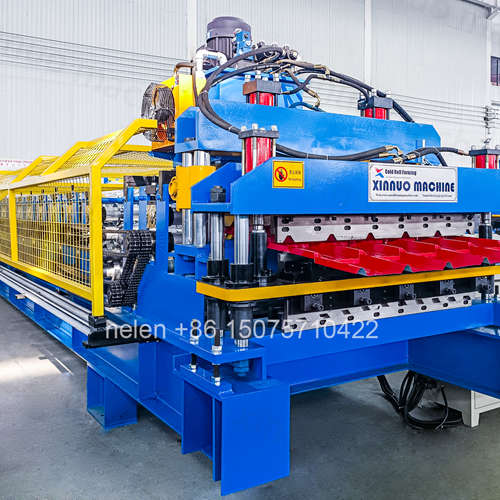
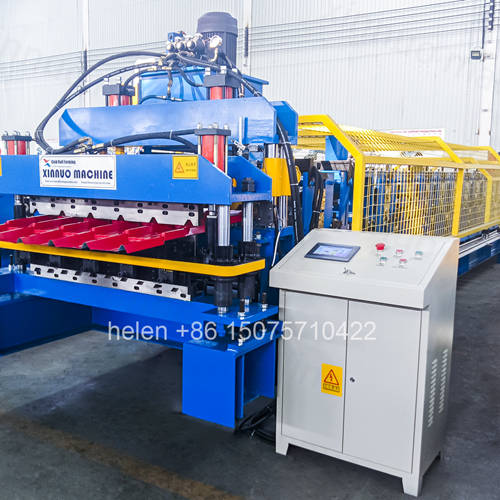
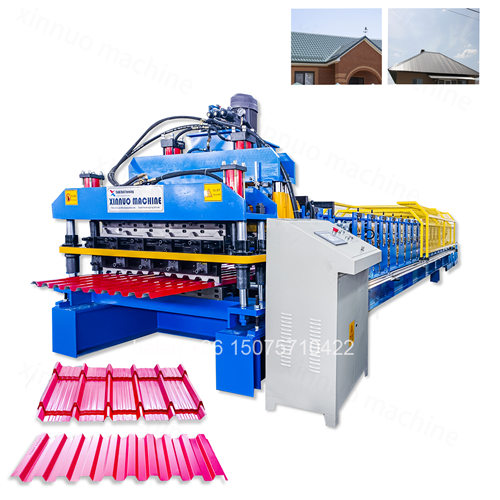
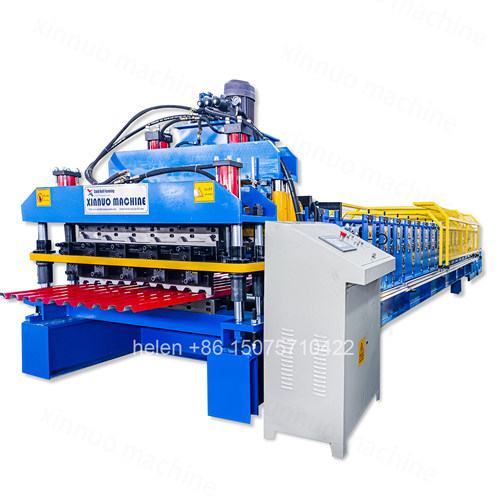
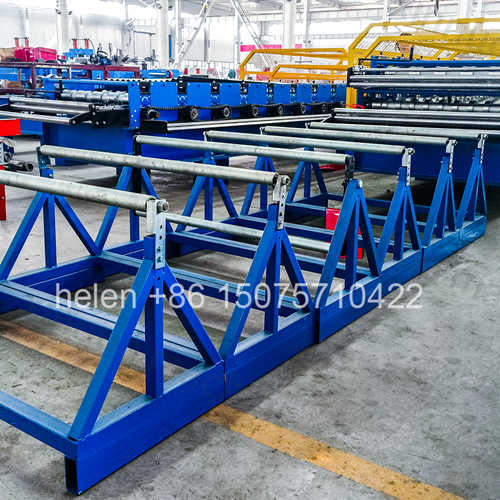
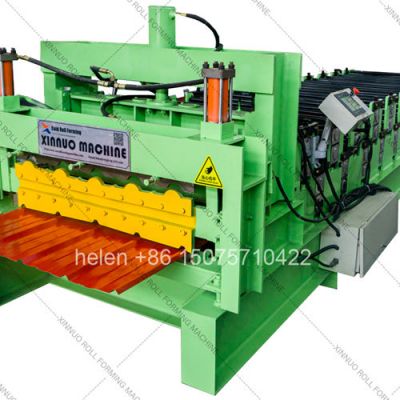
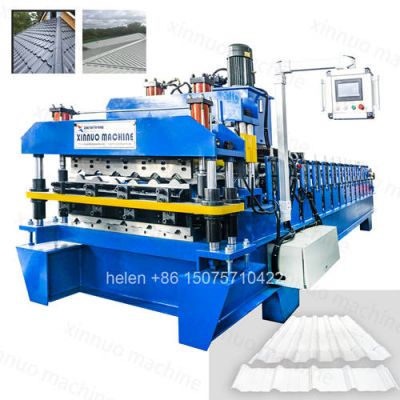
Two quotations for a double layer glazed tile and roof sheet making machine may differ by a third, and the higher figure is not automatically the worse purchase. What matters is not the absolute price but the capacity that price delivers and whether that capacity matches the market the machine will serve. A machine specified for three tile patterns, thick-gauge forming, and wide-format roofing sheets costs more than one specified for a single tile pattern and standard gauges — and it is worth the difference to a producer serving several markets, and wasted money for a producer selling into one local market with a single established profile standard.
This page approaches price from the direction buyers usually neglect: rather than asking what a machine costs, it asks what each specification step costs, how much capacity each step actually delivers, and how to identify whether a given specification is right-sized for a specific market. It also sets out normalised benchmarks that allow machines of different specifications to be compared fairly, and the post-order cost risks that a headline figure does not reveal.
Price does not rise in proportion to output capacity. It rises faster than capacity at the entry level, then delivers progressively better value per unit of price through the middle of the range, before flattening again where custom tooling and wide-format capability are involved. Understanding where a given configuration sits on this curve is more useful than comparing headline figures.
Tier
Relative Price
Relative Output Capacity
Capacity per Unit of Price
Commercial Interpretation
Entry
82 – 90
70 – 80
Below average
The lowest capital entry point, but the buyer pays a relatively high price for each unit of output. Suited only to low-volume local demand where capital is the binding constraint.
Standard
100 (baseline)
100
Baseline
The reference point. Delivers the bulk of practical capability without paying for specialist features that most markets do not require.
Upper standard
112 – 122
125 – 145
Above average
Generally the best value region of the curve. Additional rows, a heavier frame, and a larger motor deliver proportionally more capacity than they add in cost.
Heavy duty
128 – 145
150 – 180
Still favourable
Justified where thick gauge, sustained output, or deep-rib profiles are genuinely required. Diminishing value where the market cannot absorb the output.
Custom and wide format
150 – 180
165 – 200
Declining
Custom tooling and wide-format capability carry a fixed engineering cost that does not scale with volume. Justified only by a specific market requirement or a multi-pattern product plan.
The table below sets out the marginal price effect of each specification decision, expressed as a percentage of a standard configuration price. Because the effects compound, the cumulative total should be calculated by applying them in sequence rather than adding them arithmetically.
Specification Step
Marginal Price Effect
What It Actually Delivers
Two additional forming rows, roof sheet deck
+3% to +5%
Better dimensional control on the roofing deck, which matters most on deeper rib profiles and thicker gauge. On shallow profiles the gain is small.
Two additional forming rows, glazed tile deck
+4% to +6%
Tighter control of tile step geometry and reduced risk of distortion at the stamping station. Proportional to how closely customers inspect the tile pattern.
Frame grade step, for example 350H to 400H
+6% to +10%
Greater dimensional stability under the combined deck load, which protects profile accuracy over years of service. Not a performance feature so much as a durability one.
Motor step, for example 7.5 kW to 11 kW
+3% to +5%
Capability to form heavier gauge and deeper ribs without stalling, and to sustain speed under continuous load. Useless if the material range will not exceed 0.5 mm.
Mechanical cam to servo stamping
+8% to +14%
Programmable pitch distance and higher stamping precision. The single most valuable upgrade where more than one tile pattern will be sold.
Additional glazed tile pattern die set
+8% to +12% per set
A second sellable tile pattern from the same machine. Converts a single-product machine into a two-product machine on the tile side.
Decoiler upgrade to 8 t hydraulic with coil car
+4% to +7%
Faster coil changes and safe handling of heavier coils. Pays for itself in reduced changeover time where many small orders are run.
Automatic sheet stacking system
+6% to +10%
Removes manual collection as a bottleneck. Justified once output volume makes manual handling the constraint on throughput.
Wider effective profile, plus roughly 100 mm
+5% to +9%
Fewer overlaps per roof and faster installation for the end customer. Requires correspondingly wider and often less commonly held coil stock.
Certification documentation package
+2% to +4%
Formal conformity documentation for markets that require it at import. Necessary in some destinations and irrelevant in others.
Condition
Symptoms
Financial Consequence
Corrective Action
Over-specification
Machine runs well below rated speed because demand does not fill capacity; premium features sit unused; servo stamping fitted but only one tile pattern is ever sold
Capital is tied up in capability that produces no revenue, and depreciation is carried against lower output
Reduce the specification at order stage. It is far cheaper to add capability later through tooling than to recover capital already committed to unused features.
Under-specification
Machine runs at its limit on normal orders; heavier gauge cannot be formed; large orders are declined or outsourced; operators work around profile defects rather than eliminating them
Lost revenue on orders outside the machine's range, and premature replacement before the asset is paid back
Specify to the upper end of the expected material range and profile depth, not to the average of past orders.
Correct specification
Machine handles the full range of material and profiles the market actually demands, with normal capacity headroom for peak periods
Capital is matched to revenue-generating capability, with headroom available for growth without replacement
Define the material range, profile range, and expected peak order size before selecting rows, frame grade, and motor rating.
A headline price cannot be compared fairly against a machine of different specification. The benchmarks below normalise price against capability, so that two very different configurations can be placed on a common footing.
Benchmark
How It Is Calculated
What a Higher or Lower Result Indicates
Price per forming row
Machine price divided by total rows across both decks
A materially high figure against comparable quotations suggests the frame, drive, or control specification is carrying cost that the row count does not justify.
Price per tonne of forming capacity
Machine price divided by hourly throughput in tonnes at typical speed and gauge
Normalises the price against the material the machine can actually process per hour, which is closer to revenue than line speed alone.
Price per sellable product line
Machine price divided by the number of profiles and tile patterns the tooling can produce
A high figure indicates the machine is a single-product asset despite being offered as a double layer machine. Tooling scope, not machine architecture, decides this.
Price per kW of installed drive
Machine price divided by main motor rating
Useful as a sanity check. A high figure with a low motor rating suggests cost is concentrated in tooling and frame rather than in drive capability.
Landed cost per square metre of output
Total operational investment divided by expected output over the first full year
The most decision-relevant benchmark. Converts every specification and logistics choice into one figure that can be compared against annual output expectations.
Market Condition
Specification That Fits
Specification That Would Be Wasted
Single established profile standard
Standard rows and frame, mechanical cam stamping for one tile pattern, standard gauge capability
Servo stamping and multiple tile die sets, since no one in the market orders a second tile pattern
Multiple neighbouring markets
Servo stamping with two or three tile die sets, upper-standard rows, wider profiles
Entry-tier frame and rows, which will limit the profile range that can be quoted into adjacent markets
Heavy industrial demand
Heavy frame, higher motor rating, additional rows, faster decoiler
Light frame and standard motor, which will prevent thick-gauge forming and cap the order size that can be accepted
Competitive low-price market
Standard configuration with reliable tooling and durable chrome, avoiding capital-heavy features
Wide-format tooling and automation, where the capital cannot be recovered against market selling prices
Small mixed-batch demand
Faster decoiler, sound tooling, and a configuration that minimises changeover effort
High-speed capability, since throughput is limited by order size rather than by line speed
Long-length custom sheet demand
Standard formers with accurate encoder-based length control and adequate run-out length
Additional forming rows beyond those needed, since length capability is delivered by the control system rather than by the tooling
Rural or remote operation
Robust standard configuration with a spare parts reserve and a clear remote support route
Complex automation that increases dependency on specialist service that may not be locally available
Risk
How It Arises
How to Neutralise It Before Ordering
Change order pricing
A specification change after deposit is priced at the supplier's discretion rather than at the original order rate
Finalise every specification point before signing, and ask in advance how changes would be priced
Additional tile die sets
A second tile pattern is ordered later as a stand-alone tooling job, with its own setup cost
Include anticipated patterns in the original order where the product plan supports it
Spare part pricing after warranty
Parts purchased individually during a breakdown carry no competitive pressure and no bundling discount
Establish part numbers and indicative pricing within the documentation package at order stage
Consumable quality drift
Replacement blades and chains sourced on price alone, with hardness or specification lower than the original
Record the original specifications and treat them as the reorder standard
Technician dispatch costs
On-site support rates, travel, and accommodation are discovered only when needed
Confirm dispatch terms in writing at order stage, including the basis of the daily rate
Freight movement after order
Freight quoted at enquiry is superseded by the rate applying at shipment
Confirm whether the freight component is fixed or adjustable, and on what basis
Excluded commissioning scope
Remote support ends at a point that is ambiguous until it is reached
Define the scope and duration of included support explicitly in the order terms
Parameter
Standard Range
Machine configurationTwo forming decks stacked vertically in one frame; glazed tile deck with pitch stamping plus roof sheet deck
Roof sheet deck profilesTrapezoidal, corrugated wave, or arc wave, selected against the target market standard
Glazed tile deckPitch-stamping deck, cam-driven or servo-driven, with pattern-specific stamping die
Main frame grade300H, 350H, 400H, or 450H welded H-section steel selected against combined deck weight
Forming rows per deck11 – 18 rows depending on profile family and rib depth
Roller material45# forged carbon steel, CNC turned, ground, hard chrome plated to HRC 58 – 62
Roller profile tolerance±0.03 mm to ±0.05 mm
ShaftΦ75 mm or Φ80 mm solid steel, centerless ground, dual-row self-aligning bearings
TransmissionDuplex roller chain with hardened sprockets and selector clutch for deck engagement
Main motor5.5 kW, 7.5 kW, or 11 kW with variable frequency drive
Hydraulic station4.0 kW independent power pack with air-cooled oil radiator
Average electrical demandApproximately 5.5 – 8.5 kW during production
Forming speed8 – 20 m/min; the pitch-stamping deck sets the effective ceiling
Material capabilityPPGI, PPGL, galvanized, aluminium-zinc coated, pre-painted aluminium; 0.30 – 0.80 mm standard
Cutting systemHydraulic post-cut shear, Cr12MoV blades at HRC 60 – 62
Cut length tolerance±1.5 mm
Control systemPLC with colour touchscreen HMI and independent recipe banks per deck
Electrical supply380 V / 50 Hz / 3-phase standard; alternative voltages and frequencies by destination
CertificationCE marking and ISO 9001:2015 compliant manufacturing
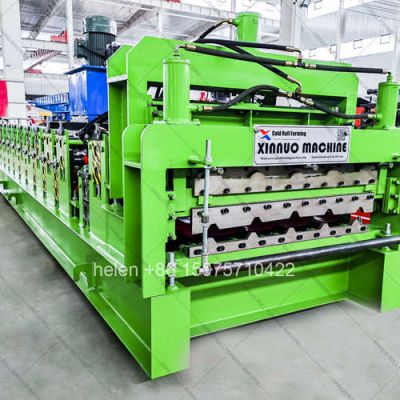
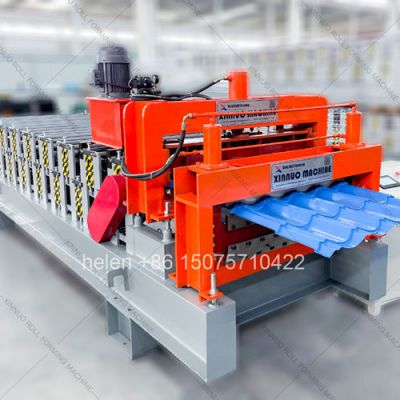
Production runs in the established sequence — coil loading, deck selection at the entry guide, roll forming on the selected deck, glazed tile pitch stamping where that deck is active, length measurement, hydraulic cutting, and discharge to the run-out table — with deck changeover completed in minutes and no disturbance to either roller set.
Two quotations for a double layer glazed tile and roof sheet making machine may differ by a third, and the higher figure is not automatically the worse purchase. What matters is not the absolute price but the capacity that price delivers and whether that capacity matches the market the machine will serve. A machine specified for three tile patterns, thick-gauge forming, and wide-format roofing sheets costs more than one specified for a single tile pattern and standard gauges — and it is worth the difference to a producer serving several markets, and wasted money for a producer selling into one local market with a single established profile standard.
This page approaches price from the direction buyers usually neglect: rather than asking what a machine costs, it asks what each specification step costs, how much capacity each step actually delivers, and how to identify whether a given specification is right-sized for a specific market. It also sets out normalised benchmarks that allow machines of different specifications to be compared fairly, and the post-order cost risks that a headline figure does not reveal.
Price does not rise in proportion to output capacity. It rises faster than capacity at the entry level, then delivers progressively better value per unit of price through the middle of the range, before flattening again where custom tooling and wide-format capability are involved. Understanding where a given configuration sits on this curve is more useful than comparing headline figures.
| Tier | Relative Price | Relative Output Capacity | Capacity per Unit of Price | Commercial Interpretation |
|---|---|---|---|---|
| Entry | 82 – 90 | 70 – 80 | Below average | The lowest capital entry point, but the buyer pays a relatively high price for each unit of output. Suited only to low-volume local demand where capital is the binding constraint. |
| Standard | 100 (baseline) | 100 | Baseline | The reference point. Delivers the bulk of practical capability without paying for specialist features that most markets do not require. |
| Upper standard | 112 – 122 | 125 – 145 | Above average | Generally the best value region of the curve. Additional rows, a heavier frame, and a larger motor deliver proportionally more capacity than they add in cost. |
| Heavy duty | 128 – 145 | 150 – 180 | Still favourable | Justified where thick gauge, sustained output, or deep-rib profiles are genuinely required. Diminishing value where the market cannot absorb the output. |
| Custom and wide format | 150 – 180 | 165 – 200 | Declining | Custom tooling and wide-format capability carry a fixed engineering cost that does not scale with volume. Justified only by a specific market requirement or a multi-pattern product plan. |
The table below sets out the marginal price effect of each specification decision, expressed as a percentage of a standard configuration price. Because the effects compound, the cumulative total should be calculated by applying them in sequence rather than adding them arithmetically.
| Specification Step | Marginal Price Effect | What It Actually Delivers |
|---|---|---|
| Two additional forming rows, roof sheet deck | +3% to +5% | Better dimensional control on the roofing deck, which matters most on deeper rib profiles and thicker gauge. On shallow profiles the gain is small. |
| Two additional forming rows, glazed tile deck | +4% to +6% | Tighter control of tile step geometry and reduced risk of distortion at the stamping station. Proportional to how closely customers inspect the tile pattern. |
| Frame grade step, for example 350H to 400H | +6% to +10% | Greater dimensional stability under the combined deck load, which protects profile accuracy over years of service. Not a performance feature so much as a durability one. |
| Motor step, for example 7.5 kW to 11 kW | +3% to +5% | Capability to form heavier gauge and deeper ribs without stalling, and to sustain speed under continuous load. Useless if the material range will not exceed 0.5 mm. |
| Mechanical cam to servo stamping | +8% to +14% | Programmable pitch distance and higher stamping precision. The single most valuable upgrade where more than one tile pattern will be sold. |
| Additional glazed tile pattern die set | +8% to +12% per set | A second sellable tile pattern from the same machine. Converts a single-product machine into a two-product machine on the tile side. |
| Decoiler upgrade to 8 t hydraulic with coil car | +4% to +7% | Faster coil changes and safe handling of heavier coils. Pays for itself in reduced changeover time where many small orders are run. |
| Automatic sheet stacking system | +6% to +10% | Removes manual collection as a bottleneck. Justified once output volume makes manual handling the constraint on throughput. |
| Wider effective profile, plus roughly 100 mm | +5% to +9% | Fewer overlaps per roof and faster installation for the end customer. Requires correspondingly wider and often less commonly held coil stock. |
| Certification documentation package | +2% to +4% | Formal conformity documentation for markets that require it at import. Necessary in some destinations and irrelevant in others. |
| Condition | Symptoms | Financial Consequence | Corrective Action |
|---|---|---|---|
| Over-specification | Machine runs well below rated speed because demand does not fill capacity; premium features sit unused; servo stamping fitted but only one tile pattern is ever sold | Capital is tied up in capability that produces no revenue, and depreciation is carried against lower output | Reduce the specification at order stage. It is far cheaper to add capability later through tooling than to recover capital already committed to unused features. |
| Under-specification | Machine runs at its limit on normal orders; heavier gauge cannot be formed; large orders are declined or outsourced; operators work around profile defects rather than eliminating them | Lost revenue on orders outside the machine's range, and premature replacement before the asset is paid back | Specify to the upper end of the expected material range and profile depth, not to the average of past orders. |
| Correct specification | Machine handles the full range of material and profiles the market actually demands, with normal capacity headroom for peak periods | Capital is matched to revenue-generating capability, with headroom available for growth without replacement | Define the material range, profile range, and expected peak order size before selecting rows, frame grade, and motor rating. |
A headline price cannot be compared fairly against a machine of different specification. The benchmarks below normalise price against capability, so that two very different configurations can be placed on a common footing.
| Benchmark | How It Is Calculated | What a Higher or Lower Result Indicates |
|---|---|---|
| Price per forming row | Machine price divided by total rows across both decks | A materially high figure against comparable quotations suggests the frame, drive, or control specification is carrying cost that the row count does not justify. |
| Price per tonne of forming capacity | Machine price divided by hourly throughput in tonnes at typical speed and gauge | Normalises the price against the material the machine can actually process per hour, which is closer to revenue than line speed alone. |
| Price per sellable product line | Machine price divided by the number of profiles and tile patterns the tooling can produce | A high figure indicates the machine is a single-product asset despite being offered as a double layer machine. Tooling scope, not machine architecture, decides this. |
| Price per kW of installed drive | Machine price divided by main motor rating | Useful as a sanity check. A high figure with a low motor rating suggests cost is concentrated in tooling and frame rather than in drive capability. |
| Landed cost per square metre of output | Total operational investment divided by expected output over the first full year | The most decision-relevant benchmark. Converts every specification and logistics choice into one figure that can be compared against annual output expectations. |
| Market Condition | Specification That Fits | Specification That Would Be Wasted |
|---|---|---|
| Single established profile standard | Standard rows and frame, mechanical cam stamping for one tile pattern, standard gauge capability | Servo stamping and multiple tile die sets, since no one in the market orders a second tile pattern |
| Multiple neighbouring markets | Servo stamping with two or three tile die sets, upper-standard rows, wider profiles | Entry-tier frame and rows, which will limit the profile range that can be quoted into adjacent markets |
| Heavy industrial demand | Heavy frame, higher motor rating, additional rows, faster decoiler | Light frame and standard motor, which will prevent thick-gauge forming and cap the order size that can be accepted |
| Competitive low-price market | Standard configuration with reliable tooling and durable chrome, avoiding capital-heavy features | Wide-format tooling and automation, where the capital cannot be recovered against market selling prices |
| Small mixed-batch demand | Faster decoiler, sound tooling, and a configuration that minimises changeover effort | High-speed capability, since throughput is limited by order size rather than by line speed |
| Long-length custom sheet demand | Standard formers with accurate encoder-based length control and adequate run-out length | Additional forming rows beyond those needed, since length capability is delivered by the control system rather than by the tooling |
| Rural or remote operation | Robust standard configuration with a spare parts reserve and a clear remote support route | Complex automation that increases dependency on specialist service that may not be locally available |
| Risk | How It Arises | How to Neutralise It Before Ordering |
|---|---|---|
| Change order pricing | A specification change after deposit is priced at the supplier's discretion rather than at the original order rate | Finalise every specification point before signing, and ask in advance how changes would be priced |
| Additional tile die sets | A second tile pattern is ordered later as a stand-alone tooling job, with its own setup cost | Include anticipated patterns in the original order where the product plan supports it |
| Spare part pricing after warranty | Parts purchased individually during a breakdown carry no competitive pressure and no bundling discount | Establish part numbers and indicative pricing within the documentation package at order stage |
| Consumable quality drift | Replacement blades and chains sourced on price alone, with hardness or specification lower than the original | Record the original specifications and treat them as the reorder standard |
| Technician dispatch costs | On-site support rates, travel, and accommodation are discovered only when needed | Confirm dispatch terms in writing at order stage, including the basis of the daily rate |
| Freight movement after order | Freight quoted at enquiry is superseded by the rate applying at shipment | Confirm whether the freight component is fixed or adjustable, and on what basis |
| Excluded commissioning scope | Remote support ends at a point that is ambiguous until it is reached | Define the scope and duration of included support explicitly in the order terms |
| Parameter | Standard Range |
|---|---|
| Machine configuration | Two forming decks stacked vertically in one frame; glazed tile deck with pitch stamping plus roof sheet deck |
| Roof sheet deck profiles | Trapezoidal, corrugated wave, or arc wave, selected against the target market standard |
| Glazed tile deck | Pitch-stamping deck, cam-driven or servo-driven, with pattern-specific stamping die |
| Main frame grade | 300H, 350H, 400H, or 450H welded H-section steel selected against combined deck weight |
| Forming rows per deck | 11 – 18 rows depending on profile family and rib depth |
| Roller material | 45# forged carbon steel, CNC turned, ground, hard chrome plated to HRC 58 – 62 |
| Roller profile tolerance | ±0.03 mm to ±0.05 mm |
| Shaft | Φ75 mm or Φ80 mm solid steel, centerless ground, dual-row self-aligning bearings |
| Transmission | Duplex roller chain with hardened sprockets and selector clutch for deck engagement |
| Main motor | 5.5 kW, 7.5 kW, or 11 kW with variable frequency drive |
| Hydraulic station | 4.0 kW independent power pack with air-cooled oil radiator |
| Average electrical demand | Approximately 5.5 – 8.5 kW during production |
| Forming speed | 8 – 20 m/min; the pitch-stamping deck sets the effective ceiling |
| Material capability | PPGI, PPGL, galvanized, aluminium-zinc coated, pre-painted aluminium; 0.30 – 0.80 mm standard |
| Cutting system | Hydraulic post-cut shear, Cr12MoV blades at HRC 60 – 62 |
| Cut length tolerance | ±1.5 mm |
| Control system | PLC with colour touchscreen HMI and independent recipe banks per deck |
| Electrical supply | 380 V / 50 Hz / 3-phase standard; alternative voltages and frequencies by destination |
| Certification | CE marking and ISO 9001:2015 compliant manufacturing |
Production runs in the established sequence — coil loading, deck selection at the entry guide, roll forming on the selected deck, glazed tile pitch stamping where that deck is active, length measurement, hydraulic cutting, and discharge to the run-out table — with deck changeover completed in minutes and no disturbance to either roller set.
Hebei Xinnuo is a professional cold roll forming machinery manufacturer with 20+ years of experience. We specialize in C/Z purlin machines, roof panel roll formers, floor deck machines, and custom profile solutions — exported to 50+ countries worldwide.