helen@hbxinnuorollforming.com
- Line length of 18 to 22 metres governs the floor area required
- Coil staging, machine zone, and sheet stacking need separate provision
- Material flows one way from coil to dispatch without reversing
- Batching by deck and by colour sharply reduces changeover time
- Manual sheet collection is usually the real output bottleneck
- Forklift and pedestrian routes must be separated around the machine
- One operator normally manages both decks from the control position
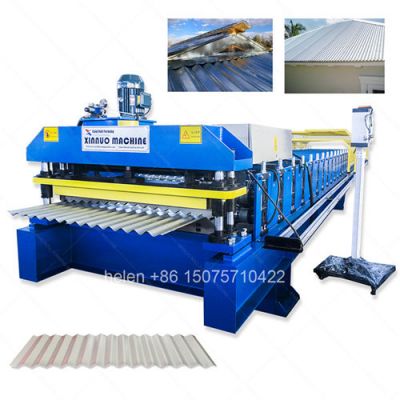
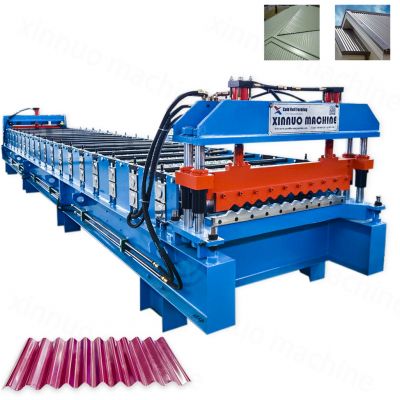
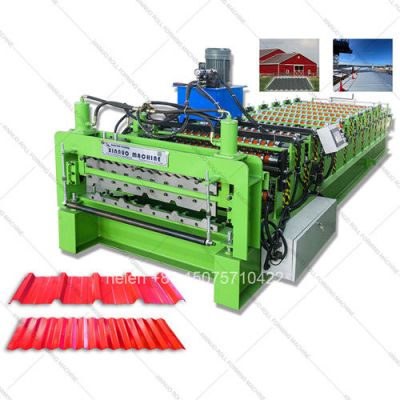
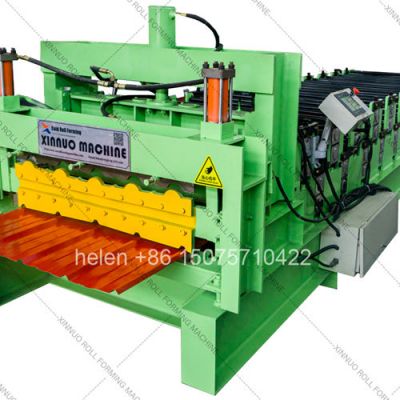
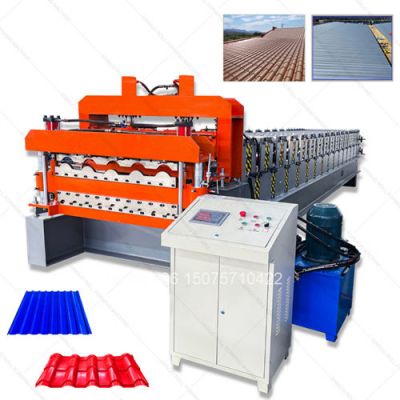
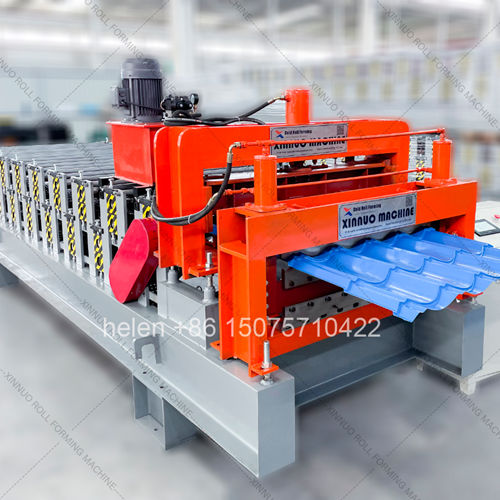
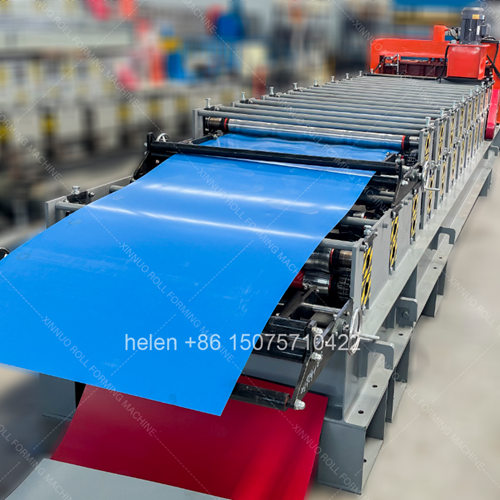
A double layer glazed tile and IBR sheet metal roll forming machine is typically specified on its forming performance and then installed into whatever space happens to be available. That sequence produces a working line that forms sheets perfectly well but runs below its potential output, because the constraint on a two-deck machine is rarely the forming operation itself. It is the arrangement around the machine: where coil is stored, how far it must be moved, where finished sheets are stacked, whether the forklift route crosses the operator's path, and how often the line is stopped to switch decks or change colour.
This page addresses the planning decisions that determine whether a well-built machine actually delivers its rated output in service. It covers the floor area a line of this type genuinely requires, the material flow path, the batching strategies that reduce unproductive changeover time, the identification of the true bottleneck in a two-deck operation, and the safety and manning arrangements that suit the configuration.
| Zone | Recommended Provision | Purpose and What Happens If It Is Underprovided |
|---|---|---|
| Machine footprint | Approximately 2.5 m wide across the full line length | The forming machine, decoiler, shear, and control cabinet. This is the irreducible minimum and cannot be compressed on either side. |
| Line length | Approximately 18 to 22 m from decoiler rear to run-out table end | Determined by roller station count and run-out length. Longer run-out is required where long sheets are produced. |
| Clearance each side of the machine | 1.5 to 2 m on the operator side, 1 m on the far side | Operator access for monitoring, adjustment, and sheet inspection. Insufficient clearance forces operators to work at unsafe proximity to moving material. |
| Coil staging area | Sufficient for several coils, with forklift access from one end only | Coils positioned beside the decoiler must be moved twice, which is both slower and more damaging to coil edges than organised staging. |
| Finished sheet stacking area | Proportional to the longest sheet produced and the batch size held before dispatch | An undersized stacking area forces sheets onto the floor, where they are scratched, and blocks the run-out table. |
| Forklift and pedestrian routes | Forklift route separated from the operator walkway wherever the building allows | A shared route puts a moving forklift and an operator working near the shear in the same space. |
| Maintenance access | Clear access to the drive side, the hydraulic power pack, and the shear for servicing | Blocked access converts routine lubrication into a production stoppage, which discourages routine maintenance from being performed at all. |
| Control cabinet clearance | Working space in front of the cabinet door and clear airflow behind it | A cabinet that cannot be fully opened prevents inspection and fault finding. Restricted airflow causes overheating and shortens controller life. |
| Sequence | Stage | Flow Principle |
|---|---|---|
| 1 | Coil storage | Positioned so that coil is delivered to the decoiler without passing through the forming area or crossing the operator walkway |
| 2 | Coil loading | Loaded from the storage side directly onto the decoiler mandrel; loading path must not require the machine to be stopped while a forklift crosses the line |
| 3 | Entry and deck selection | Material enters once and is routed to the selected deck; the operator performs deck selection from a fixed position rather than moving along the line |
| 4 | Roll forming | Continuous one-way travel through the selected roller set; material direction never reverses at any point in the line |
| 5 | Pitch stamping | Applied in-line on the glazed tile deck only; does not require a separate handling step |
| 6 | Cutting | Shearing occurs in-line without stopping the material; finished sheet continues onto the run-out table |
| 7 | Stacking and collection | Sheets collected at the end of the run-out table and moved to dispatch or further processing |
| 8 | Dispatch staging | Positioned beyond the collection point so that collected sheets do not obstruct the run-out table as the next batch is produced |
The underlying principle is that material should travel in one direction only, from coil to dispatch, and that no handling step should require the material to be moved back past the machine. Configurations that force coil or finished sheets to cross the forming line create interference between material handling and production, and typically cause the machine to be stopped more often than the forming operation itself requires.
| Batching Basis | Changeover Avoided | Practical Guidance |
|---|---|---|
| Batch by deck | Deck changeover, approximately 5 to 15 minutes each | Group all glazed tile orders together and all IBR orders together rather than alternating between them as orders arrive. On a typical day this alone can eliminate several changeovers. |
| Batch by colour | Coil change, approximately 5 to 15 minutes each | Within each deck batch, sequence orders by colour rather than by delivery date. Three colours run in three blocks instead of six changes. |
| Batch by gauge | Coil change plus possible roller gap check | Gauge changes on the same profile may require gap verification, so grouping by gauge avoids repeated checking. |
| Batch by profile | Deck changeover and tooling verification | Where a deck can produce more than one profile or tile pattern, run each pattern as a continuous block. |
| Sheet length | Effectively no changeover cost | Length is entered at the control panel. Unlike colour, gauge, or deck, length variation within a batch costs almost nothing, so orders should not be resequenced to group lengths. |
A practical illustration makes the benefit clear. A shift containing six orders split across two decks and three colours, run in arrival order, might require five or six changeovers of roughly ten minutes each — approximately one hour of a typical shift, or roughly twelve percent of available production time. The same six orders grouped into two deck blocks and three colour blocks within them require three changeovers, recovering most of that hour without any change to the machine, the material, or the specification.
| Potential Bottleneck | Symptom | Action |
|---|---|---|
| Manual sheet collection | Operator cannot keep pace with the run-out table; sheets accumulate and the line is stopped repeatedly | The most common bottleneck in practice. Resolve by adding stacking assistance rather than by reducing line speed, which sacrifices output unnecessarily. |
| Cutting cycle at short sheet lengths | Output falls noticeably when short sheets are produced, even though forming speed is unchanged | At short lengths, cutting cycles become frequent relative to forming time. Grouping long sheets into separate batches allows the line to run at its natural rhythm for longer periods. |
| Changeover frequency | Machine idle time is high despite acceptable forming speed | Address through batching strategy rather than through machine modification. |
| Coil change frequency | Frequent stops for coil loading, particularly with small orders in varied colours | Larger coils or faster decoiler expansion reduce this; so does batching by colour. |
| Material supply | Machine waits for coil to arrive from storage | Hold a buffer of each colour and gauge in the staging area rather than in a distant store. |
| Forming speed | Rarely the binding constraint on a two-deck line producing mixed orders | Where it is genuinely limiting, the correct response is a larger motor and additional forming rows, which is a specification change rather than a planning one. |
| Consideration | Requirement |
|---|---|
| Emergency stop positions | Accessible from the entry end, the control position, and the discharge end, so that the line can be stopped from wherever the operator happens to be |
| Guarding of drives | Chain and sprocket assemblies enclosed, with inspection provision for monitoring chain condition during operation |
| Control position | Positioned with sight of the material entry, the selected deck, and the shear — the three points where intervention is most often required |
| Access during operation | A defined no-go zone along the forming decks while the line is running, with access only after the line is stopped and isolated |
| Forklift and pedestrian separation | Marked walkways and separate forklift routes wherever the building geometry permits |
| Shearing zone | Clear marking and guarding at the shear, which is the point of highest injury risk on the line |
| Isolation for maintenance | A lockable isolator for the main motor and the hydraulic power pack, so both can be positively isolated before any work |
| Ceiling and lighting | Adequate light along the full line, since surface defects on pre-painted sheets are most easily detected under good directional light |
| Operating Pattern | Operating Staff | When It Applies |
|---|---|---|
| Single operator | One | Standard arrangement for a double layer machine. One operator manages deck selection, parameter entry, coil changes, and sheet collection where sheet volume is moderate. |
| Operator plus assistant | Two | Appropriate where output volume makes manual sheet collection the limiting factor, or where long sheets require two people to handle safely. |
| Operator plus material handler | Two, different roles | Appropriate where coil supply and finished sheet movement compete for the operator's time. The handler manages material; the operator manages the machine. |
| Multi-shift operation | Per shift | Where demand justifies it. Handover procedure should include the current deck, the profile being run, parameters in use, and any defect observed during the shift. |
| Parameter | Standard Range |
|---|---|
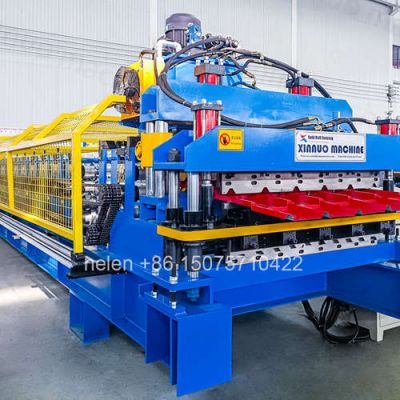
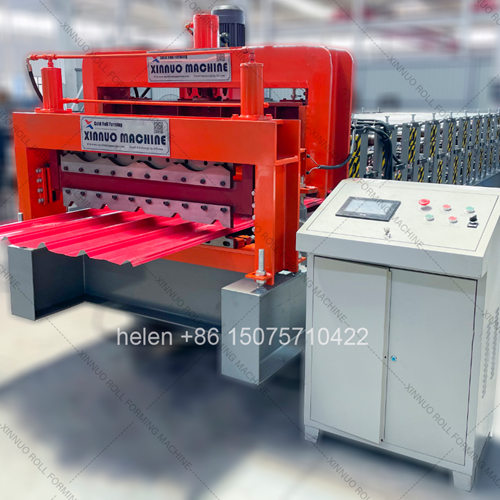
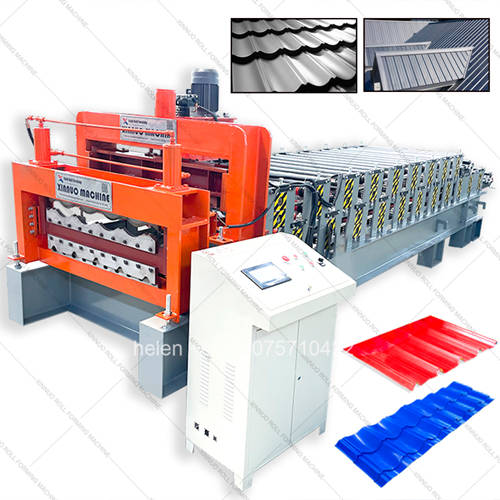
| Machine configuration | Two forming decks stacked vertically in one frame; glazed tile deck with pitch stamping plus IBR deck |
| IBR deck profiles | Trapezoidal, rib heights from approximately 28 mm to 43 mm depending on effective width |
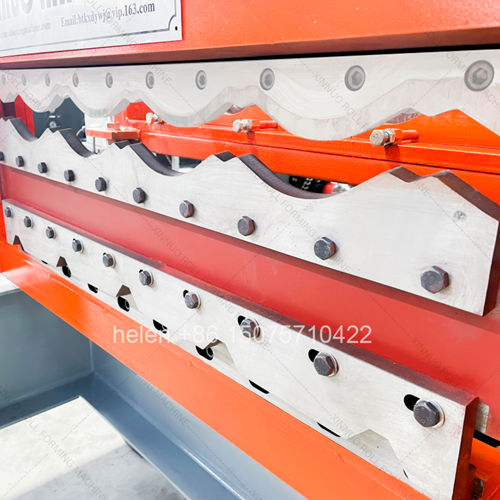
| Glazed tile deck | Pitch-stamping deck, cam-driven or servo-driven, with pattern-specific stamping die |
| Main frame grade | 300H, 350H, 400H, or 450H welded H-section steel selected against combined deck weight |
| Forming rows per deck | 11 – 18 rows depending on profile family and rib depth |
| Roller material | 45# forged carbon steel, CNC turned, ground, hard chrome plated to HRC 58 – 62 |
| Shaft | Φ75 mm or Φ80 mm solid steel, centerless ground, dual-row self-aligning bearings |
| Transmission | Duplex roller chain with hardened sprockets and selector clutch for deck engagement |
| Main motor | 5.5 kW, 7.5 kW, or 11 kW with variable frequency drive |
| Hydraulic station | 4.0 kW independent power pack with air-cooled oil radiator |
| Forming speed | 8 – 20 m/min; the pitch-stamping deck sets the effective ceiling |
| Material capability | PPGI, PPGL, galvanized, aluminium-zinc coated, and pre-painted aluminium coil; 0.30 – 0.80 mm |
| Cutting system | Hydraulic post-cut shear, Cr12MoV blades at HRC 60 – 62 |
| Cut length tolerance | ±1.5 mm |
| Control system | PLC with colour touchscreen HMI and independent recipe banks per deck |
| Line length | Approximately 18 – 22 m including decoiler and run-out table |
| Deck changeover time | Approximately 5 – 15 minutes |
| Electrical supply | 380 V / 50 Hz / 3-phase standard; alternative voltages and frequencies by destination |
| Certification | CE marking and ISO 9001:2015 compliant manufacturing |
Coil loading, deck selection at the entry guide, roll forming on the selected deck, glazed tile pitch stamping where that deck is active, length measurement, hydraulic cutting, and discharge to the run-out table follow the established sequence, with deck changeover completed in minutes and no disturbance to either roller set.
Hebei Xinnuo is a professional cold roll forming machinery manufacturer with 20+ years of experience. We specialize in C/Z purlin machines, roof panel roll formers, floor deck machines, and custom profile solutions — exported to 50+ countries worldwide.