helen@hbxinnuorollforming.com
- Coil quality decides finished sheet quality more than machine settings do
- IBR deck forms deep ribs and demands high coating flexibility
- Glazed tile deck stamps discrete steps and needs consistent thickness
- Coil thickness variation shifts roller gap and stamping force together
- Substrate and coating choice should follow local corrosion conditions
- Feed width shared across both decks simplifies coil inventory
- Incoming coil inspection prevents defects that cannot be corrected later
Operators frequently attribute sheet defects to the machine: a wavy edge, a cracked rib, an inconsistent tile step, a colour that looks wrong on the roof. In practice a large share of these defects originate in the coil rather than in the tooling, and no amount of roller adjustment will correct them. A double layer glazed tile and IBR metal roofing machine places two quite different forming demands on the same material: the IBR deck bends the strip through deep trapezoidal ribs at 28 to 43 mm, while the glazed tile deck forms the base profile and then stamps discrete steps into it. Material that suits one deck may be marginal on the other, which makes coil specification a joint decision rather than a single one.
This page sets out the coil properties each deck actually requires, how coating and substrate selection should follow the local corrosion environment, how gauge choice interacts with both decks, and what to verify when coil arrives at the factory. It is written for buyers and production managers who want to prevent defects rather than chase them after the sheets have been formed.
| Coil Property | IBR Deck | Glazed Tile Deck |
|---|---|---|
| Forming severity | High. Deep trapezoidal ribs require the material to bend sharply at the rib corners through 14 to 18 progressive stations. | Moderate for the base profile, but the pitch-stamping operation applies a discrete deformation at each tile step rather than a continuous bend. |
| Coating flexibility demanded | High at rib corners. A coating with limited elongation will crack at the rib base even when the profile dimensions are correct. | Very high at the tile step edges, where the stamping operation concentrates deformation over a short distance. |
| Thickness consistency demanded | High. Roller gaps are set against the actual gauge, so a coil running lighter than nominal changes the forming condition across the whole deck. | Very high. Stamping force is calibrated to thickness, so gauge variation shows up directly as variation in tile step depth. |
| Surface sensitivity | High. Scratch lines along a rib face are immediately visible on an installed roof. | Very high. The tile pattern is bought for its appearance, so any surface marking defeats the purpose of the product. |
| Preferred gauge range | Wider range acceptable, from 0.30 mm up to 0.80 mm with appropriate motor and frame selection. | Narrower range preferred, generally 0.30 to 0.60 mm, because thicker material demands higher stamping force and increases die loading. |
| Consequence of a marginal coil | Rib cracking, inconsistent rib height, edge waviness, or dimensional drift. | Inconsistent step depth, pitch appearance variation, coating damage at step edges, and visible sheet-to-sheet differences. |
| Substrate | Corrosion Performance | Suitable Environment | Practical Consideration |
|---|---|---|---|
| Hot-dip galvanized | Standard zinc protection; cut edges rely on sacrificial protection | Inland and moderately humid locations away from the coast | Most economical option and the most widely stocked coil type in most markets |
| Aluminium-zinc coated | Better cut-edge and long-term corrosion performance than plain galvanized | Industrial atmospheres and higher-humidity regions | Harder coating surface, which increases roller wear slightly but improves roof service life materially |
| Zinc-aluminium-magnesium coated | Improved edge protection compared with conventional coatings | Coastal districts and aggressive environments | Higher coil cost, justified where roof replacement cycles are short due to corrosion |
| Pre-painted aluminium | No rust risk from the substrate at all | Marine frontage, island construction, high-salinity environments | Softer than steel, so forming force requirements differ and gauge selection should be confirmed against the tooling |
| Coating System | Typical Thickness | Forming Behaviour | Durability Position | Best Suited To |
|---|---|---|---|---|
| Polyester | 15 – 25 µm | Good flexibility; forms most profiles without cracking | General purpose, suitable for moderate environments | High-volume roofing where cost position matters most |
| Silicone-modified polyester | 20 – 25 µm | Similar forming behaviour to polyester | Improved colour and chalk resistance over polyester | Commercial and institutional buildings where appearance is specified |
| Polyvinylidene fluoride | 25 – 35 µm | Less flexible than polyester; requires care on tight radii and deep ribs | Best colour retention and weathering performance | Architecturally specified projects and coastal buildings |
| Polyurethane | 20 – 30 µm | Good balance of flexibility and hardness | Strong resistance to abrasion and marking | Applications where handling and transport damage is a concern |
| Plastisol | 100 – 200 µm | Thick film; not suited to tight bend radii | Very high durability and impact resistance | Wall cladding and low-pitch applications rather than deep-rib profiles |
Where a single coil type must serve both decks, polyester on a galvanized or aluminium-zinc substrate is the most commonly workable compromise. Where the glazed tile deck is producing decorative product for premium projects, a higher-performance coating is usually justified on that deck specifically, which means holding two coil specifications rather than one.
| Gauge | Typical Application | Behaviour on the IBR Deck | Behaviour on the Glazed Tile Deck |
|---|---|---|---|
| 0.30 – 0.35 mm | Economy roofing, fencing, temporary structures | Forms readily; risk of dimpling and handling damage rather than forming difficulty | Forms and stamps easily; risk of step deformation under handling after stamping |
| 0.36 – 0.42 mm | General residential roofing | Comfortable forming range with good profile definition | Well suited to tile stamping with consistent step depth |
| 0.43 – 0.50 mm | Residential and light commercial roofing | Good structural performance with acceptable forming load | Upper end of the comfortable stamping range; verify die loading at this gauge |
| 0.51 – 0.60 mm | Industrial roofing and longer spans | Requires adequate motor rating and row count for clean forming | Requires increased stamping force; check that the die and press are specified for it |
| 0.61 – 0.80 mm | Structural and heavy-duty applications | Demands a heavier frame and higher motor rating; deep ribs become difficult | Generally outside the preferred range for pitch stamping |
| Strategy | Advantage | Trade-Off |
|---|---|---|
| Shared feed width across both decks | One coil specification serves both production lines; inventory simplified and coil change time reduced | May constrain the profile width selection on one deck to match the other |
| Different feed width per deck | Each deck is tooled to the width that best suits its own market standard | Two coil specifications held in stock, and two purchasing streams to manage |
| Narrow feed width range held across both | Reduces total inventory value and simplifies storage | Limits the range of effective profile widths that can be offered to customers |
| Wide feed width capability retained | Maximum flexibility to quote wide-format profiles as market demand shifts | Higher inventory value tied up in coil, and wider storage requirements |
Coil faults that reach the machine cannot be corrected by it. Every incoming coil should be checked against these points before it is loaded onto the decoiler.
| # | Inspection Point | What to Check and Why It Matters to This Machine |
|---|---|---|
| 1 | Mill certificate present | Confirms substrate, coating mass, and mechanical properties. Without it, nothing else about the coil can be relied upon. |
| 2 | Nominal thickness confirmed | Measured at several points across the strip. Roller gaps are set against actual gauge on both decks. |
| 3 | Thickness consistency along the coil | Variation within a coil produces varying tile step depth and varying IBR rib height along the same sheet. |
| 4 | Coil width verified | Confirms the feed width the tooling was designed for, and that the side guides will centre the strip correctly. |
| 5 | Coating thickness checked | Thin coating is the most common cause of a sheet that appears correct but weathers prematurely on the roof. |
| 6 | Colour matched to previous batches | Batch-to-batch colour variation is highly visible on an installed roof where sheets from two coils sit side by side. |
| 7 | Surface inspected for defects | Dents, scratches, coating runs, or roll marks present in the coil pass through the machine unchanged. |
| 8 | Edge condition checked | Damaged coil edges form poorly, mark the guides, and produce sheet edges that are unsuitable for overlapping. |
| 9 | Coil identification and traceability recorded | Allows a defect traced on a finished sheet to be linked back to a specific coil and supplier. |
| 10 | Storage condition verified | Coil stored outdoors or in damp conditions can develop edge corrosion before it is ever formed. |
| Practice | Reason |
|---|---|
| Store indoors, off the floor | Ground moisture and condensation cause edge corrosion on coated coil long before it reaches the forming line |
| Use racks or pallets supporting the full coil | Coil supported only at two points deforms and damages the outer wraps |
| First in, first out | Prevents older coil sitting in storage while newer coil is consumed, which is how batch colour mismatch appears on a roof |
| Avoid stacking coils directly on each other | Direct stacking dents the outer wraps and damages the coating at the contact line |
| Handle with proper coil handling equipment | Forklift tynes contacting the coil face are a common and entirely avoidable source of coating damage |
| Keep edge protection in place until loading | Edge damage occurs mainly during movement and storage rather than during forming |
| Record coil location and batch | Allows the correct batch to be selected when a customer requires colour consistency with an earlier order |
| Criterion | Why It Matters for a Two-Deck Production Line |
|---|---|
| Thickness control | Both decks depend on accurate gauge, so a supplier with inconsistent thickness creates defects on both product lines simultaneously |
| Coating adhesion quality | Poorly adhered coating can delaminate at the tile step edge or at the IBR rib corner, producing a defect that is not repairable |
| Colour batch consistency | Determines whether sheets from successive deliveries can be installed on the same roof without visible mismatch |
| Mechanical property consistency | Yield strength variation changes spring-back, so a supplier with variable properties shifts the forming condition on both decks |
| Width accuracy | Width variation affects strip centring at the entry guide and therefore tracking through both decks |
| Certification reliability | Mill certificates that do not reflect the delivered material remove the basis for any quality dispute |
| Lead time and minimum order | Determines the inventory buffer required, which in turn determines working capital tied up in coil |
| Availability of both substrate types | Where the two decks serve different corrosion environments, a supplier able to serve both avoids splitting purchasing across two sources |
| Parameter | Standard Range |
|---|---|
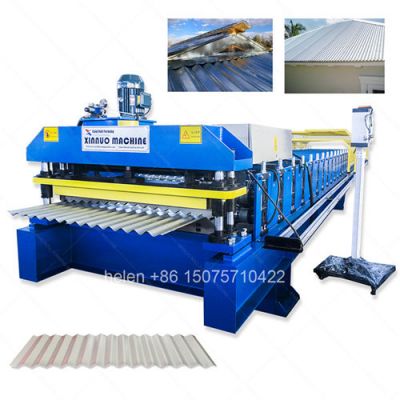
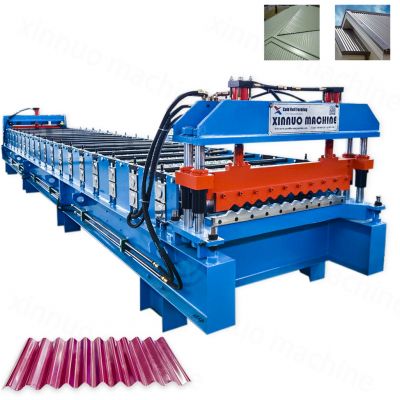
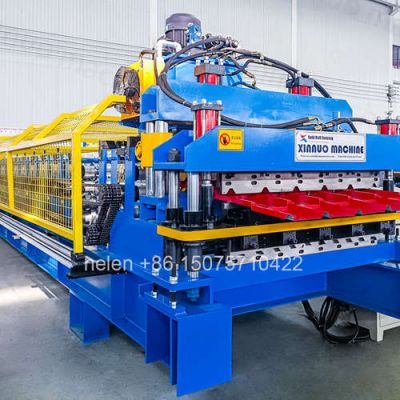
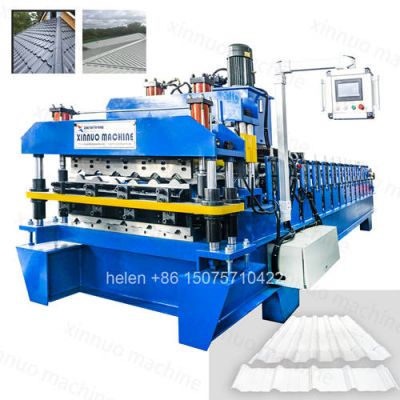
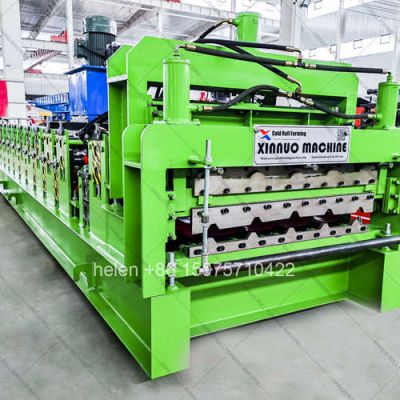
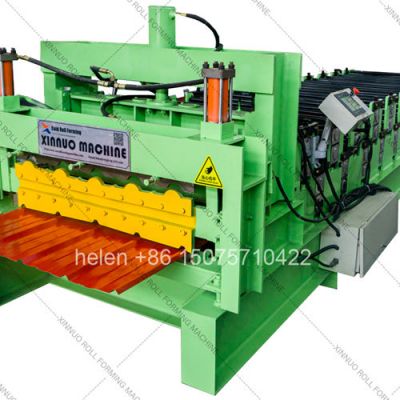
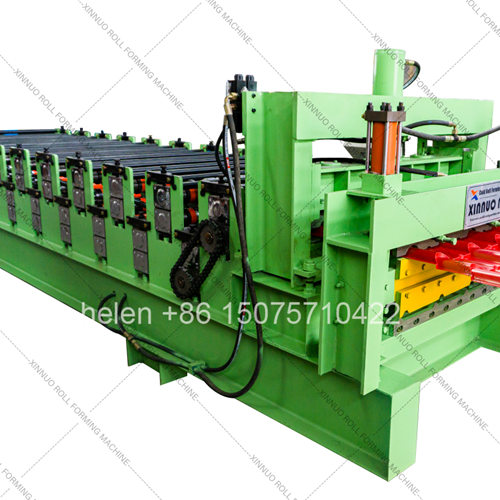
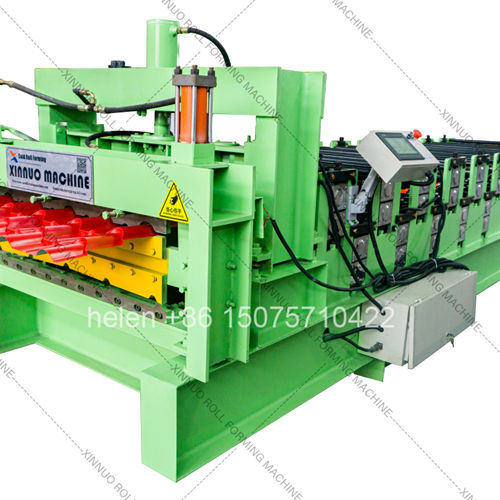
| Machine configuration | Two forming decks stacked vertically in one frame; glazed tile deck with pitch stamping plus IBR deck |
| IBR deck profiles | Trapezoidal, rib heights from approximately 28 mm to 43 mm depending on effective width |
| Glazed tile deck | Pitch-stamping deck, cam-driven or servo-driven, with pattern-specific stamping die |
| Main frame grade | 300H, 350H, 400H, or 450H welded H-section steel selected against combined deck weight |
| Forming rows per deck | 11 – 18 rows depending on profile family and rib depth |
| Roller material | 45# forged carbon steel, CNC turned, ground, hard chrome plated to HRC 58 – 62 |
| Shaft | Φ75 mm or Φ80 mm solid steel, centerless ground, dual-row self-aligning bearings |
| Transmission | Duplex roller chain with hardened sprockets and selector clutch for deck engagement |
| Main motor | 5.5 kW, 7.5 kW, or 11 kW with variable frequency drive |
| Hydraulic station | 4.0 kW independent power pack with air-cooled oil radiator |
| Forming speed | 8 – 20 m/min; the pitch-stamping deck sets the effective ceiling |
| Material compatibility | PPGI, PPGL, galvanized, aluminium-zinc coated, zinc-aluminium-magnesium coated, and pre-painted aluminium coil |
| Gauge capability | 0.30 – 0.80 mm overall; 0.30 – 0.60 mm preferred on the glazed tile deck |
| Cutting system | Hydraulic post-cut shear, Cr12MoV blades at HRC 60 – 62 |
| Cut length tolerance | ±1.5 mm |
| Control system | PLC with colour touchscreen HMI and independent recipe banks per deck |
| Electrical supply | 380 V / 50 Hz / 3-phase standard; alternative voltages and frequencies by destination |
| Certification | CE marking and ISO 9001:2015 compliant manufacturing |
Coil loading, deck selection at the entry guide, roll forming on the selected deck, glazed tile pitch stamping where that deck is active, length measurement, hydraulic cutting, and discharge to the run-out table follow the established sequence, with deck changeover completed in minutes and no disturbance to either roller set.
Hebei Xinnuo is a professional cold roll forming machinery manufacturer with 20+ years of experience. We specialize in C/Z purlin machines, roof panel roll formers, floor deck machines, and custom profile solutions — exported to 50+ countries worldwide.