helen@hbxinnuorollforming.com
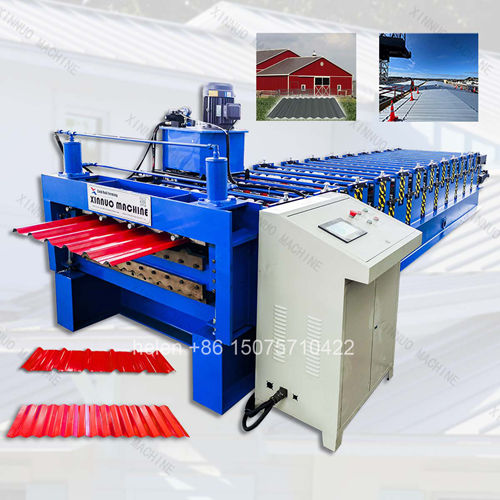
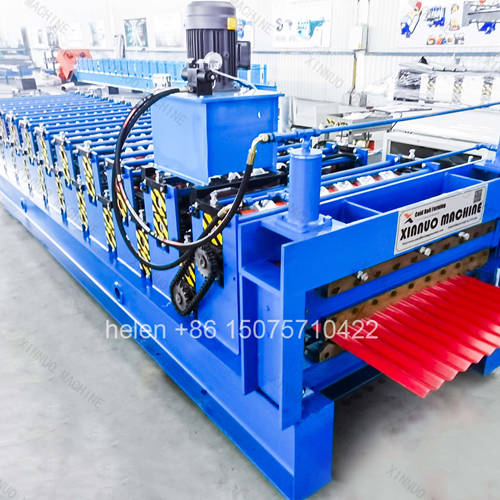
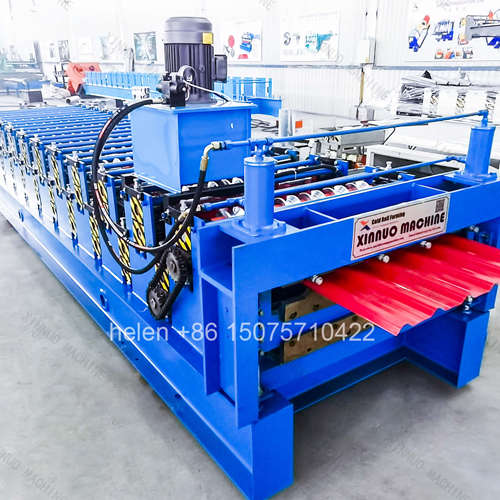
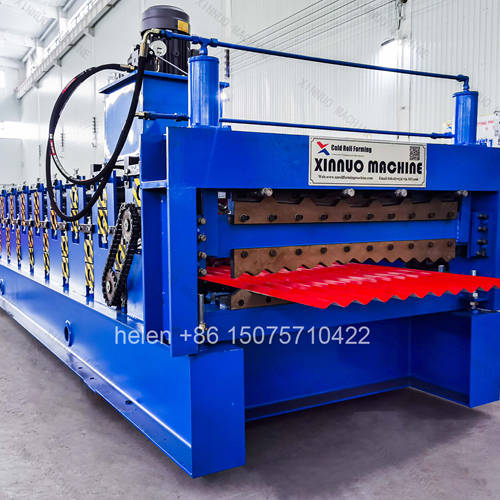
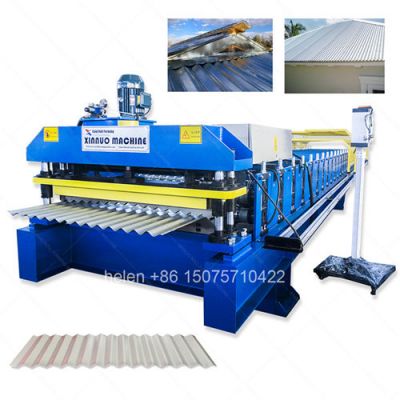
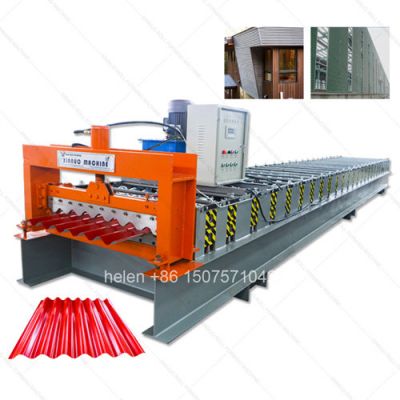
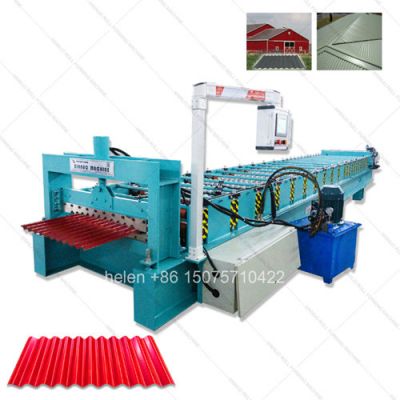
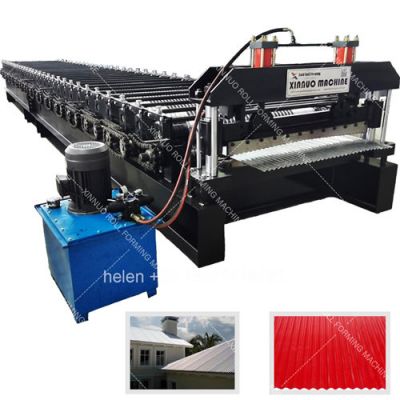
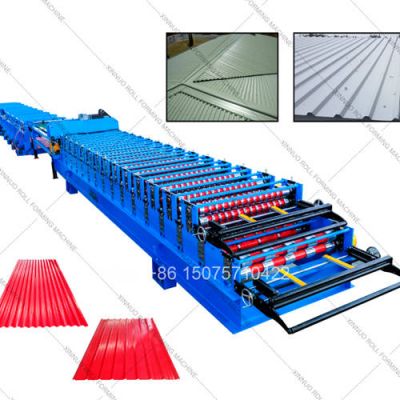
One machine produces two roofing sheet profiles for building construction
Lower roller deck forms corrugated wave sheets upper deck forms IBR sheets
Sequential roller stations progressively shape flat coil into finished roofing
PLC touchscreen programs roofing sheet length batch quantity and line speed
Hydraulic flying shear cuts formed roofing sheet at preset length on the fly
Hard chrome roller coating protects zinc and paint coating on steel surface
Entire roofing sheet production line shipped as single container load package
One machine produces two roofing sheet profiles for building construction Lower roller deck forms corrugated wave sheets upper deck forms IBR sheets Sequential roller stations progressively shape flat coil into finished roofing PLC touchscreen programs roofing sheet length batch quantity and line speed Hydraulic flying shear cuts formed roofing sheet at preset length on the fly Hard chrome roller coating protects zinc and paint coating on steel surface Entire roofing sheet production line shipped as single container load package 3. Product Introduction (URL Version)
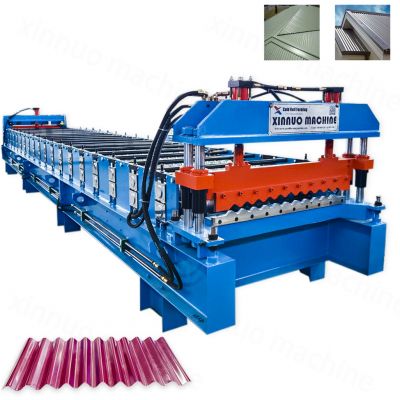
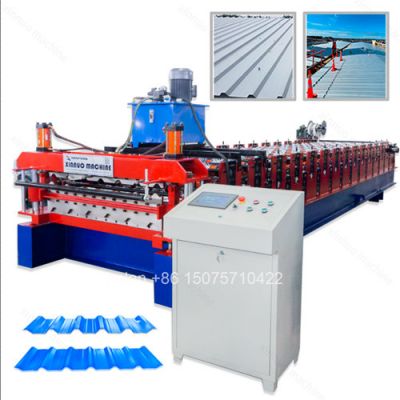
This double layer roofing sheet machine is a complete industrial production system that manufactures two different roofing sheet profiles from a single integrated equipment platform. The machine houses two independent roller forming decks vertically stacked within one welded structural steel chassis. The lower deck produces traditional corrugated wave roofing sheets — the classic sinusoidal profile that has been the world's most accessible and widely deployed roofing material for residential homes, agricultural buildings, and community structures across every developing construction market. The upper deck produces IBR (Inverted Box Rib) trapezoidal roofing sheets — a structural roofing profile engineered with deep stiffening ribs that deliver the superior span strength, wind uplift resistance, and weather protection performance required by industrial warehouses, commercial building envelopes, school halls, and cyclone-resistant construction.
| Roofing Sheet Characteristic | Corrugated Wave Roofing Sheet | IBR Trapezoidal Roofing Sheet |
|---|---|---|
| Sheet Cross-Section Design | Continuous sinusoidal wave pattern, uniform curvature radius | Deep trapezoidal ribs, flat valley floor pans between stiffeners |
| Effective Cover Width | 660mm to 1000mm per roofing sheet | 762mm to 1100mm per roofing sheet |
| Profile Depth | 12–18mm wave crest-to-trough amplitude | 28–43mm rib crown height above valley plane |
| Waves or Ribs per Sheet | 5, 7, 9, or 11 wave repetitions | 4, 5, or 6 structural ribs |
| Sheet Length Capability | 1.0m to 14.0m per roofing sheet | 1.0m to 14.0m per roofing sheet |
| Side Lap Joint Detail | Minimum 1.5-wave weathertight overlap | Single overlap, optional anti-capillary groove |
| Purlin Span Distance | Up to 2.5m standard spacing | Up to 4.5m standard spacing |
| Production Phase | Stations | Steel Strip Transformation |
|---|---|---|
| Strip Reception | Station 1 | Flat steel strip feeds into the first roller pair from the decoiler at controlled tension. Entry rollers guide and laterally constrain the strip to establish the roofing sheet centerline. Edge flange formation begins as material enters the production sequence |
| Bend Initiation | Stations 2–5 | Contoured rollers apply precise bending force at the positions where wave crests or sheet ribs will develop. Approximately 5–10 degrees per station. Steel remains within safe forming limits, protecting the galvanized coating from stress micro-cracking |
| Progressive Shaping | Stations 6–12 | Wave troughs deepen and crests tighten for corrugated roofing sheets; rib walls steepen and valley floors flatten for IBR roofing sheets. Seven consecutive stations evenly distribute total plastic deformation to maintain consistent sheet gauge thickness through all profile areas |
| Final Sheet Geometry | Stations 13–16 | Last active forming rollers establish the finished roofing sheet dimensions — wave amplitude and pitch for corrugated output; rib height, valley width, and side lap profile for IBR output. Springback compensation is engineered into the roller design |
| Calibration Pass | Stations 17–18 | Final sizing roller pair removes any residual dimensional deviation. The roofing sheet achieves its complete engineered cross-section verified to ±0.5mm of the profile specification drawing across the full sheet width |
| Tooling Feature | Corrugated Roofing Sheet Deck | IBR Roofing Sheet Deck |
|---|---|---|
| Station Count | 13–16 pairs of upper and lower rollers | 14–18 pairs of upper and lower rollers |
| Roller Material Grade | 45# forged medium carbon steel, ultrasonic inspected | 45# forged medium carbon steel, ultrasonic inspected |
| CNC Machining Tolerance | Sinusoidal wave contour turning, geometry ±0.05mm | Trapezoidal rib contour turning, geometry ±0.05mm |
| Hardening Method | Gas carburizing furnace, oil quench, surface HRC 58–62 | Gas carburizing furnace, oil quench, surface HRC 58–62 |
| Chrome Surface Finish | Industrial hard chrome, 0.05mm minimum, mirror polish | Industrial hard chrome, 0.05mm minimum, mirror polish |
| Shaft Specification | Φ75–Φ80mm 40Cr alloy, h7 tolerance, sprocket keyway | Φ75–Φ80mm 40Cr alloy, h7 tolerance, sprocket keyway |
| Bearing Support | Split pillow block, spherical roller, Zerk grease fitting | Split pillow block, spherical roller, Zerk grease fitting |
| System | Construction Detail |
|---|---|
| Welded Frame Structure | Heavy channel steel beams and cross-braced 300H–400H H-beam columns. Post-weld thermal stress-relief annealed. Bearing mounting pads precision machined after heat treatment to guarantee exact shaft axis parallelism through all roller stations in both roofing sheet decks |
| Motor and Gearbox | 5.5kW or 7.5kW AC induction motor (4-pole, IP54) coupled to worm-type dual-output speed reducer with oil-bath lubrication. Ratios 1:40 or 1:59. Each output shaft independently drives one roofing sheet deck through separate heavy-duty double-row roller chain circuits with hardened alloy sprockets and individual chain tension adjustment |
| Hydraulic Cut-Off System | 4.0kW gear pump motor, 80L reservoir with filtration and temperature monitor. Flying shear carriage on linear guide rails with pneumatic roofing sheet clamp. Cr12MoV blade set vacuum heat treated to HRC 60–64, profile-ground to match sheet cross-section for clean cuts that preserve sheet geometry |
| PLC Digital Control | Siemens S7-1200, Delta DVP, or Mitsubishi FX3U PLC with VFD inverter for stepless speed control. 7-inch or 10-inch color touchscreen HMI with multi-language interface and recipe storage. Rotary encoder on final shaft for real-time sheet length measurement with digital feedback correction. Mechanical limit switches plus three emergency stop pushbuttons along the line |
| No. | Equipment | Function |
|---|---|---|
| 1 | Hydraulic Mandrel Uncoiler | Holds steel coil on expanding hydraulic jaws, 5-ton or 8-ton capacity. Adjustable brake system ensures uniform strip feed tension for consistent roofing sheet quality from coil start to finish |
| 2 | Entry Guide and Pre-Shear | Side guide rollers center the strip on the machine centerline. Integrated manual guillotine squares the coil leading edge before strip enters the selected roller deck |
| 3 | Double Layer Main Roofing Sheet Unit | Lower corrugated roofing sheet deck and upper IBR roofing sheet deck in one welded frame. Pivoting diverter plate routes the strip into the active deck. Shared motor, gearbox, chain circuits, hydraulic shear, and PLC |
| 4 | Flying Hydraulic Post-Cut Shear | On cut command: pneumatic clamp grips roofing sheet → shear carriage accelerates to line speed → hydraulic cylinder drives profiled blade through sheet → blade and carriage return to home — cycle completes without production interruption |
| 5 | Digital Control Enclosure | IP54 steel cabinet with PLC, VFD, contactors, overload protectors, breakers, and terminal blocks. External touchscreen HMI for sheet length, batch count, speed, and fault diagnostics |
| 6 | Roofing Sheet Discharge Conveyor | 3m–5m free-roller receiving table with adjustable legs. Supports finished roofing sheets for manual stacking, steel strapping, and warehouse transport |
| Specification | Data |
|---|---|
| Compatible Coil Materials | Hot-dip galvanized steel (Z60–Z275 g/m²), pre-painted GI (PPGI PE/SMP/PVDF), aluzinc/Galvalume (AZ150–AZ200), cold-rolled steel, aluminum alloy (1100/3003) |
| Sheet Gauge Processing Range | 0.25mm to 0.80mm (gauge 30 through gauge 20) |
| Yield Strength Limit | 200 MPa to 400 MPa (mild through structural steel) |
| Production Line Speed | 10–18 linear meters per minute, infinitely variable via VFD |
| Sheet Cut Length Accuracy | ±1.0mm via rotary encoder feedback to PLC auto-correction |
| Profile Changeover Method | Manual diverter plate; corrugated to IBR in 10–15 minutes |
| Electrical Supply | 380V 50Hz 3-phase standard; custom voltage/frequency per destination |
| Total Motor Power | Approximately 10–12 kW (drive 5.5/7.5kW + pump 4.0kW) |
| Machine Dimensions (L×W×H) | Approximately 7.0–8.0m × 1.4–1.6m × 1.7–2.0m per configuration |
| Machine Net Weight | 5.0–7.5 metric tons per profile and frame specification |
| Uncoiler Rating | 5 metric tons standard, 8 metric tons heavy duty |
| Coil Inner Bore | Φ508mm standard; Φ610mm with adapter sleeve |
| Step | Operation | Description |
|---|---|---|
| 1 | Coil Installation | Steel coil positioned onto hydraulic uncoiler mandrel via crane or coil cart. Expansion jaws lock the coil bore. Brake resistance set for uniform strip feed tension through the entire roofing sheet production run |
| 2 | Strip Entry | Coil leading edge threaded through adjustable side guide rollers for centerline alignment. Manual pre-shear squares the coil head before strip enters the selected roller deck |
| 3 | Deck Activation | Operator sets the pivoting diverter — downward for corrugated roofing sheet production on lower deck; upward for IBR roofing sheet production on upper deck. Changeover time approximately 10 minutes |
| 4 | Sequential Roll Forming | Flat strip advances through each roller station pair in order. At every station the steel receives incremental bending until the final station delivers a complete corrugated wave roofing sheet or fully formed IBR trapezoidal roofing sheet ready for length cutting |
| 5 | Length Tracking | Rotary encoder on the final shaft sends continuous digital pulses to the PLC. Controller compares real-time accumulated count against the operator-programmed target roofing sheet length |
| 6 | Automated Cut Cycle | At target length: PLC triggers cut — pneumatic clamp grips roofing sheet → shear carriage accelerates to line speed → hydraulic cylinder drives Cr12MoV blade through sheet cross-section → blade and carriage return to home — cut completes without production stoppage |
| 7 | Sheet Stacking | Finished roofing sheet slides onto the discharge conveyor. Operator lifts each sheet and stacks onto the product pallet for steel strapping, warehousing, and customer delivery to construction sites |
| Cost Factor | Two Separate Roofing Sheet Machines | One Double Layer Roofing Sheet Machine |
|---|---|---|
| Equipment Investment | 100% — total price of two machines plus two uncoilers | Approximately 65–75% of the two-machine total |
| Workshop Floor Area | 44–70 square meters for both lines | 20–35 square meters for one line |
| Ocean Freight Cost | Two 20GP containers, two freight invoices | One 20GP or 40HQ container, one freight invoice |
| Foundation and Power | Two concrete pads, two power drops, two cable runs | One concrete pad, one power drop, one cable run |
| Workers per Shift | 3–4 operators across two lines | 1–2 operators for one line |
| Monthly Electricity | Two motors and two pumps operating | One motor and one pump — about 40% less consumption |
| Spare Parts Stock | Two complete wearing parts sets | One kit covers both roofing sheet decks |
Each completed roofing sheet machine undergoes a strict three-phase inspection before export crating. Phase one — dimensional verification: all roller gaps measured with calibrated feeler gauges against engineering tolerances; shaft runout checked with dial indicators at every bearing position; frame alignment confirmed with precision spirit levels and laser instruments. Phase two — extended dry run: machine operates at maximum rated speed without material for a minimum of four hours; bearing temperatures logged every 30 minutes with infrared thermometers; chain drive engagement inspected visually and audibly for smooth sprocket meshing; all PLC functions validated — power-up, start-stop, speed regulation, sheet length programming, batch quantity setting, recipe recall, emergency stop, and restart. Phase three — live roofing sheet production trial: factory technicians load genuine galvanized steel coil and produce 50 corrugated roofing sheets plus 50 IBR roofing sheets; every 10th sheet measured for length, profile geometry, and cut edge quality with calibrated digital instruments. Only machines passing all three phases with zero out-of-tolerance results receive export packaging authorization.
The main roofing sheet machine body receives three-layer protective export packaging: VCI anti-rust inner wrap, high-density closed-cell foam padding at all corners and machined surfaces, and UV-stabilized polyethylene outer shrink wrap. The wrapped unit is bolted to a fumigated ISPM-15 certified plywood pallet or welded steel export skid. The hydraulic uncoiler, discharge conveyor, hydraulic power pack, and electrical control cabinet are packed individually in marked fumigated wooden crates with internal foam bracing and bolted tie-downs. An accessories crate contains the operator tool kit, spare wearing parts starter pack, and complete printed technical documentation: mechanical assembly drawings, electrical schematic, PLC parameter guide, lubrication schedule, and English operation manual. Standard manufacturing lead time is 25–35 working days from deposit receipt and customer-signed profile approval drawings. Standard warranty is 12 months from the bill of lading date against material and workmanship defects.
| Option | Description and Benefit |
|---|---|
| Servo Motor Drive | Programmable servo drive replaces standard AC motor for controlled acceleration, enhanced sheet length precision, and reduced energy use during intermittent production |
| Automatic Sheet Stacker | Motorized stacking arm transfers finished roofing sheets from discharge conveyor to aligned pallet bundles, eliminating manual sheet handling labor |
| Electric Coil Loading Cart | Battery-powered trolley on floor rails with hydraulic lift; moves steel coils up to 10 tons from storage to the uncoiler mandrel without crane dependency |
| IoT Remote Monitor | 4G cellular module transmits real-time roofing sheet production data — daily output, motor hours, fault alerts, and maintenance reminders — to a smartphone app or web dashboard |
| Custom Embossing Roller | Engraved forming roller permanently stamps a brand name, logo, or batch code into each roofing sheet during production for product identification and marketing |
| Stainless Roller Option | Full 304 or 316L stainless steel roller set for roofing sheet production in food-grade, pharmaceutical, chemical processing, or high-salinity coastal environments |
Hebei Xinnuo is a professional cold roll forming machinery manufacturer with 20+ years of experience. We specialize in C/Z purlin machines, roof panel roll formers, floor deck machines, and custom profile solutions — exported to 50+ countries worldwide.