helen@hbxinnuorollforming.com


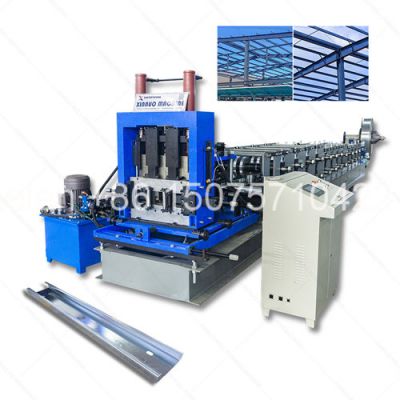
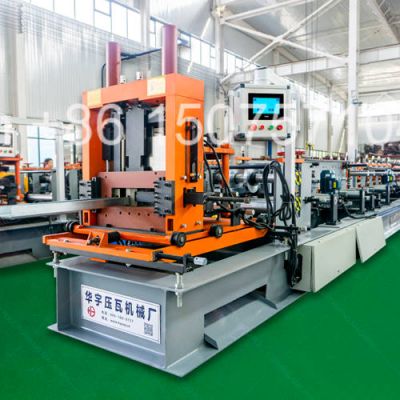
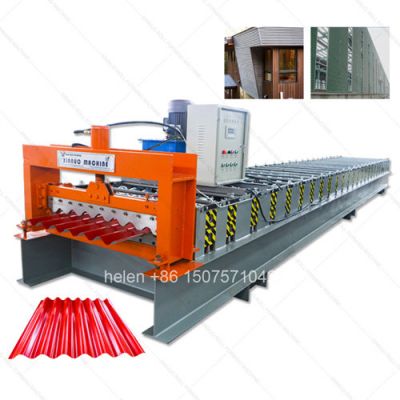
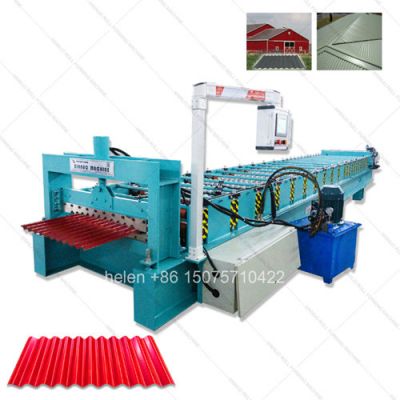
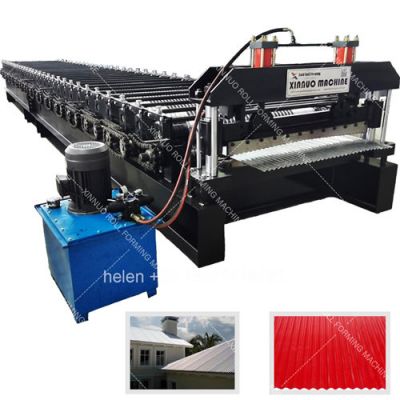
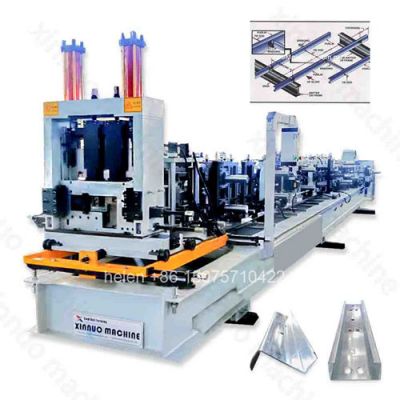
Trapezoidal open-type floor deck cold roll forming production line
Twin 11KW motor, 22-28 station progressive forming, PLC auto control
Clutch-governed dimple embossment station for concrete shear bond
Dual-cylinder hydraulic floor shear, gravity stack, 510-1025 profiles
The trapezoidal (open) floor deck profile dominates global composite floor construction — accounting for approximately 80% of all steel deck produced worldwide. Its universal adoption is not accidental: the trapezoidal geometry represents the optimal balance of structural performance, manufacturing simplicity, and construction practicality. The open rib shape is the simplest to cold roll form, the easiest to handle and install on site, and the most forgiving of minor dimensional variation — all reasons why engineers, contractors, and deck manufacturers default to trapezoidal profiles unless a specific project requirement demands the more complex dovetail alternative. This machine produces the full family of trapezoidal floor deck profiles — from light-gauge 510 type for residential mezzanines to heavy-gauge 1025 type for industrial warehouse floors — with the reliability and consistency that high-volume decking manufacturers depend on.
| Comparison Factor | Trapezoidal (Open) Deck | Re-Entrant (Dovetail) Deck | Why Trapezoidal Wins for Most Projects |
|---|---|---|---|
| Manufacturing Complexity | 22-28 forming stations. Standard progressive V-shape roller geometry. No internal mandrels. No wall inversion phase. Straightforward roller maintenance. | 32-36 forming stations. Complex two-phase roller set. Internal mandrel system at 14 stations. Wall inversion forming. Specialized maintenance skills required. | Simpler machine = faster production (10-15 m/min vs. 8-12 m/min). Lower maintenance cost. Less operator skill required. More uptime, fewer specialized spare parts. |
| Machine Investment Cost | Lower capital cost — fewer stations, standard tooling, standard drive system. 2×11KW motor sufficient for most profiles. | 25-35% higher capital cost. More stations. Specialized mandrel system. 2×15KW motor required. Extra Phase 2-4 roller sets for profile changes. | Lower entry cost enables faster payback. For a new decking manufacturer, the trapezoidal machine reaches breakeven 6-12 months sooner than a dovetail machine producing the same volume. |
| Profile Changeover Time | 2-3 hours. Only Phase 1 rollers (rows 1-16) need changing for most width changes. Phase 2 (rows 17-28) often reusable across similar profiles. | 5-6 hours. Full roller set change including mandrel system. Timing verification required for every mandrel station. Higher risk of setup errors during changeover. | Trapezoidal changeover is 3× faster. Multi-profile deck manufacturers can switch between 688, 750, and 1000 type profiles within a single shift — dovetail changeover consumes an entire shift. |
| Production Speed | 10-15 m/min standard. 15 m/min achievable for lighter gauges (0.8-1.0mm) on shorter rib depths (50-53mm). | 8-12 m/min. Speed limited by Phase 2 wall inversion stations — folding walls inward requires slower throughput to prevent material buckling. | 30-50% higher output from same floor space and labor. On 750 type panels at 1.0mm gauge: trapezoidal = 1,800m/shift vs. dovetail = 1,200m/shift. That's 50% more revenue per shift. |
| Operator Skill Requirement | Standard roll forming operator skills. Roller gap adjustment is straightforward. No specialized training beyond basic machine familiarization. | Specialized operator required — mandrel timing setup is not intuitive. Training takes 2-3 weeks vs. 3-5 days for trapezoidal operators. | Easier to hire and train operators. Lower labor cost (specialized operators command higher wages). Less dependency on single skilled individual — any trained operator can run the line. |
| Spare Parts Availability | Standard bearings, chains, sprockets — commonly available from industrial suppliers worldwide. No specialized parts. | Mandrel rollers and springs are custom-manufactured — must be ordered from machine manufacturer. Lead time 4-8 weeks for replacements. | Parts availability reduces downtime risk. A failed bearing on a trapezoidal machine is a same-day fix from local supplier. A failed mandrel spring on a dovetail machine is a week-long production stop while parts ship internationally. |
| Maximum Span (0.9mm, 130mm slab) | 2.5-3.5m unpropped (profile dependent) | 3.5-4.5m unpropped for same gauge and slab depth | For 80% of building projects, the trapezoidal span is sufficient. The additional span of dovetail deck is only needed for long-span spec projects — a smaller market segment. |
| Contractor Acceptance | Universal — every steel deck installer worldwide knows how to install trapezoidal deck. No learning curve. No resistance. | Regional — common in Europe and high-end commercial in Asia/Middle East. Not all contractors are familiar. Some refuse to bid projects specifying dovetail deck due to unfamiliarity. | Broader customer base. You can sell trapezoidal deck to any contractor. Dovetail deck limits your market to a subset of contractors — and the subset that typically demands more documentation and lower prices. |
| Profile | Coverage (mm) | Ribs | Rib Depth (mm) | Feed Width (mm) | Gauge Range | Typical Weight (kg/m²) | Target Application |
|---|---|---|---|---|---|---|---|
| T-510 | 510 | 2 | 50 | 750 | 0.8-1.0mm | 8.5-10.6 | Residential mezzanine, light commercial renovation |
| T-600 | 600 | 3 | 50 | 1000 | 0.8-1.2mm | 8.5-12.7 | Office floors, school construction, retail |
| T-688 | 688 | 2 | 76 | 1000 | 0.8-1.5mm | 10.2-19.1 | Industrial mezzanine, warehouse, medium span |
| T-720 | 720 | 3 | 51 | 1000 | 0.8-1.2mm | 8.7-13.0 | Apartment, hotel, residential multi-story |
| T-750 | 750 | 3 | 53 | 1000 | 0.8-1.5mm | 9.0-16.8 | Factory floors, logistics centers, general commercial |
| T-780 | 780 | 3 | 50 | 1000 | 0.8-1.2mm | 8.5-12.7 | Standard commercial, mixed-use buildings |
| T-870 | 870 | 3 | 60 | 1250 | 0.8-1.5mm | 9.8-18.3 | Shopping malls, airport terminals, long span |
| T-900 | 900 | 3 | 75 | 1250 | 0.8-1.5mm | 10.5-19.6 | High-rise commercial, hospital, institutional |
| T-915 | 915 | 3 | 76 | 1250 | 0.8-1.5mm | 10.8-20.2 | Parking structures, transfer slabs, long-span commercial |
| T-990 | 990 | 3 | 50 | 1250 | 0.8-1.2mm | 8.5-12.7 | Wide-coverage commercial, fast installation priority |
| T-1000 | 1000 | 3 | 50 | 1250 | 0.8-1.5mm | 8.5-16.8 | Standard wide-coverage, mixed gauge applications |
| T-1025 | 1025 | 3 | 51 | 1250 | 0.8-1.5mm | 8.7-16.8 | Maximum coverage efficiency — industrial, warehouse |
| Geometric Feature | Design Purpose | Typical Dimension Range | How Machine Forms It |
|---|---|---|---|
| Rib Wall Angle (Taper) | Slight outward taper (3-5° from vertical) on rib walls enables the concrete to flow into the rib cavity during pouring without trapping air bubbles. Also allows the formed panel to release cleanly from the forming rollers. | 3-7° per wall face. Total rib top width typically 15-25% narrower than rib base width. | Phase 1 rollers (rows 2-12) establish the wall angle progressively. Taper is built into the roller profile — each station deepens the V-shape while maintaining the same wall angle. |
| Rib Crest (Top Flat) | Flat top surface provides bearing area for the concrete reinforcement mesh chairs. Also serves as the screed reference plane — the finished concrete surface is referenced from the rib crest height. | 30-50mm flat width at rib crest. Must be truly flat — any curvature creates an uneven mesh support surface. | Final sizing rollers (rows 24-28) establish the flat crest. These are flat-profile rollers with sharp edge transitions — the corner radius where crest meets wall is the tightest bend in the profile. |
| Rib Base (Inter-Rib Flat) | Flat area between ribs sits directly on the supporting steel beam. This is the bearing surface — the full panel reaction is transferred through the inter-rib flats to the beam flange. | Minimum flat width ≥ rib depth (rule of thumb). For 50mm rib: minimum 50mm inter-rib flat. Wider flat = better bearing distribution. | Phase 1 bottom rollers establish the inter-rib flat. These rollers do not change geometry through the forming sequence — they maintain the flat reference plane that all other forming is measured from. |
| Rib Corner Radius | Inside radius at the rib-to-base transition prevents stress concentration. Radius too sharp = stress cracking during forming. Radius too generous = reduces effective rib depth, weakening the composite section. | Inside radius = 1.5-2.5× material thickness. For 1.0mm gauge: 1.5-2.5mm inside radius. | Roller corner radius is machined into the roller profile. This is a fixed geometric feature — cannot be adjusted. Proper radius design is critical to roller set engineering — get it wrong and the entire roller set must be re-machined. |
| Dimple Location | Embossments are pressed into the rib walls — not the crest, not the inter-rib flat. Wall location maximizes concrete bond area while keeping the bearing surfaces flat for beam contact and mesh chair support. | Centered vertically on the rib wall face. 30-50mm horizontal spacing between dimples along the rib length. 3-4 dimple rows per rib wall face. | Dimple station (row 1-2) presses the embossment pattern while the strip is still flat at the rib locations. Pattern is imprinted before any forming bends — this ensures uniform embossment depth unaffected by subsequent bending. |
| Side Lap Configuration | One edge of the panel has an underlap rib; the opposite edge has an overlap rib. Adjacent panels interlock: the overlap rib of panel 2 sits on top of the underlap rib of panel 1. Side-lap screws penetrate both layers. | Overlap width: minimum 30mm (one full rib). Screw spacing: 450mm centers along the lap joint. | Edge rollers at both ends of each station form the side lap geometry. Left edge and right edge rollers are asymmetric — left forms underlap, right forms overlap. Edge roller alignment is critical — misalignment creates lap joints that don't fit. |
| Component | Specification | Standard vs. Optional Upgrade |
|---|---|---|
| Main Frame | 400H Laisteel I-beam, 10mm wing, welded monolithic bed | Standard. Upgrade to 450H / 12mm wing for heavy-duty G550 production. |
| Mid-Plates | 22mm, CNC line-bored, 22-28 plates at 500mm centers | Standard. Upgrade to 25mm for additional stations (28+ rows). |
| Forming Shafts | Φ95mm, 100mm round bar, chrome plated 0.03mm | Standard. Upgrade to Φ115mm for deep-rib profiles (75mm+). |
| Forming Rollers | 45# forged steel, quenched HRC 48-52, GCr15 bearing steel optional | Standard. GCr15 upgrade for extended wear life on abrasive coated coils. |
| Motor Power | 2 × 11KW (8#), 8-pole, 750 RPM, TEFC | Standard. Upgrade to 2×15KW for ≥1.2mm gauge continuous production. |
| Drive Chain | 2-inch pitch heavy series, external guard housing | Standard. 2.5-inch upgrade for 915/1025 wide profiles. |
| Forming Stations | 22-28 rows (profile-dependent) | Standard for 50-60mm rib depth. 28-30 rows for 75-76mm deep rib profiles. |
| Forming Speed | 10-15 m/min (VFD adjustable) | Standard. Speed limited by gauge and rib depth — thicker/deeper = slower. |
| Cutoff System | Dual-cylinder floor-standing hydraulic shear, Cr12MoV blades | Standard. Higher tonnage cylinders for heavy gauge option. |
| Decoiler | 5-ton hydraulic expanding mandrel, manual expansion | Standard. 8-ton upgrade with pneumatic expansion for faster coil change. |
| Control System | PLC + 7-inch color touchscreen, batch counter, length presets, fault display | Standard. 10-inch screen + remote diagnostic module optional. |
| Hydraulic Station | 4KW pump motor, independent power unit, oil temp monitoring | Standard. Larger reservoir for tropical climate operation optional. |
| Cost Component | Typical Value | How to Reduce / Optimize |
|---|---|---|
| Raw Material (Galvanized Coil) | 60-70% of total production cost. Market price fluctuates — this is your dominant variable cost. No machine can change this. | Negotiate annual supply contracts with mills. Buy master coils and slit in-house if volume justifies slitting line investment. Maintain 2-3 qualified suppliers for price competition. |
| Machine Amortization | 5-8% of per-m² cost (assuming 5-year amortization on single-shift operation). Drops to 2-4% on double-shift operation — same machine cost spread over 2× output. | Add second shift before buying second machine. Keep machine running — every idle day the amortization cost continues without revenue to offset it. Target 250+ production days per year. |
| Labor | 8-12% of per-m² cost (3 operators per shift, single shift). Highly market-dependent — adjust for local wage rates. | Cross-train all operators on multiple roles — when one person is absent, others cover without production stop. Automate stacking if local labor costs are high. |
| Energy | 2-3% of per-m² cost. 22KW motor load at 70% = ~123 kWh per 8-hour shift. | Schedule production during off-peak electricity tariff hours if available. VFD soft-start reduces peak demand charges. Turn off hydraulics during coil changes. |
| Maintenance & Consumables | 3-5% of per-m² cost. Includes chains, bearings, hydraulic oil, grease, shear blade re-grinds, and preventive parts replacement. | Follow maintenance schedule diligently — preventive replacement during planned downtime costs a fraction of emergency repair during production. Stock critical spares — a $50 bearing in stock saves a $5,000 day of lost production. |
| Factory Overhead | 5-8% of per-m² cost. Rent, insurance, forklift, crane, lighting, security, administration. | These are fixed costs — spread them over as much production volume as possible. Adding a shift doubles output without doubling overhead. |
| Freight & Logistics | 5-10% of per-m² cost (highly variable — distance from factory to customer sites). | Optimize truck loading — maximize bundle weight within legal axle limits. Back-load trucks returning from delivery runs with incoming coil — reduces empty return trips. |
| Check | Action | Time | Sign-Off |
|---|---|---|---|
| Pre-Start Safety | Walk full length of machine. Verify all guards are closed and interlocked. Emergency stops: press each one, verify machine won't start. Check fire extinguisher presence at decoiler and electrical cabinet. | 5 min | Operator initials |
| Chain Inspection | Visually inspect full chain loop. Check for: loose chain tension (sagging between sprockets), dry links (no oil film visible), damaged rollers (flattened or cracked). Report any issues — do not start if chain damage found. | 5 min | Operator initials |
| Roller Surface Check | Open roller access panels at stations 1, 10, and 20 (sample check). Run fingers lightly over roller surfaces — feel for embedded debris, scoring, or rough patches. Clean with solvent wipe if dirty. | 5 min | Operator initials |
| Hydraulic Check | Check hydraulic oil level in reservoir sight glass. Check for oil leaks at cylinders, hoses, and fittings — any wet spot is a leak that needs attention. Check oil temperature gauge — normal range 30-50°C. | 3 min | Operator initials |
| First-Off Panel Check | Produce first panel of the shift. Measure: coverage width (both ends + mid), rib depth (all ribs), cut squareness (carpenter's square at both ends). Record measurements in shift log. Only proceed if all within tolerance. | 5 min | Operator + Supervisor initials |
| Production Monitoring | During production: visually inspect every 20th panel for surface defects. Check HMI display for any fault codes. Listen for abnormal noise — clicking, grinding, or rhythmic knocking indicate developing problems. | Continuous | Operator initials each hour |
| End-of-Shift Clean | Clear all metal debris and off-cuts from machine bed and floor around machine. Wipe HMI screen. Top up chain oil reservoir. Empty scrap bin. Record shift output (linear meters, panel count, coil consumption) in production log. | 10 min | Operator initials |
| Month | Preventive Maintenance Action | Parts / Consumables | Estimated Time |
|---|---|---|---|
| 1 | Post-commissioning check: re-torque all frame anchor bolts. Re-check frame level (settling occurs in first month). Re-verify roller alignment across all stations. Inspect chain tension (initial stretch period). | None — inspection only. Torque wrench, spirit level, feeler gauges. | 4-6 hours, planned weekend shutdown |
| 2 | First oil change: drain and replace hydraulic oil. Replace hydraulic oil filter element. Clean reservoir interior. | 200L hydraulic oil (ISO VG 46). Filter element. Cleaning rags, solvent. | 3-4 hours |
| 3 | Chain condition assessment: measure chain elongation with gauge. If >2% elongation from new, plan replacement. Grease all bearing points (manual grease gun — 20+ nipples). Check sprocket tooth wear. | Grease cartridge. Chain elongation gauge. Mark chain master link for reference. | 3-4 hours |
| 4 | Electric check: verify all cable connections are tight in electrical cabinet (thermal cycling loosens terminals). Test emergency stop response time. Check PLC battery voltage. Clean cabinet air filters. | PLC backup battery (if <3V measured). Compressed air for filter cleaning. | 2-3 hours |
| 5 | Roller surface inspection: measure roller diameter at 3 points on 10 sample rollers across the machine. Record baseline for wear tracking. Check chrome plating for damage. Polish any surface marks. | Micrometer or digital caliper. Fine polishing compound. Chrome plating inspection light. | 4-5 hours |
| 6 | Semi-annual major service: full chain and sprocket inspection (all stations). Bearing rotation check (all stations — spin each shaft manually). Full roller alignment verification (dial indicator on all shafts). Shear blade condition assessment. Hydraulic system pressure test. Replace hydraulic oil filter. Update maintenance log. | Hydraulic oil filter. Grease. Dial indicator with magnetic base. Pressure test gauge. Maintenance log template. | Full day (8 hours), planned production shutdown |
Hebei Xinnuo is a professional cold roll forming machinery manufacturer with 20+ years of experience. We specialize in C/Z purlin machines, roof panel roll formers, floor deck machines, and custom profile solutions — exported to 50+ countries worldwide.