helen@hbxinnuorollforming.com


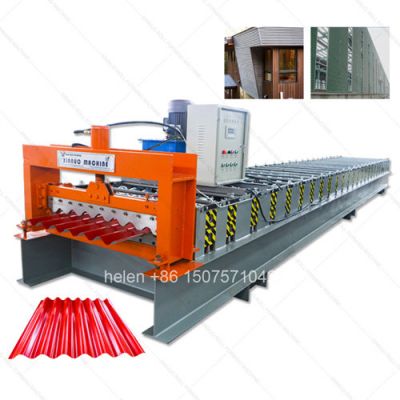
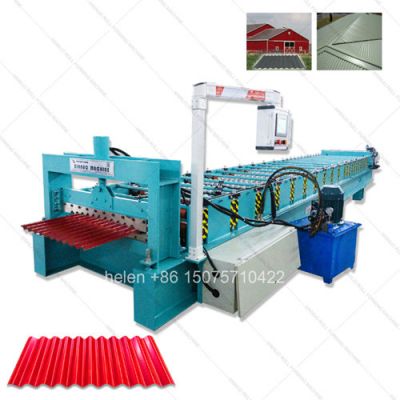
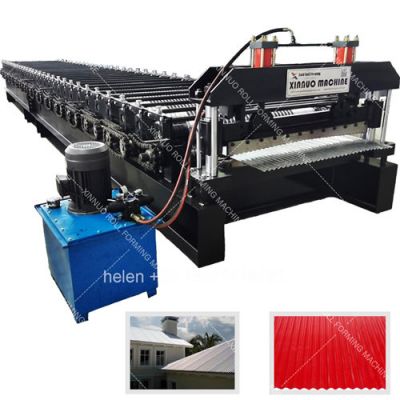
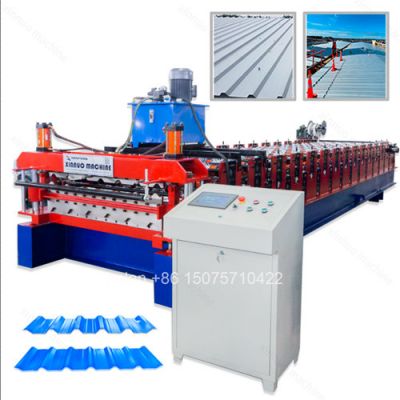
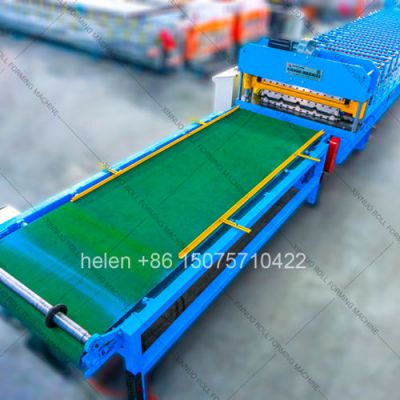
Open type floor deck cold roll forming production line equipment
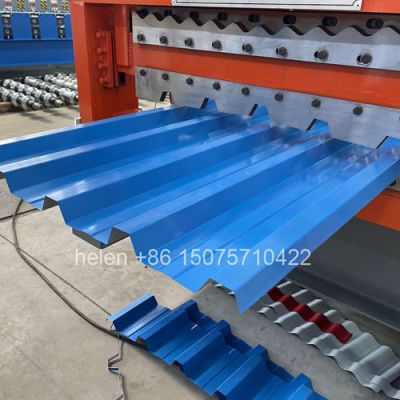
Trapezoidal rib profile with exposed underside for concrete bonding
Twin motor drive, 22-28 stations, dimple emboss, hydraulic shear
510-1025 profile range, 0.8-1.5mm gauge, 10-15 m/min output speed
An open type floor deck is defined by its exposed trapezoidal rib profile — the underside of the panel shows the full depth of the formed ribs with no closure or restriction at the opening. This distinguishes it from closed (dovetail/re-entrant) deck where the rib narrows at the opening to trap the concrete. The open configuration is the original and still dominant floor deck type, chosen for its simplicity, reliability, and proven performance across millions of square meters of completed construction worldwide. The open rib provides unrestricted concrete flow during pouring, full visual access for inspection after concrete placement (unlike closed deck where the concrete-to-steel interface is hidden), and straightforward connection detailing for services, hangers, and ceiling fixings that must attach to the slab soffit. For the deck manufacturer, open type forming is mechanically simpler — no mandrel rollers, no wall inversion stations, no specialized tooling beyond standard progressive trapezoidal rollers. This translates directly to lower machine cost, faster production, simpler maintenance, and wider operator availability.
| Floor Construction Method | Speed (m²/day/crew) | Formwork Cost | Structural Efficiency | Where Open Type Deck Wins |
|---|---|---|---|---|
| Traditional Timber Formwork + Cast-in-Place RC | 50-80 m² | High — timber, labor, stripping, cleaning, waste disposal. Reusable 3-5 cycles only. | Standard — slab depth governed by span/depth ratio for deflection. No composite action with formwork. | Open deck eliminates all formwork operations. 3-5× faster installation. Zero formwork waste. Permanent — no stripping. Composite action reduces slab depth and rebar quantity. |
| Precast Hollow-Core Planks | 150-200 m² | Low on site — craned into place, grouted. High in factory — requires casting beds, steam curing, storage yard. | Efficient — prestressed, optimized cross-section. Heavy — transport cost significant for remote sites. | Open deck is lighter to transport (coil to site, formed locally or in regional factory). No heavy precast logistics. Continuous slab — better diaphragm action for seismic zones. Easier to accommodate service penetrations. |
| Open Type Steel Deck + Composite Slab | 300-400 m² | Lowest total installed cost. Steel deck supply + fast on-site placement + no stripping. Permanent formwork with zero waste. | High — composite action utilizes the steel deck as external tensile reinforcement. Shallower slab for same span. Lighter structure overall. | This is the benchmark. Open type deck offers the best combination of speed, cost, and structural performance for 80% of multi-story steel-frame buildings. |
| Closed (Dovetail) Steel Deck + Composite Slab | 250-350 m² | 10-15% higher deck cost than open type. Installation speed slightly slower — heavier panels, more careful placement required for dovetail interlock alignment. | Highest — dovetail geometry provides superior bond. Longer unpropped spans. Thinner slab for same fire rating. | Open type matches or exceeds closed deck on cost and speed for standard applications. Closed deck only justified for long-span, high-seismic, or fire-rated projects where its premium performance is required. |
| Composite Steel Beam + Precast Concrete Slab | 100-150 m² | High — precast units + transport + crane + grouting + shear studs through pockets in precast. | Good — composite action via shear studs in grouted pockets. Heavier than steel deck composite. | Open deck eliminates precast elements entirely. Lighter structure — smaller columns, smaller foundations. More flexible for irregular floor layouts — precast is economic only for repetitive rectangular grids. |
| Site Activity | Open Type Deck Advantage | Closed Deck Limitation |
|---|---|---|
| Concrete Pour Inspection | After pouring, the concrete-filled ribs are fully visible from below. Inspector can verify concrete has flowed completely into all rib cavities — no hidden voids. Any honeycombing is immediately visible and can be repaired before slab loading. | The dovetail throat hides the concrete-to-steel interface. Voids inside the rib cavity are invisible from below. Undetected voids compromise composite action — discovered only if the slab shows excessive deflection in service. |
| Service Hanger Installation | Post-installed anchors and hangers are drilled through the slab from below. With open deck, the installer can see exactly where the deck rib is — avoiding drilling through ribs. Anchors placed in the inter-rib flat zone are in the thinnest part of the slab. | Dovetail geometry obscures rib locations from below. Installer must reference setting-out drawings or use cover-meter scanning — adding time and equipment cost for every hanger installation. |
| Ceiling / Soffit Fixing | Suspended ceiling hangers, sprinkler pipe supports, cable trays, and duct hangers are all fixed to the slab soffit. Open deck soffit is predominantly flat inter-rib areas — direct fixing with standard anchors. | Dovetail soffit has narrow inter-rib flats and wide rib openings — fewer flat areas for fixing. Specialized fixing details may be required. More fixings land on rib locations — require longer anchors or offset brackets. |
| Fire Protection Application | Spray-applied fire protection (vermiculite or intumescent) is applied directly to the deck soffit. Open ribs allow the spray to coat all surfaces — the applicator can see coverage on both rib walls and the soffit. | Dovetail geometry creates shadow zones — the inward-leaning rib walls shield the internal rib surface from spray application. Achieving uniform fire protection thickness requires more material and applicator skill. |
| Retrofit / Renovation Assessment | Existing open deck floors can be visually assessed — the steel deck condition, any corrosion, concrete cracking patterns, and previous hanger locations are all visible. Structural assessment is straightforward. | Existing dovetail deck floors hide much of the steel-concrete interface. Assessment of structural condition may require invasive inspection — core drilling, borescope inspection, or load testing. |
| Time | Activity | Operator Action | Quality Check |
|---|---|---|---|
| 07:30 | Pre-Start Inspection | Walk full machine length. Check chain tension, roller surfaces, hydraulic oil level, emergency stops. Record in shift log. Sign off pre-start checklist. | All emergency stops functional. No chain damage. No roller surface damage. Hydraulic oil at correct level. |
| 07:45 | Machine Warm-Up | Start machine at 3 m/min without material. Run for 5 minutes. Listen for abnormal noise. Check all rollers rotate freely. Check chain oiler is dispensing. | No knocking or grinding sounds. All rollers rotating — no seized bearings. Oil film visible on chain. |
| 07:50 | First Coil Load | Forklift positions coil on decoiler. Expand mandrel. Cut coil straps. Thread strip through entry guide, leveler, to first forming station. Use jog function to feed strip into station 1. | Strip centered in entry guide. Strip flat after leveler — no residual curvature. Strip aligned with first station rollers. |
| 08:00 | PLC Setup | Enter panel length, batch quantity, speed. Load profile recipe. Verify parameters against production order. Confirm encoder calibration value matches recipe. | Length setting matches production order. Batch quantity matches order quantity + 2 spare. Recipe name matches installed roller set. |
| 08:05 | First-Off Panel | Produce first panel at 5 m/min. Stop machine. Measure: coverage width (both ends + mid), rib depth (all ribs), cut squareness (both ends), surface condition (visual). Record all measurements. | All dimensions within tolerance. No surface defects. If any measurement fails: adjust, re-run, re-measure. Do not proceed until first panel passes. |
| 08:15 | Ramp to Production Speed | Step speed: 5 → 8 → 10 → 12 m/min. At each step: visual check of panel quality. At 12 m/min: full measurement check on one panel. | Panel quality maintained at each speed step. Final panel at production speed passes all dimensional checks. |
| 08:30 | Continuous Production | Monitor machine during production. Check panel quality every 20 panels visually. Full dimensional check every 50 panels. Watch HMI for fault codes. Listen for abnormal noise. | Production log updated with: panel count, coil change times, any stoppages, any quality issues, hourly output. |
| 12:00 | Mid-Shift Check | Pause production. Check chain tension (hot chain lengthens — may need adjustment). Check hydraulic oil temperature. Quick roller surface inspection at stations 1, 10, 20. Record mid-shift check. | Chain tension within spec at operating temperature. Oil temp below 55°C. Rollers clean, no damage. |
| 12:15 | Resume Production | Re-start. First panel after pause: full dimensional check. Resume continuous monitoring. | First panel after pause passes dimensional check — confirms machine settled correctly after brief stop. |
| 16:00 | Last Panel Check | Full dimensional check on last panel of shift. Compare measurements against first-off panel measurements. Record in shift log. | Last panel within tolerance. No significant dimensional drift from first panel — confirms machine stability through the shift. |
| 16:15 | End-of-Shift Procedures | Stop machine. Clear all scrap and debris. Wipe HMI screen. Check chain oiler reservoir — top up if needed. Record shift output in production log: linear meters, panel count, coil consumption, scrap percentage. | Machine clean. Production log complete. Shift report handed to next shift supervisor or filed for next day. |
| Handling Stage | Correct Method | Incorrect Method | Damage if Done Wrong |
|---|---|---|---|
| Lifting from Run-Out Table | Bundles of 20-30 panels lifted with spreader bar and fabric slings. Slings positioned at quarter points. Lift evenly — no tilting. | Single lifting point at bundle center — bundle bends into a V-shape. Forklift forks under bundle without timber support — fork tips dent bottom panels. | Bent panels will not sit flat on beams. Dented panels have weakened cross-section at dent location. Both are rejection causes at site delivery inspection. |
| Factory Storage (Short Term) | Bundles stored on level ground on timber dunnage (minimum 3 supports). Maximum stack 3 bundles high. Covered with breathable tarpaulin if outdoors. | Bundles stored directly on ground — bottom panels in contact with soil, rapid corrosion. Stacked more than 3 high — bottom bundle crushed. Plastic wrap without ventilation — condensation trapped. | Corroded panels from ground contact — rejected on delivery. Crushed panels from over-stacking — ribs flattened, profile distorted. White rust from condensation — zinc coating damaged. |
| Factory Storage (Long Term) | Indoor storage preferred. Bundles on racking system with forklift access. FIFO rotation. Inventory tagged with production date and coil heat number. | Outdoor long-term storage in tropical climate — even with tarpaulin, humidity and temperature cycling cause condensation. Stacked in order of production — oldest bundles buried at back. | Long-term outdoor storage loses 1-2% of inventory to corrosion annually in humid climates. Non-FIFO rotation leads to aged stock delivery — customer complaints about panel appearance even if structurally sound. |
| Loading for Transport | Flatbed truck. Bundles loaded with timber dunnage between layers. Strapped independently — each bundle secured to truck bed, not resting on the bundle below. Tarpaulin cover for weather protection. | Bundles stacked directly on each other without dunnage. Single strap over top bundle only — lower bundles free to shift. No weather cover in rainy season. | Panels rubbing together in transit — zinc coating scuffed. Lower bundles shift and impact truck sides — edge damage. Rain during transit causes water staining and white rust. |
| Site Offloading | Crane or forklift offloads individual bundles. Bundles placed on level, drained ground on timber dunnage. Stored in installation sequence order — floor 1 panels nearest access, floor 10 panels furthest. | Bundles dumped in random order. No dunnage. Stored under trees or in low-lying area that collects water. Bundle tags facing away from access — crew cannot identify which bundle is which floor. | Random storage = hours lost searching for correct bundles per floor. Ground contact = corrosion. Incorrect sequencing = panel shortages on one floor while another floor has excess — requires re-handling and transport. |
| Site Lifting to Deck Level | Bundles craned directly to installation level. Spreader bar mandatory — never single-point lift. Bundles placed on temporary dunnage on erected steel, distributed to avoid overloading any single beam. | Single-point lift — bundle folds. Bundles dropped onto bare steel beams — impact damages beam primer and panel. All bundles stacked in one location — local beam overload. | Folded bundle: all panels permanently bent. Dropped bundles: panel edge damage at impact point. Concentrated bundle weight on single beam: beam may deflect beyond acceptable tolerance, requiring re-levelling. |
| Component | Expected Service Life | Wear Indicators | Replacement Lead Time | Spare Holding Recommendation |
|---|---|---|---|---|
| Forming Rollers (45# Forged Steel) | 5-8 years (single shift, G345 material). 3-5 years (G550 material). | Profile dimensions drifting out of tolerance despite correct roller gap setting. Chrome plating worn through — dull gray base steel visible. Surface roughness increasing — panels showing longitudinal marks. | 4-6 weeks (manufactured to order from original CAD files). | Keep original roller set after first replacement — send for re-chroming and keep as ready spare. Reduces replacement downtime from 4-6 weeks to 2-3 days (changeover time only). |
| Drive Chains (2-inch Heavy Series) | 3-5 years (properly lubricated, correctly tensioned). | Chain elongation exceeds 3% from new length (measured with elongation gauge). Sprocket teeth showing hooked profile. Chain links stiff or seized — links don't articulate freely when chain is flexed by hand. | 1-2 weeks (standard industrial chain — widely available). | One full set of chains + one set of master links. Keep in factory stores. Replace as complete set — mixing old and new chain causes uneven wear and rapid new chain degradation. |
| Sprockets | 6-8 years (replaced with second chain set). | Teeth worn to a hooked or pointed profile — original tooth shape is symmetric, worn teeth are asymmetric. Chain rides up on worn teeth under load — audible clicking. | 2-4 weeks (machined to machine specification). | Order replacement sprocket set when ordering second chain replacement. Replace sprockets and chains together — new chain on worn sprockets wears 3× faster. |
| Bearings (Deep Groove Ball) | 5-8 years (greased per schedule, normal loading). | Audible roughness when shaft is rotated manually. Increased motor current draw — failing bearings increase rotational resistance. Visible grease leakage from seals — seal failure precedes bearing failure. | 1-3 days (standard bearing sizes — available from industrial suppliers). | Full set of bearings in factory stores. Replace as complete set when 2 or more bearings show wear indicators — remaining bearings are at similar life stage. |
| Shear Blades (Cr12MoV) | 500,000 cuts between re-grinds. 2,000,000 cuts total life (4 re-grinds). | Panel cut edge showing burr — blade dull. Panel end flare increasing — blade gap has opened due to edge wear. Cut requires visibly more hydraulic pressure than when blade was new. | Re-grind: 1 week (send to tool grinding service). New set: 3-4 weeks. | Two complete blade sets: one in machine, one re-ground and ready. Rotate: when installed set reaches re-grind interval, swap with spare set. Send removed set for re-grind. |
| Hydraulic Hoses | 5-7 years (normal operating temperature, no external damage). | Surface cracking on outer rubber cover. Bulging under pressure — internal reinforcement damaged. Weeping at crimped fittings — seal failure at hose-to-fitting interface. | 1-3 days (made to measure by local hydraulic service). | One complete set of hoses in factory stores — pre-made to machine specification. Replace as complete set when 2 or more hoses show age indicators — remaining hoses are same age, same condition. |
| Hydraulic Oil | 2,000 operating hours between changes (6-12 months depending on shift pattern). | Oil color darkening — from clear amber to dark brown. Oil sample analysis shows increased particle count and water content. Oil temperature running higher than normal — degraded oil has reduced cooling efficiency. | Off-the-shelf (ISO VG 46 hydraulic oil — standard product). | Minimum 1 full oil change volume in stock. Filter elements: 3 in stock (change with every oil change + one spare). |
| PLC & HMI | 10-15 years (industrial environment, IP65 enclosure). | HMI screen showing dead pixels or reduced brightness. PLC battery low warning — replace battery immediately to prevent program loss on power cycle. Communication errors between PLC and HMI. | PLC: 2-4 weeks. HMI: 2-4 weeks. | One PLC CPU module + one HMI panel in factory stores. Program backup stored on USB and on off-site cloud storage. Without program backup, replacing PLC means re-programming from scratch — weeks of downtime. |
| VFD (Variable Frequency Drive) | 8-12 years (clean power supply, within rated ambient temperature). | Overcurrent faults occurring at normal load. Cooling fan noisy or stopped — overheating imminent. Capacitor aging — visible bulging on capacitor tops inside VFD enclosure. | 1-3 weeks (standard industrial VFD). | One spare VFD in factory stores. Pre-programmed with machine parameters — plug-and-play replacement. Without pre-programmed spare: replacement VFD must be commissioned from scratch by electrical technician. |
| Production Scenario | Machine Speed | Effective Hours/Shift | m² per Shift | m² per Month (25 days) | Coil Required (tons/month) |
|---|---|---|---|---|---|
| Single shift — 750 type, 0.9mm | 12 m/min | 7.0 (allowing 1h for setup, breaks, checks) | 3,780 | 94,500 | ~890 |
| Single shift — 1000 type, 1.0mm | 12 m/min | 7.0 | 5,040 | 126,000 | ~1,500 |
| Double shift — 750 type, 0.9mm | 12 m/min | 14.0 (two 7h shifts) | 7,560 | 189,000 | ~1,780 |
| Double shift — 1000 type, 1.0mm | 12 m/min | 14.0 | 10,080 | 252,000 | ~3,000 |
| Single shift — 915 type, 1.2mm heavy | 8 m/min | 7.0 | 3,074 | 76,850 | ~1,110 |
| Factor | Open Type Advantage | Industry Evidence |
|---|---|---|
| Proven Track Record | Open type deck has been used in composite floor construction since the 1950s — 70+ years of performance data. Building codes worldwide have codified open deck design methods based on thousands of full-scale tests and decades of in-service observation. | An open type deck floor installed in 1970 is still performing as designed in 2026. Engineers can inspect it, assess it, and if necessary, strengthen it — because the steel-concrete interface is accessible and the composite action mechanism is well understood. |
| Design Code Coverage | Every major structural design code includes specific provisions for open type trapezoidal composite deck: EN 1994-1-1 (Europe), ANSI/SDI-C (North America), AS 2327.1 (Australia), IS 11384 (India), and equivalents in 40+ countries. | An engineer in any country can design with open type deck using their local code. No special approvals, no project-specific testing waivers, no additional certification. This universality is the single biggest commercial advantage of open type deck. |
| Manufacturing Ecosystem | Open type deck roll forming machines are produced by dozens of manufacturers worldwide. Roller sets, spare parts, and technical support are widely available. Operators can be trained locally. Maintenance skills are transferable. | A deck manufacturer in Vietnam can buy an open type machine, hire locally trained operators, source spare parts from multiple suppliers, and begin production within weeks. The same is not true for dovetail deck — specialized mandrel systems create dependency on a single machine supplier. |
| Material Flexibility | Open type deck is produced from standard galvanized coil — G345 or G550 grade, Z180 to Z275 coating. These are commodity steel products available from every major mill. No special steel grades, no special coatings, no minimum order quantity challenges. | The deck manufacturer can switch coil suppliers based on price and availability. This purchasing flexibility protects margins and ensures production continuity. Specialized profiles may require specific steel grades that limit supplier choice. |
| Quality Inspection | Open type deck panel quality can be fully verified at the factory and on site with simple measurement tools: tape measure, depth micrometer, angle gauge, and visual inspection. No specialized test equipment required. | This enables the customer's engineer to independently verify delivered panel quality. Trust is built on measurable, verifiable facts — not on supplier claims. Independent verification builds long-term customer relationships. |
Hebei Xinnuo is a professional cold roll forming machinery manufacturer with 20+ years of experience. We specialize in C/Z purlin machines, roof panel roll formers, floor deck machines, and custom profile solutions — exported to 50+ countries worldwide.