helen@hbxinnuorollforming.com
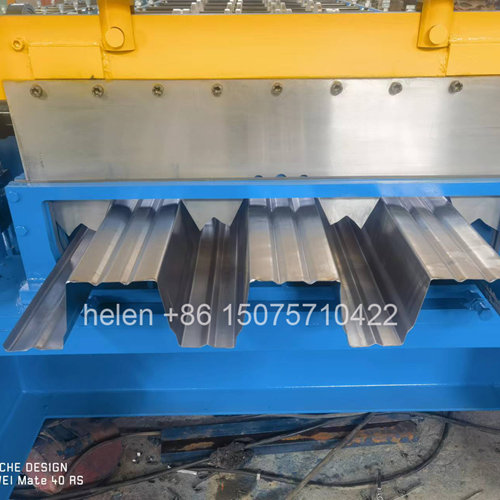
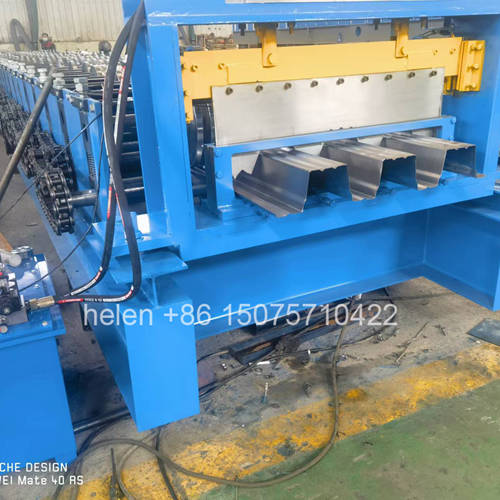
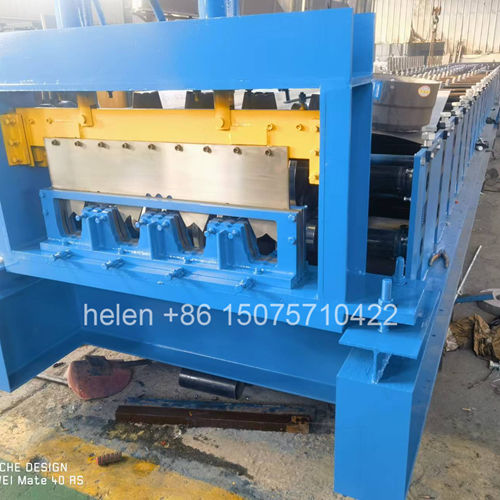
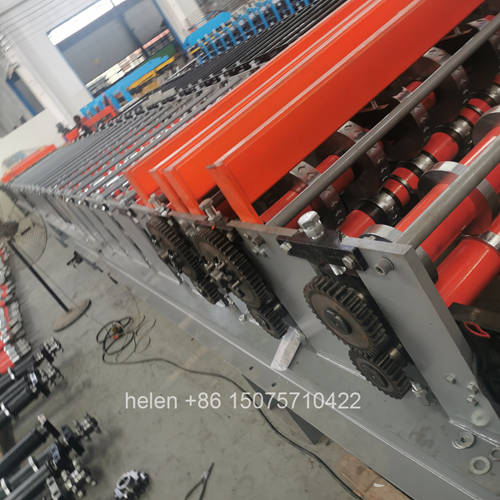
- Big wave profiles run 32 to 40 mm peak height at wide wave pitch
- Wave pitch spans roughly 126 to 201 mm across this band
- Feed widths sit between about 1000 and 1270 mm
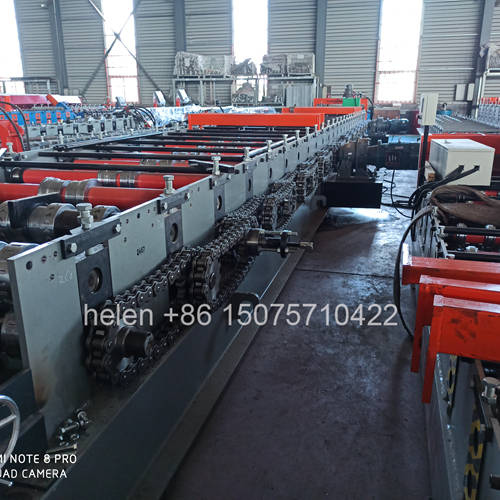
- Large deformation demands 28 to 32 forming rows, well above normal
- Frames step up to 400H or 450H and shafts to 70 mm and above
- Big wave panels are formed from thin coated material, not thick sheet
- Machine weight reaches 8 to 12 tonnes on the heaviest configurations
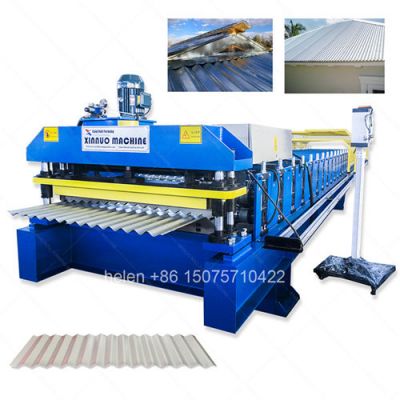
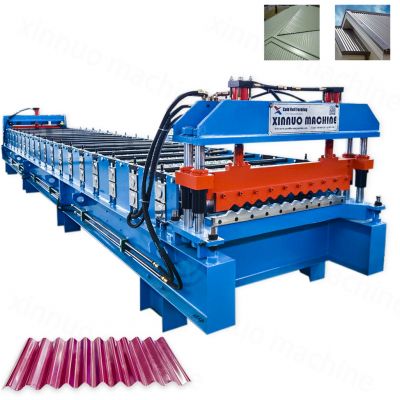
In wave-formed metal decking, the profile is described by three figures rather than one: peak height, wave pitch and wave count. A big wave profile is one in which the peak height reaches 32 to 40 mm on a wave pitch of roughly 126 to 201 mm — a broad, deep, continuous corrugation rather than the tight ripples of a small arc profile or the regular flutes of a trapezoidal sheet. The panels are used where spanning capability, drainage and architectural presence all matter, typically on large-span industrial buildings.
Wave geometry drives machine design far more directly than coverage width does, and a big wave is the extreme case. Forming a 38 mm peak requires the material to be carried a long distance out of its original plane and back again, which cannot be done in the number of passes used for a shallow wave. The consequences run through the whole machine: row counts rise to 28 or more, frames step up to 400H or 450H, shafts grow, motors move from a single 5.5 kW drive to 15 kW, and total machine weight reaches 8 to 12 tonnes. This page sets out what defines a big wave profile, why wave geometry governs the machine, why big wave panels are formed from thin material rather than thick, the forming consequences of a large wave, the configuration that follows, and how wave profiles are verified.
| Wave Band | Peak Height | Wave Pitch | Feed Width | Effective Width | Character |
|---|---|---|---|---|---|
| Small arc | 8 – 18 mm | 31.5 – 78.5 mm | 914 – 1000 mm | 760 – 882 mm | Dense, visually flat, suited to light steel construction where appearance matters |
| Medium arc | 18 – 25 mm | 75 – 100 mm | 914 – 1250 mm | 608 – 1067 mm | The mainstream specification, widest range of widths and the largest market volume |
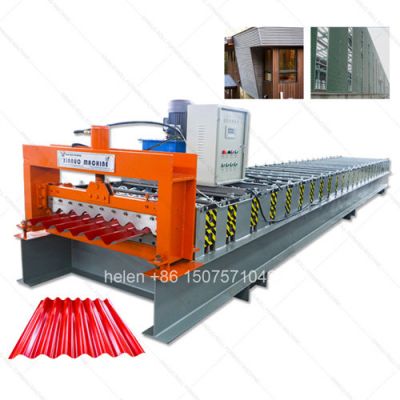
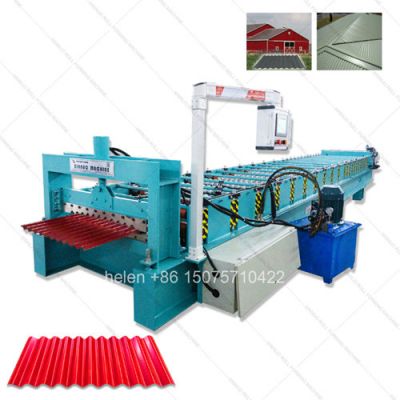
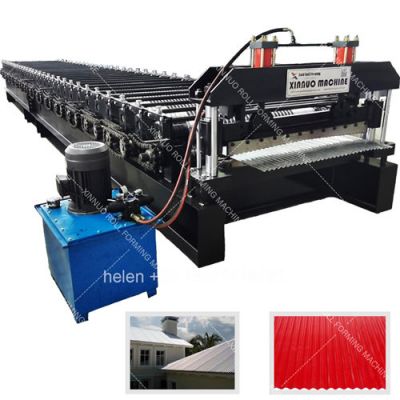
| Big wave | 32 – 40 mm | 126 – 201 mm | 1000 – 1270 mm | 756 – 1040 mm | Tall peaks, broad pitch, high load capacity, suited to large-span industrial buildings |
| Representative big wave profiles | A 38 mm peak on a 756 mm effective width at 26 rows; a 32 mm peak at 780 mm; a 35 mm peak at 780 mm at 28 rows; a 37 mm peak at 1040 mm at 30 rows on a 450H frame | ||||
| Material range for the band | Colour-coated steel sheet from approximately 0.3 to 0.8 mm, with the thin end of the range being the norm rather than the exception | ||||
| Parameter | Effect on the Machine | Why It Dominates |
|---|---|---|
| Peak height | Determines forming row count, wheel diameters and frame weight | Each pass can only carry the material a limited distance out of plane. A 38 mm peak needs far more passes than a 15 mm one, regardless of width. |
| Wave pitch | Determines roller profile, the number of waves across the sheet and the total forming work per pass | A longer pitch at the same peak height means a gentler transition and less material strain per wave, but fewer waves across the width for the same coverage. |
| Wave count | Determines the number of forming positions per pass and the width of the roll face | Twelve waves and four waves at the same pitch are entirely different tools, even though each is a wave profile. |
| Symmetry | Determines whether both flanks of every wave can be formed by the same tooling geometry | An asymmetric or offset wave requires individual attention to each flank, which increases tooling complexity and forming control requirements. |
| Coverage width | Determines roller length, shaft length and blank width | An important procurement and handling figure, but it does not change how hard the profile is to form. |
| The practical conclusion | Configuration should be set from peak height and material first, then width | Sizing from coverage width alone produces a machine that cannot form the wave it was bought for. |
It seems counter-intuitive that the profile with the tallest peaks is formed from the thinnest material, but the geometry explains it. A big wave imposes a large and repeated deformation on every element of the sheet, and the bending strain at each wave crest increases with peak height and decreases with the bend radius available. Thick material reaches its forming limit at a shallower peak than thin material does, and beyond that limit the crests crack or the coating fails.
| Reason | Explanation |
|---|---|
| Bending strain at the crest | The outer surface of each wave crest is stretched as the material is bent over the forming wheel. The strain increases with peak height and with material thickness. |
| Forming limit of the material | Every material has a limit beyond which it cracks rather than deforms. A big wave exhausts much of that allowance, so starting gauge must be modest. |
| Coating performance | Colour-coated material has a coating that must bend with the steel. Large deformation on thick material with a heavy coating causes the coating to crack at the crest, which becomes the first corrosion point. |
| Successive passes compound the deformation | Forming a big wave takes many passes, and each pass adds further deformation. Thick material accumulates damage across the sequence rather than distributing it. |
| Hence the practical range | Big wave profiles are formed from colour-coated sheet in roughly the 0.3 to 0.8 mm range. Thick material belongs on trapezoidal profiles with generous radii, not on tall wave forms. |
| Consequence for the machine | The forming load comes from the depth of the wave rather than from the thickness of the material, which is why a big wave machine is heavy in structure but not necessarily extreme in drive rating. |
| Consequence for handling | Thin colour-coated panels mark and crease readily. Handling and stacking provision matters as much on a big wave line as on any other, despite the light gauge. |
| Consequence | Reason | Machine Response |
|---|---|---|
| Row count rises sharply | A deep wave requires many incremental steps. Attempting it in a short train over-works the material at individual passes and produces a misshapen wave or cracked crests. | 28 to 32 forming rows on a big wave profile, against 13 to 18 rows for a normal arc profile of similar width. |
| Frame weight increases | The taller roll stands needed for a deep wave, combined with the longer train, produce a substantially heavier assembly. | 400H or 450H frame construction, with the heaviest configurations reaching the top of the standard range. |
| Shaft diameter increases | Longer shafts carrying larger wheels deflect more under forming load, which opens the roll gap at the point of maximum load. | Shafts from 70 mm upward, with 40Cr steel precision turned and ground to maintain finish and stability. |
| Motor rating increases | Forming load across a deep wave, multiplied by the number of waves and the width of the sheet, requires more drive power than a shallow profile. | From 5.5 kW at the lighter end of the band to 15 kW on the heaviest configurations. |
| Machine weight reaches 8 to 12 tonnes | The frame, shafts, wheels and drive all scale with the wave depth and the row count. | Foundation, floor loading and lifting provision must be established against the actual machine mass, not assumed from a lighter arc machine. |
| Forming speed is more conservative | Achieving a consistent deep wave is more sensitive to speed than forming a shallow one, since material behaviour changes with the rate of deformation. | Standard wave machines run in the region of 3 to 8 m/min, with higher rates achievable where the profile and material permit. |
| Machine cost rises materially | The additional rows, heavier frame, larger shaft and higher motor rating all add cost well beyond the material involved. | A big wave machine typically costs 30 to 50 percent more than a medium arc machine of the same coverage width. |
| Parameter | Configuration |
|---|---|
| Profile band | Big wave arc profile, 32 – 40 mm peak height at 126 – 201 mm wave pitch |
| Effective coverage width | 756 – 1040 mm across the big wave range |
| Feed width | 1000 – 1270 mm, established from the profile drawing |
| Forming rows | 28 – 32 rows, against 13 – 18 rows for a normal arc profile of comparable width |
| Frame | 400H – 450H welded H-section, with the heavier configurations at the top of the range |
| Shaft | Φ70 mm and above, 40Cr steel precision turned and ground |
| Forming wheels | 45# forged steel, quenched to HRC 45 – 50, finish turned, keyed, polished and chrome plated |
| Frame machining | Gantry milled to a flatness tolerance in the region of 0.05 mm, which is what keeps the wave uniform across the sheet width |
| Motor configuration | 5.5 kW at the lighter end of the band, rising to 15 kW on the heaviest configurations; variable frequency drive |
| Transmission | Chain drive with a cycloidal reducer as the mainstream arrangement |
| Material capability | Colour-coated steel sheet from approximately 0.3 to 0.8 mm |
| Forming speed | Approximately 3 – 8 m/min, higher where the profile and material permit |
| Shear | Hydraulic shear with a dedicated hydraulic system, in a separate shear arrangement as used on wave profile lines |
| Control system | PLC with computer control panel, programmable cut length and sheet count control |
| Machine mass | Approximately 8 – 12 tonnes on heavy big wave configurations |
| Options | Inline arching section for curved roof applications; asymmetric or offset wave forming; reinforced crest detail where added panel stiffness is required |
| Electrical supply | 380 V / 50 Hz / 3-phase standard; alternative voltages and frequencies by destination |
| Certification | CE marking and ISO 9001:2015 compliant manufacturing, with destination-market documentation arranged as required |
| Variable | Effect on the Panel | Effect on the Machine |
|---|---|---|
| Peak height | Increases stiffness and spanning capability, and increases the depth available for drainage | The dominant driver of row count, wheel size and frame weight |
| Wave pitch | A longer pitch reduces the number of waves across the width and changes the interlock pattern at the lap | Sets the roller profile and the total forming work per pass |
| Wave count | Determines the number of waves in each panel and the coverage per sheet | Sets the number of forming positions across the roll face |
| Symmetric or offset | An asymmetric profile gives greater visual depth and a more pronounced architectural character | Requires individual attention to each flank, increasing tooling complexity |
| Crest reinforcement | An additional formed rib at the crest increases panel stiffness without adding material | Additional formed features requiring passes beyond those needed for the basic wave |
| Lap detail | Determines whether adjacent panels engage tightly and whether the joint sheds water | Edge geometry formed within the roll train, with tolerance holding along the full panel length |
| Application | Why Big Wave Fits |
|---|---|
| Large-span industrial buildings | Spanning capability is the governing requirement, and a tall wave provides it where a shallow profile could not. Buildings with spans beyond roughly 18 metres are the typical case. |
| Warehouses and logistics buildings | Long spans with few internal supports, combined with roof drainage requirements that a deeper wave serves better. |
| Agricultural and shed structures | Wide clear spans with simple roof geometry, where a robust wave form gives both strength and drainage. |
| Exposed roofs requiring drainage | The deep wave channels water effectively, which matters where roof falls are shallow or rainfall is heavy. |
| Buildings where the roof form is part of the design | The broad wave gives a pronounced visual character that carries across a large roof area. |
| Curved roof applications | Where an inline arching provision is fitted, the formed panel can be curved to suit arched roofs and tunnel-type structures. |
| Roof and wall use on the same profile | The same section is frequently used for both, simplifying stockholding and specification. |
| Check | Requirement |
|---|---|
| Peak height | Measured across several waves and at several positions along the panel. Wave height control in the region of plus or minus 0.3 mm is the standard that keeps laps closing tightly. |
| Uniformity across the width | The wave should be consistent from the first wave to the last. Variation across the sheet indicates frame or shaft deflection rather than a tooling error. |
| Wave pitch | Measured between wave centres, since pitch error accumulates and shows up as a panel that will not lap correctly at the far edge. |
| Crest condition | Inspected for cracking, thinning and coating damage, since the crest is where a big wave profile is most highly strained. |
| Lap engagement | Two panels lapped together to confirm the joint closes along its full length and sheds water as intended. |
| Effective cover width | Measured on the finished panel, since it is the basis on which roof area and pricing are calculated. |
| Flatness along the panel | Sighted along the length, since a long wave panel that twists is difficult to align on the roof. |
| Surface condition | Inspected on coated material, since the panel is visible in service and surface defects are permanent. |
| Sustained run | Verified over a continuous run rather than a short sample, since a deep wave profile is sensitive to speed and to accumulating forming load. |
| Information | Why It Determines the Specification |
|---|---|
| Profile drawing | The authoritative input. Peak height, wave pitch, wave count, symmetry and lap detail all read from it. |
| Peak height and wave pitch | Together these establish the row count, wheel diameters, frame weight and motor rating. |
| Wave count and coverage width | Sets the roll face width, shaft length and the blank width to be purchased. |
| Feed width and coil specification | Determines the decoiler working width and the entry guide range. |
| Material thickness range | Big wave forming is thickness-sensitive; the maximum thickness that can be formed without crest cracking must be confirmed against the drawing. |
| Coating type and thickness | Determines bend performance at the crest and the surface protection required through a long forming train. |
| Required production rate | Determines the drive and speed specification, and whether the configuration moves to a heavier tier. |
| Span to be served | Confirms whether a big wave profile is the correct section or whether a medium arc would serve the application. |
| Panel length range | Drives run-out provision, cut length control and handling arrangements. |
| Whether inline arching is required | Determines whether the machine needs an integrated curving section, which changes both the line length and the specification. |
| Parameter | Standard Range |
|---|---|
| Profile type | Big wave continuous arc profile, produced to the buyer's drawing |
| Peak height | 32 – 40 mm |
| Wave pitch | 126 – 201 mm |
| Effective coverage width | 756 – 1040 mm across the big wave range |
| Feed width | 1000 – 1270 mm, established from the drawing |
| Forming rows | 28 – 32 rows, against 13 – 18 rows for a normal arc profile of comparable width |
| Frame | 400H – 450H welded H-section, gantry milled to approximately 0.05 mm flatness |
| Shaft | Φ70 mm and above, 40Cr steel, precision turned and ground |
| Forming wheels | 45# forged steel, quenched to HRC 45 – 50, finish turned, keyed, polished and chrome plated |
| Motor configuration | 5.5 kW at the lighter end of the band through to 15 kW on the heaviest configurations, with variable frequency drive |
| Transmission | Cycloidal reducer with chain drive as the mainstream arrangement |
| Material | Colour-coated steel sheet, approximately 0.3 – 0.8 mm |
| Forming speed | Approximately 3 – 8 m/min, higher where the profile and material permit |
| Shear | Hydraulic shear with a dedicated hydraulic system |
| Cut length tolerance | ±1.5 mm |
| Wave height control | In the region of ±0.3 mm, which is the standard that keeps panel laps closing tightly |
| Machine mass | Approximately 8 – 12 tonnes on heavy big wave configurations |
| Control system | PLC with computer control panel, programmable cut length and sheet count control |
| Options | Inline arching section, asymmetric wave forming, reinforced crest detail |
| Electrical supply | 380 V / 50 Hz / 3-phase standard; alternative voltages and frequencies by destination |
| Certification | CE marking and ISO 9001:2015 compliant manufacturing, with destination-market documentation arranged as required |
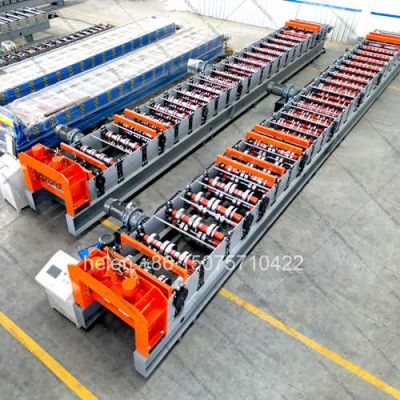
Coil loading on the decoiler, strip entry through the guide, progressive forming of the wave across a long roll train where the peak is developed in small increments over 28 to 32 rows, length measurement, hydraulic shearing, and discharge to the run-out position follow the established sequence, with the wave geometry set by roller tooling produced to the buyer's profile drawing.
Hebei Xinnuo is a professional cold roll forming machinery manufacturer with 20+ years of experience. We specialize in C/Z purlin machines, roof panel roll formers, floor deck machines, and custom profile solutions — exported to 50+ countries worldwide.