helen@hbxinnuorollforming.com


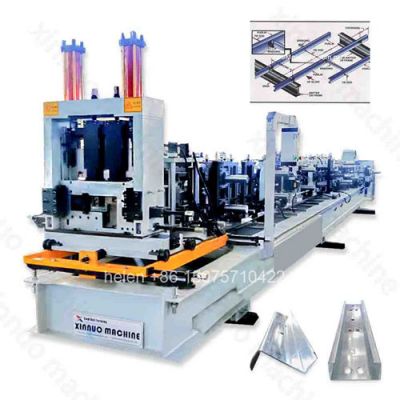
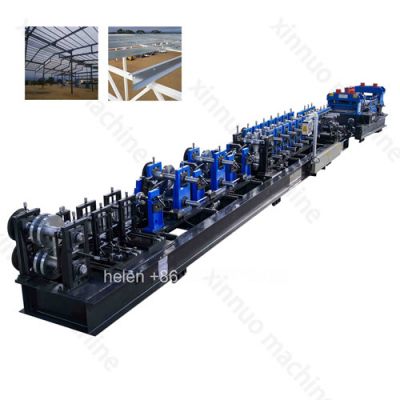
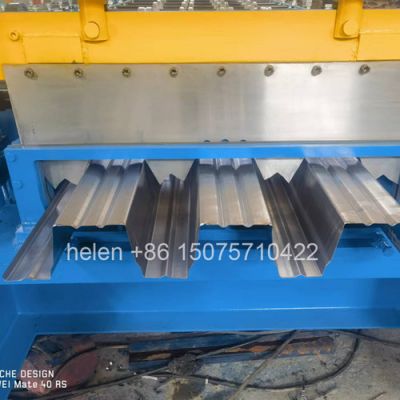
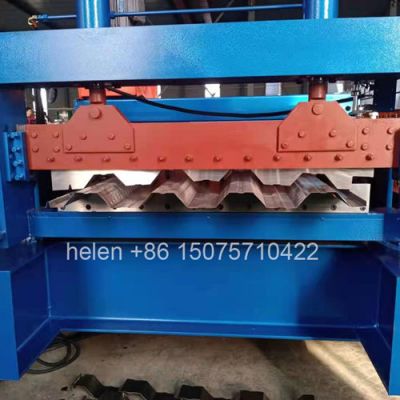
Cold roll forming production line for steel floor deck panels
Twin motor chain drive with progressive 22-30 station forming
PLC auto length control, hydraulic shear, gravity stack output
0.8-1.5mm galvanized coil input, 510-1025 type profile range
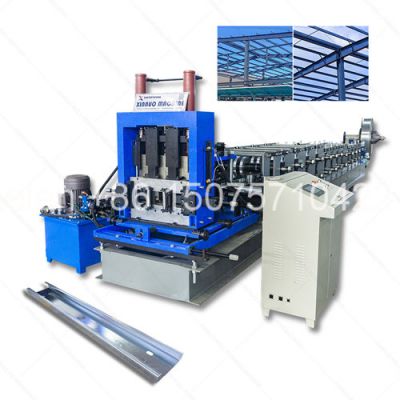
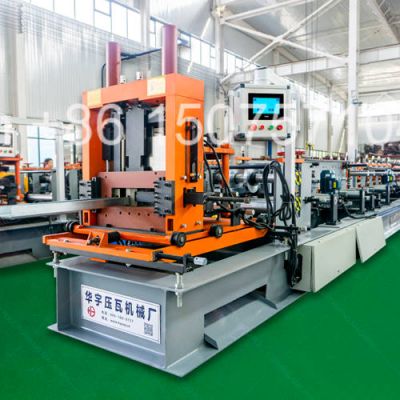
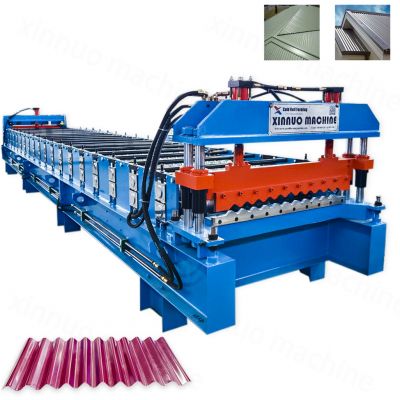
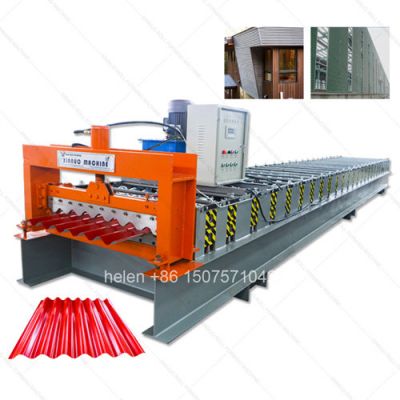
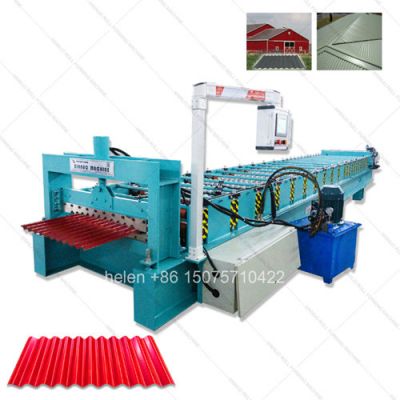
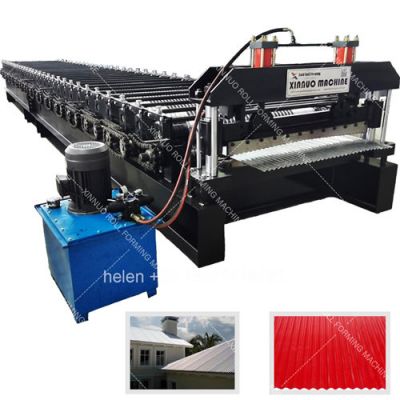
This floor deck panel machine is a complete cold roll forming production line that converts galvanized steel coil into finished structural floor deck panels in one continuous pass — no intermediate handling, no secondary operations. Each panel exits the line cut to precise length, fully formed, dimple-embossed, and ready for bundling and dispatch. The machine is engineered for sustained high-volume production in dedicated decking manufacturing facilities, with a rigid 450H I-beam welded frame that maintains profile accuracy across millions of linear meters. Panel quality consistency is the core design priority: every station is independently adjustable with calibrated gap settings to ensure identical profile geometry from the first panel to the last.
| Quality Parameter | Standard Value | Measurement Method | Check Frequency |
|---|---|---|---|
| Coverage Width | Nominal ±2mm | Calibrated steel tape at panel midpoint and both ends | Every 50th panel |
| Rib Height | Nominal ±1mm | Digital height gauge at each rib peak | Every 50th panel |
| Rib Spacing | Nominal ±1.5mm | Vernier caliper, center-to-center | Every 100th panel |
| Panel Straightness (Camber) | ≤ 2mm per 3m length | String line along panel edge, measure max deviation | Every shift start |
| Cut Length Accuracy | Nominal ±1.5mm | Calibrated tape, both edges | Every 20th panel |
| Cut Squareness | ≤ 1mm deviation across width | Carpenter's square on cut edge vs. panel side | Every 50th panel |
| Dimple Depth | 0.5–1.2mm per specification | Dial indicator depth gauge at 3 points per rib | Every shift start + after tooling change |
| Surface Finish | No scratches, no zinc coating damage | Visual inspection under 500 lux lighting | Continuous by operator |
| Edge Burr | ≤ 0.1mm, no sharp edges | Fingertip test + micrometer where disputed | Every 100th panel |
| Twist / End Flare | ≤ 3mm uplift at any corner when panel lies flat | Place on flat surface plate, measure at 4 corners | Every shift start |
| Feature | Standard Configuration | Semi-Automatic Upgrade | Full Automatic Upgrade |
|---|---|---|---|
| Length Input | Manual entry on HMI touchscreen per batch | Same as standard | Job queue upload via USB or network, auto-executes sequential orders |
| Quantity Control | Batch counter with auto-stop at preset piece count | Same as standard | Multi-batch scheduling — machine auto-switches length and quantity between orders |
| Coil Changeover | Manual — operator positions new coil, expands mandrel, threads strip | Coil car with hydraulic lift reduces changeover time | Coil car + automatic strip threading system + butt-weld joining station for non-stop production |
| Panel Stacking | Gravity drop onto run-out table, manual bundling | Powered roller conveyor to stacking zone | Automatic stacker with pneumatic lift and bundle counting — operator-free output |
| Quality Inspection | Manual measurement per schedule above | Same as standard | In-line laser profile scanner — real-time width/height monitoring with automatic reject diverter |
| Production Logging | Manual logbook entry by operator | HMI export to USB — CSV file with timestamps | Cloud-connected production dashboard — real-time OEE, coil consumption, output by shift |
| Fault Diagnostics | PLC error codes displayed on HMI screen | Same as standard | Remote diagnostic access — engineer can view PLC from anywhere, plus SMS alert for critical stops |
| Operator Requirement | 2–3 persons per shift | 2 persons per shift | 1 person per shift (supervisory role only) |
| Material Property | Standard Grade | High-Strength Grade | Supplier Verification |
|---|---|---|---|
| Base Steel | Commercial quality, ASTM A653 / EN 10346 | Structural quality, ASTM A653 Grade 80 / EN 10346 S350GD | Request mill test certificate (MTC) with each coil delivery |
| Yield Strength | 235–280 MPa (Grade 33–40) | 350–550 MPa (Grade 50–80) | Verify MTC values; spot-test with portable hardness tester if uncertain |
| Zinc Coating | Z180–Z275 (G60–G90), 180–275 g/m² | Z275 minimum (G90), 275 g/m² | Coating weight certificate; salt spray test only for high-corrosion markets |
| Coil Thickness Tolerance | ±0.05mm across width, ±0.08mm along length | ±0.03mm across width, ±0.05mm along length | Ultrasonic gauge or micrometer check at 3 points across coil width on delivery |
| Coil Width Tolerance | +5/-0mm from nominal feed width | +3/-0mm from nominal feed width | Tape measure at decoiler; oversize strips jam entry guide |
| Coil ID Standard | 508mm (20 inch) — global standard | 508mm or 610mm (24 inch) | Confirm ID before ordering decoiler mandrel configuration |
| Coil OD Maximum | 1,200mm (standard decoiler capacity) | 1,500mm (reinforced decoiler) | Check with supplier; oversize coils may not fit decoiler cage |
| Surface Condition | Regular spangle, no visible rust, no edge damage | Minimum spangle preferred for uniform concrete bond | Reject coils with edge dents deeper than 1mm or visible red rust spots |
| Coil Weight | 3–5 tons (standard production coil) | 5–8 tons (reduced changeover frequency) | Confirm handling equipment capacity at receiving warehouse |
| Cost Item | Consumption Rate | Unit Cost (Typical) | Monthly Cost (Single Shift) |
|---|---|---|---|
| Main Motor Electricity | 22KW × 70% average load × 8h = 123 kWh/day | $0.08–0.15/kWh | $250–470 |
| Hydraulic Pump Motor | 4KW × 30% duty cycle × 8h = 9.6 kWh/day | $0.08–0.15/kWh | $20–36 |
| Hydraulic Oil | 200L charge, replace every 6 months | $2–4/L | $33–67 (amortized) |
| Chain Lubricant | 2 kg per week, automatic drip system | $5–8/kg | $40–64 |
| Bearing Grease | 1 kg per week, manual application | $8–12/kg | $32–48 |
| Shear Blade Replacement | Re-grind every 500K cuts, replace every 2M cuts | $300–500 per blade set | $25–42 (amortized) |
| Roller Re-Chroming | Every 5–8 years depending on usage | $2,000–3,500 full set | $21–58 (amortized) |
| Spare Parts (Bearings, Seals, Chains) | Preventive replacement per schedule | $1,500–2,500/year | $125–208 |
| Operator Labor | 2–3 operators per shift | Market-dependent | Market-dependent |
| Total Operating Cost (Excl. Labor) | $546–993/month | ||
| Safety Feature | Standard | Description |
|---|---|---|
| Emergency Stop Circuit | ISO 13850 / EN 60204-1 | Red mushroom-head pushbuttons at decoiler, forming unit entry/exit, shear station, and electrical cabinet — any button triggers Category 0 stop (immediate power removal) |
| Fixed Guards | ISO 14120 | Welded steel mesh panels with tool-only access covering all chain drives, sprockets, and rotating shafts along full machine length |
| Interlocked Access Doors | ISO 14119 | Magnetic safety switches on roller access panels — opening any door during operation triggers controlled stop |
| Light Curtain (Optional) | IEC 61496 | Infrared barrier across shear zone entry; breaking the beam stops hydraulic motion within 50ms |
| Phase Sequence Relay | Built-in | Prevents motor reverse rotation if power phases are swapped during installation — protects roller and chain damage |
| Overload Protection | Built-in | Thermal overload relays on both main motors and hydraulic pump motor; VFD current limiting as secondary protection |
| Warning Siren & Beacon | Standard | Audible siren + rotating amber beacon activates 5 seconds before line start; continuous beacon during operation |
| Noise Level | ≤ 85 dB(A) at operator position | Measured at 1m from forming unit under full production load — within occupational exposure limit for 8-hour shift |
| Method | Process | Best For | Limitation | This Machine Uses |
|---|---|---|---|---|
| Press Brake Forming | Hydraulic press bends each rib sequentially | Very short runs, prototype panels | 3–5 min per panel, inconsistent rib geometry, high labor | No — too slow for production volumes |
| Roll Forming — Single Stand | One motor drives one set of rollers; coil pulled through by exit pull rolls | Light gauge roofing, simple profiles | Insufficient torque for deep rib floor deck, material slip, inconsistent forming | No — unsuitable for floor deck gauges |
| Roll Forming — Gearbox Drive | One motor drives a gearbox distribution shaft; each station driven via bevel gears | Medium profiles, moderate forming forces | Gear backlash accumulates over 20+ stations, causing roller timing drift and panel twist | No — backlash unacceptable for floor deck precision |
| Roll Forming — Chain Drive (This Machine) | Dual motors drive heavy roller chain sprockets on each station; all rollers synchronized mechanically | Heavy gauge, deep rib, high precision profiles | Requires regular chain tension maintenance | Yes — only method capable of sustained floor deck production |
| Roll Forming — Servo Direct Drive | Individual servo motor on each station, electronically synchronized | Flexible production, quick profile changeover | 3–5× cost of chain drive, complex controls, requires climate-controlled environment | Optional upgrade — available for advanced automation requirements |
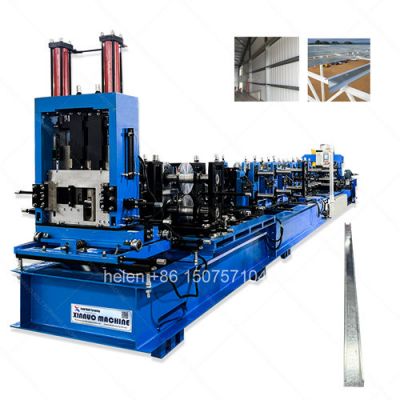
Hebei Xinnuo is a professional cold roll forming machinery manufacturer with 20+ years of experience. We specialize in C/Z purlin machines, roof panel roll formers, floor deck machines, and custom profile solutions — exported to 50+ countries worldwide.