helen@hbxinnuorollforming.com


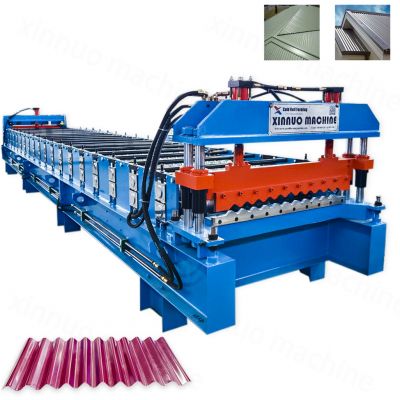
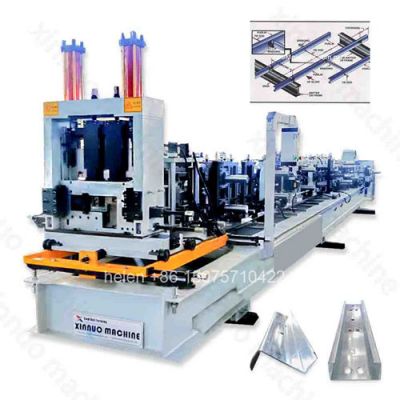
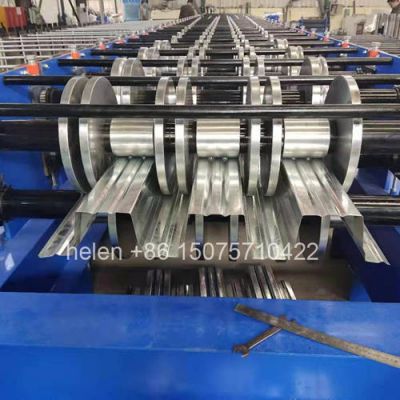
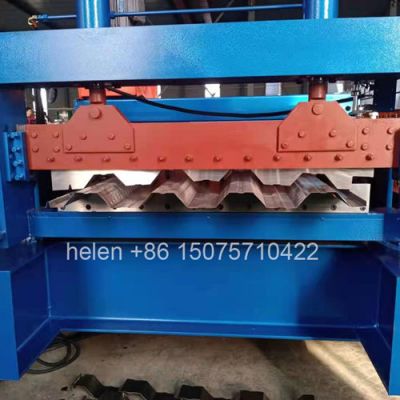
Dedicated 750 type floor deck roll forming production line equipment
3-rib trapezoidal profile, 750mm coverage, 53mm depth, 1000mm coil
Twin 11KW drive, 24-26 stations, dimple emboss, hydraulic shear
World's most popular floor deck profile — standard in 60+ countries
The 750 type floor deck profile — 750mm effective coverage, 3 trapezoidal ribs, 53mm rib depth — is the single most produced floor deck profile worldwide. Its near-universal adoption across 60+ countries is not accidental. The 750 profile sits at the geometric sweet spot of floor deck design: deep enough ribs for reliable composite action and 3.0-3.5m unpropped spans, wide enough coverage for efficient installation (fewer panels per floor area), yet shallow enough to form with a standard-duty machine at competitive production speeds. The 1000mm feed width is the most commonly available galvanized coil width globally — meaning 750 deck manufacturers have more steel suppliers to choose from and better pricing leverage than manufacturers of wider profiles requiring 1250mm coil. For a decking business entering the market or expanding capacity, the 750 type is the lowest-risk, highest-volume profile choice.
| Dimension | Value | Tolerance | Measurement Reference |
|---|---|---|---|
| Effective Coverage Width | 750mm | ±2mm | Measured across panel from overlap rib center to underlap rib center, at both ends and mid-panel |
| Overall Panel Width | ~810mm (including side lap) | ±2mm | Measured from panel outer edge to outer edge including overlap rib |
| Rib Count | 3 trapezoidal ribs | Fixed | Visual count — 3 ribs per panel, plus one side lap rib at each edge |
| Rib Depth | 53mm | ±1mm | Measured from rib crest (top) to panel soffit (underside between ribs) with depth micrometer |
| Rib Spacing (Center-to-Center) | ~250mm | ±1.5mm | Measured from center of rib 1 throat to center of rib 2 throat, repeat for rib 2 to rib 3 |
| Rib Crest Width (Top Flat) | ~35-40mm | ±1mm | Flat surface at top of each rib — measured across the flat portion, excluding corner radii |
| Rib Base Width (Inter-Rib Flat) | ~55-60mm | ±1mm | Flat area between ribs — measured as the clear flat distance between adjacent rib wall base transitions |
| Rib Wall Angle | 3-5° outward from vertical | ±0.5° | Measured with digital angle gauge on rib wall face. Outward taper is essential for concrete flow into ribs |
| Feed Width (Coil Input) | 1000mm | +3/-0mm | Coil width required to develop the full 750mm coverage + 53mm rib depth × 3 ribs + side laps |
| Side Lap Overlap Width | ~30mm (one full rib width) | ±1mm | Overlap rib of panel 2 sits on underlap rib of panel 1 — measured as engaged contact width |
| Component | Specification | 750-Specific Notes |
|---|---|---|
| Main Frame | 400H Laisteel I-beam, 10mm wing | Standard frame sufficient for 53mm rib depth. 750 profile does not require the 450H heavy frame used for 75mm+ deep ribs. |
| Forming Stations | 24 rows (standard), 26 rows (heavy gauge) | 24 rows sufficient for 0.8-1.2mm gauge. Add 2 rows for 1.2-1.5mm — extra stations ensure gradual forming without thinning at the deeper gauge. |
| Motor Power | 2 × 11KW (8#), balanced dual drive | Twin motor standard for 3-rib forming — ensures even torque distribution across panel width. Single motor insufficient for consistent rib geometry. |
| Drive Chain | 2-inch pitch heavy series | Standard chain adequate for 750 forming forces. 2.5-inch upgrade only if production is primarily 1.5mm gauge. |
| Forming Shafts | Φ95mm, 100mm round bar, chrome 0.03mm | Standard shaft diameter sufficient. Φ115mm upgrade available for extended wear life on high-volume continuous production. |
| Forming Speed | 12-15 m/min (0.8-1.0mm gauge), 10-12 m/min (1.2-1.5mm gauge) | 750 profile strikes the best speed-to-quality balance among all floor deck types. Faster than deep-rib 915 (8-10 m/min), comparable to shallow-rib 600 (12-15 m/min). |
| Dimple Station | Clutch-controlled, 3-rib embossment pattern | Dimple pattern specific to 750 rib geometry. Dimples on all 6 rib wall faces (3 ribs × 2 walls each). Clutch disengages after strip entry. |
| Cutoff System | Dual-cylinder floor shear, Cr12MoV blades | Cutting width ~810mm (overall panel width including side laps). Blade length ~900mm with end clearance. |
| Decoiler | 5-ton hydraulic, 1000mm width capacity | Standard decoiler sufficient. 1000mm coil is lighter per linear meter than 1250mm — less decoiler load at equivalent coil diameter. |
| Line Length | ~20m total | Shorter than deep-rib machines (22m for 915). Saves factory floor space — fits in 20m bay, common in industrial buildings. |
| Economic Factor | 750 Type Value | Comparison vs. Other Profiles |
|---|---|---|
| Coil Cost per m² of Deck | 1000mm coil ÷ 750mm coverage = 1.333 linear meters of coil per m² of deck. At 0.9mm gauge: ~9.5 kg/m² steel used. | Vs. 600 type (1000mm ÷ 600mm = 1.667 m/m²): 20% less coil per m². Vs. 915 type (1250mm ÷ 915mm = 1.366 m/m²): comparable efficiency. 750 offers near-best material efficiency with standard coil width. |
| Production Speed per Shift | 12 m/min × 60 min × 7.5 effective hours = 5,400 linear meters/shift. 5,400m × 0.75m width = 4,050 m²/shift. | Vs. 915 type at 8 m/min: 2,700 m²/shift. 750 produces 50% more area per shift than deep-rib profiles. Labor cost per m² is proportionally lower. |
| Coil Availability | 1000mm width — most common galvanized coil width globally. Available from virtually every steel mill. Competitive pricing from multiple suppliers. | Vs. 1250mm coil for 870/915/1000 profiles: fewer mills produce 1250mm, longer lead times, higher minimum order quantities, 5-10% price premium per ton. |
| Machine Investment | Standard-duty machine: 24 stations, 2×11KW, 400H frame. Lower capital cost than deep-rib or dovetail machines. | Approx. 20-25% lower machine cost vs. 915-type machine. Approx. 30-35% lower vs. dovetail machine. Faster payback for new market entrants. |
| Installation Labor | 750mm coverage × 3 ribs: 1.33 panels per linear meter of floor. For 3m span: 2.25 panels installed per minute by 3-person crew. | Vs. 600 type (1.67 panels/m): 20% fewer panels to install per floor area. Vs. 1025 type (0.98 panels/m): 1025 is faster to install but limited market demand. |
| Transport Efficiency | 750mm coverage, typical bundle 2 tons, ~40 panels per bundle. 12 bundles per truck = 360 m² per truckload. | Comparable to most profiles. Wider profiles (915/1000) get more m² per truckload — but this advantage only matters if market demand for those profiles exists. |
| Slab Depth | Gauge | Single Span (Unpropped) | Single Prop at Mid-Span | Composite Imposed Load |
|---|---|---|---|---|
| 120mm | 0.8mm | 2.2m | 3.2m | 3.0 kN/m² (office) |
| 120mm | 0.9mm | 2.5m | 3.5m | 4.0 kN/m² (office/light retail) |
| 120mm | 1.0mm | 2.8m | 4.0m | 5.0 kN/m² (retail) |
| 120mm | 1.2mm | 3.2m | 4.5m | 5.0 kN/m² (retail/light industrial) |
| 130mm | 0.9mm | 2.8m | 4.0m | 4.0 kN/m² (office) |
| 130mm | 1.0mm | 3.0m | 4.2m | 5.0 kN/m² (retail) |
| 130mm | 1.2mm | 3.5m | 4.8m | 7.5 kN/m² (heavy retail/storage) |
| 150mm | 0.9mm | 3.0m | 4.2m | 4.0 kN/m² (office) |
| 150mm | 1.0mm | 3.3m | 4.5m | 5.0 kN/m² (retail) |
| 150mm | 1.2mm | 3.8m | 5.0m | 7.5 kN/m² (heavy retail/storage) |
Note: Values are indicative for preliminary planning. Final design must be verified by a qualified structural engineer per applicable building code. Actual performance depends on steel grade, concrete cylinder strength (typically C25/30 minimum), shear stud configuration, and project-specific loading conditions.
| Station Group | Rows | What Happens to the Steel Strip |
|---|---|---|
| Entry Guide | Pre-form | 1000mm wide flat strip enters through side guides. Centered to ±0.5mm. Leveling rollers remove residual coil curvature. |
| Dimple Embossment | 1 | Clutch-controlled embossing wheel stamps dimple pattern into the 6 rib wall zones. Pattern is imprinted while strip is still flat — ensures uniform embossment depth unaffected by subsequent bending. |
| Edge Forming | 2-4 | Left edge underlap rib and right edge overlap rib begin forming. Edge ribs are formed before the main ribs — edges act as strip guides for the central forming zone. |
| Rib Initiation | 5-8 | Three central ribs begin lifting from the flat strip. Outer ribs initiated first, center rib follows. Each station lifts ribs 8-12mm — progressive deepening prevents material stress concentration. |
| Rib Deepening | 9-16 | Ribs deepen to 30-45mm. Inter-rib flats are established. Rib wall angle set at 3-5° outward taper. This is the highest-forming-force phase — twin motor torque is fully utilized here. |
| Final Depth & Sizing | 17-22 | Ribs reach full 53mm depth. Final wall angle locked in. Rib crest flattened. Side lap geometry finalized. Station 22 is the last geometry-changing station. |
| Straightening | 23-24 | Straightening roller set removes any camber or twist. Panel exits forming unit straight within 2mm per 3m. Final profile geometry verified. |
| Cutoff | Post-form | PLC triggers hydraulic shear at preset length. Dual cylinders deliver balanced cut across 810mm panel width. Panel drops to run-out table. |
| Country / Region | 750 Adoption Status | Local Specification Context |
|---|---|---|
| United Kingdom | Primary standard — the most common composite deck profile in UK steel-frame construction. Specified on 60-70% of commercial projects. | BS 5950 / Eurocode design. CF46 or ComFlor 46 equivalent profiles. SCI (Steel Construction Institute) published load tables. CE Marking mandatory. |
| Australia | Primary standard — Condeck HP (750mm coverage) is the dominant profile in Australian steel construction. | AS 2327.1 composite design. Formwork code AS 3610. Bond testing to AS 2327.1 Appendix A. Fielders and Lysaght are major suppliers. |
| New Zealand | Primary standard — same profile as Australia. Seismic provisions in NZS 3404 require cyclic bond performance verification. | NZS 3404 Steel Structures Standard. HERA (Heavy Engineering Research Association) design guidance. Seismic testing often required for Wellington/Christchurch zones. |
| South Africa | Primary standard — Bond-Dek (750mm) is the standard composite deck profile. Used in virtually all steel-frame commercial buildings. | SANS 10162 Steel Design. Bond-Dek published load tables. Local manufacturers supply to standard specification. Strong established market. |
| Middle East (UAE, Qatar, Saudi Arabia) | Common — 750 specified alongside 688 and 870. Project-specific profile selection by structural engineer. | Eurocode / BS-based design. Dubai Civil Defence fire approval required. Large project volumes suit dedicated 750 production runs. |
| Southeast Asia (Philippines, Malaysia) | Growing adoption — 750 is the most common imported profile. Local manufacturing expanding. | NSCP (Philippines) / MS (Malaysia) standards. Engineers default to 750 as the standard composite deck — ideal for new market entrants. |
| India | Emerging standard — 750 gaining traction as composite deck becomes more widely specified. Competition from 688 and 1000 profiles. | IS 11384 composite construction code. Price-sensitive market — efficient 750 production cost is a competitive advantage. |
| Panel Length (m) | Panels per Hour (12 m/min) | m² per Hour | m² per 8h Shift | Coil Consumption (tons/shift) |
|---|---|---|---|---|
| 2.0 | 360 | 540 | 4,050 | ~38 (0.9mm gauge) |
| 2.5 | 288 | 540 | 4,050 | ~38 (0.9mm gauge) |
| 3.0 | 240 | 540 | 4,050 | ~38 (0.9mm gauge) |
| 3.5 | 206 | 540 | 4,050 | ~38 (0.9mm gauge) |
| 4.0 | 180 | 540 | 4,050 | ~38 (0.9mm gauge) |
| 4.5 | 160 | 540 | 4,050 | ~38 (0.9mm gauge) |
| 5.0 | 144 | 540 | 4,050 | ~38 (0.9mm gauge) |
Note: Output is constant in m²/hour regardless of panel length — machine speed is linear meters. Panel count varies inversely with length. Coil consumption assumes 7.5 effective production hours. 0.9mm gauge × 1000mm coil = ~9.42 kg/m². Add 2% for cut-off ends and startup scrap.
| Setup Step | Action | Time |
|---|---|---|
| 1. Coil Loading | Forklift positions 5-ton coil on decoiler mandrel. Expand mandrel, remove coil straps. Thread strip through entry guide and leveler to first forming station. | 10-15 min |
| 2. PLC Programming | Enter: panel length, batch quantity, production speed. Select 750 profile recipe (pre-loaded with all roller gap settings reference). Verify encoder calibration. | 3-5 min |
| 3. First-Off Panel | Run first panel at slow speed (5 m/min). Stop. Measure: coverage width at both ends and mid-panel, rib depth on all 3 ribs, cut squareness. Record in shift log. | 5 min |
| 4. Adjust if Needed | If any dimension out of tolerance, adjust relevant station roller gaps. Re-run test panel. Repeat until all dimensions pass. | 5-15 min |
| 5. Ramp to Production Speed | Step speed: 5 → 8 → 10 → 12 m/min. Check panel quality at each speed step. Once quality confirmed at 12 m/min, begin continuous production. | 5 min |
| Total Setup from Cold Machine | 30-45 min |
Hebei Xinnuo is a professional cold roll forming machinery manufacturer with 20+ years of experience. We specialize in C/Z purlin machines, roof panel roll formers, floor deck machines, and custom profile solutions — exported to 50+ countries worldwide.