helen@hbxinnuorollforming.com


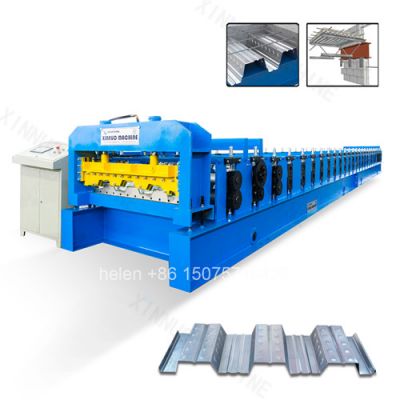
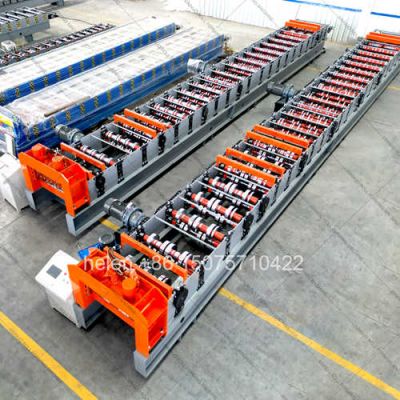
Reinforced 450H frame floor deck roll former for thick gauge production
Twin 15KW motor drive, 30-36 station forming with 2.5-inch chain
Processes 0.8-1.5mm G550 high-strength steel coil at 10-12 m/min
Heavy mid-plate, large shaft, enhanced anti-pooling, floor shear
A heavy duty floor deck roll former is not simply a standard deck machine with a larger motor. It is an entirely different build class — engineered for the punishing combination of thick material (up to 1.5mm), high-strength steel (G550 grade, 550 MPa yield), deep rib profiles (60-76mm), and sustained multi-shift production. The frame, shafts, drive system, and anti-pooling mechanisms are all upgraded beyond the standard specification to handle forming forces that would distort or stall a standard-duty machine within months of operation. This machine is built for deck manufacturers who run 16-24 hours daily, produce for long-span or heavy-load applications, or compete in markets where G550 high-strength deck is the norm rather than the exception.
| Component | Standard Duty | Heavy Duty (This Machine) | Why It Matters |
|---|---|---|---|
| Main Frame | 400H I-beam, 10mm wing | 450H I-beam, 12mm wing, stress-relieved | Stiffer bed eliminates frame twist under deep-rib G550 forming loads; stress relief prevents weld cracking after years of vibration |
| Mid-Plate Thickness | 18-22mm | 25mm, CNC line-bored | Carries increased torque from 15KW motors without flexing; line-bored bores ensure shaft parallelism across full machine length |
| Forming Shafts | Φ95mm | Φ115mm from 100mm round bar | 21% larger diameter resists bending under heavy-gauge forming; maintains roller alignment at maximum material resistance |
| Motor Power | 2 × 11KW (8# motor) | 2 × 15KW (10# motor) | 36% more torque for G550 steel; no stalling on 1.5mm gauge at production speed |
| Drive Chain | 2-inch pitch | 2.5-inch pitch, heavy series | 25% larger chain handles increased drive load; reduced elongation rate under sustained high-torque operation |
| Forming Stations | 22-28 rows | 30-36 rows | More progressive forming steps for G550 — high-strength steel springback requires gentler incremental deformation per pass |
| Gear Drive Boosters | 3 locations | 5 locations — dimple station, mid-section, oversized wheel entry, sizing entry, exit row | Additional torque injection points overcome the higher forming resistance of thick, high-strength material at critical forming stages |
| Shear Capacity | 1.5mm max, G345 | 1.5mm max, G550 (requires ~40% more cutting force) | Cr12MoV blade + larger hydraulic cylinders + higher system pressure to cleanly shear high-tensile steel without burr |
| Decoiler | 5-ton hydraulic | 8-ton hydraulic with reinforced mandrel | Handles heavier coils for longer uninterrupted runs; reinforced mandrel bearings for frequent coil cycling |
| Machine Weight | ~12-15 tons | ~18-22 tons | Additional steel mass = vibration damping = better surface finish on high-strength panels |
| Material Property | Standard G345 Steel | G550 High-Strength Steel | Machine Design Implication |
|---|---|---|---|
| Yield Strength | 345 MPa | 550 MPa (59% higher) | Forming force increases proportionally — every station experiences 60% higher roller reaction forces. Frame, shafts, and bearings must be sized accordingly. |
| Tensile Strength | 450 MPa | 570 MPa minimum | Cutoff shear requires correspondingly higher force. Standard shear hydraulics will stall or produce incomplete cuts on G550 at 1.5mm gauge. |
| Springback After Forming | Moderate — 2-5° angular recovery after each bend station | High — 4-8° angular recovery. Each forming step achieves less net deformation. | More forming stations needed to achieve final profile geometry. Standard 22-row machine under-forms G550 profiles; 30+ rows required for dimensional accuracy. |
| Work Hardening Rate | Standard — material progressively hardens through bending but remains within design limits | Rapid — high-strength steel work-hardens faster at bend radii. Over-working in a single pass can embrittle the bend zone. | Incremental deformation per pass must be smaller. More stations sharing the total forming load = gentler bending per station = no work hardening failure. |
| Surface Hardness (Post-Galvanizing) | Galvanized surface — zinc coating is softer than base steel. Rollers form through coating without scoring. | Hot-dip G550 may have a thin iron-zinc intermetallic layer at the surface — harder than pure zinc. Increases roller wear rate. | Forming rollers must be harder than standard (HRC 48-52 vs. HRC 45-50). Chrome plating must be thicker (0.05mm vs. 0.03mm) for wear resistance. |
| Coil Consistency | Mature production — thickness and property variation within normal mill tolerances | Thinner gauges (0.8-0.9mm G550) are more sensitive to coil thickness variation — 0.05mm variation has proportionally larger effect | Machine must maintain forming accuracy across the full coil tolerance range. Roller gap adjustment resolution must be finer — standard 0.1mm adjustment steps are too coarse for G550 thin gauge. |
| Stage | Device | Heavy Duty Upgrade Detail | Why Standard Duty Fails Here |
|---|---|---|---|
| 1 | Clutch-Controlled Dimple Wheel | Heavy series electromagnetic clutch rated for 2× standard torque. Positive engagement dogs (not friction plate) — no slip under G550 dimple forming resistance. | Standard friction clutch slips when dimpling G550 — inconsistent embossment depth, accelerated clutch wear, replacement required every 6-12 months |
| 2 | Bearing-Mounted Oversized Rear Rollers | Double-row spherical roller bearings (not standard deep-groove ball). Handles combined radial + axial loads from G550 material springback pushing rollers sideways. | Standard ball bearings fail within 12-18 months under G550 side loads. Spherical rollers accept 3× the axial load — machine runs years between bearing changes. |
| 3 | Pressure Reinforcement Bars | Hardened and ground bar surface, 50mm diameter (standard 40mm). Hydraulic pre-load system — operator sets exact pressure, not manual torque wrench guesswork. | Manual pressure bars drift during production runs — operator cannot feel 5% pressure loss. G550 demands consistent pressure; drift causes progressive springback increase through a coil run. |
| 4 | Gear Drive Boosters | Helical gear sets (not spur gears) at 5 locations. Helical teeth engage progressively — quieter, smoother, handles shock loading when G550 material enters station. | Spur gears at 3 locations transmit torque as impact pulses when material enters — shock loading on chains. G550 amplifies this effect due to higher entry resistance. |
| 5 | Dual-Cylinder Floor Shear | Larger bore hydraulic cylinders (100mm vs. 80mm standard). Higher system pressure (21 MPa vs. 16 MPa). Shear triggering synchronized via PLC — both cylinders fire within 10ms of each other. | Standard shear on G550: one cylinder leads, panel twists during cut, edge flaring up to 3mm. Synchronized triggering + balanced force = clean square cut every time. |
| Drive Component | Specification | Engineering Rationale |
|---|---|---|
| Main Motor (×2) | 15KW, 8-pole, 750 RPM, TEFC enclosure, Class F insulation | 8-pole motor delivers higher torque at lower speed than 4-pole — better match for forming speed range without gearbox losses. Class F insulation handles hot climate operation. |
| Motor Coupling | Flexible jaw coupling with polyurethane spider, 250mm diameter | Dampens torsional vibration from chain drive pulsation before it reaches motor bearings. Spider replacement is a 30-minute maintenance item — much cheaper than motor bearing failure. |
| Primary Reduction | Planetary gear reducer, 5:1 ratio, direct-coupled to motor | Reduces motor RPM before entering chain drive. Planetary design handles the high radial load from chain tension without output shaft deflection. |
| Drive Sprockets | 2.5-inch pitch, 18-tooth, induction-hardened teeth to HRC 50-55 | Larger pitch distributes chain pull force over larger tooth area. Hardened teeth resist wear from the constant tension of high-torque G550 forming. |
| Drive Chain | 2.5-inch pitch heavy series roller chain, 4-strand at primary drive sprocket | Multi-strand at primary sprocket splits the load — no single chain link carries full motor torque. Provides redundancy: if one strand fails, others maintain drive until scheduled stop. |
| Chain Tensioner | Spring-loaded idler sprocket with hydraulic damping cartridge | Chain length changes with temperature and wear. Spring maintains constant tension; hydraulic damper prevents oscillation at production speed — removes the clicking noise of loose chain on start-stop cycles. |
| Lubrication | Automatic brush-oiler system, 3L reservoir, adjustable drip rate | 2.5-inch chain running at production speed generates friction heat. Continuous lubrication is mandatory — manual greasing cannot keep up with the oil film breakdown rate under heavy load. |
| Capability | Standard Duty Limit | Heavy Duty Capability | Market Advantage |
|---|---|---|---|
| Maximum Material Gauge | 1.2mm G345 | 1.5mm G550 | Can produce the heaviest deck panels specified for parking structures, industrial floors, and long-span applications your competitors with standard machines cannot bid on |
| Maximum Rib Depth | 60mm | 76mm (915 type) | Deeper rib = longer unpropped span. Architects and engineers prefer deeper decks for open-plan buildings — you capture the premium end of the market |
| Sustained Daily Runtime | 8-12 hours | 24 hours continuous | 3× production capacity from same floor space and same operator headcount per shift. Amortize machine cost over 3× the output volume |
| Profile Range (Single Machine) | 510-750 type | 510-915 type (with cassette change) | Wider market coverage without second machine investment. Serve residential mezzanine through high-rise commercial from one production line |
| Annual Output (Single Shift) | ~90,000m² | ~110,000m² (faster setup, less downtime) | 23% more output from same labor cost — heavy duty reliability keeps the line running when standard machines are being adjusted or repaired |
| Coil Width Capacity | 1000mm | 1250mm | Access to the 870/915/1000/1025 market segment — these require 1250mm coil input and heavier forming forces that standard frames cannot sustain |
| Roller Set Life (G550 Production) | 3-5 years | 5-8 years | Harder rollers (HRC 48-52) and thicker chrome (0.05mm) extend service intervals on abrasive G550 material. Lower per-year tooling cost amortized over longer life |
| Requirement | Standard Machine | Heavy Duty Machine | Reason for Difference |
|---|---|---|---|
| Foundation Type | Flat reinforced concrete floor, no anchors | Reinforced concrete plinth, 300mm minimum thickness, anchor bolts at frame base plates | 18-22 ton machine weight + dynamic forming forces require positive anchorage. Unanchored machine will walk across the floor over months of operation. |
| Floor Load | 3 tons/m² | 5 tons/m² under forming unit | Heavier machine on smaller footprint = higher ground pressure. Verify with structural engineer if installing on suspended floor. |
| Leveling Tolerance | ±3mm across full frame length | ±1mm across full frame length | Tighter leveling tolerance required because G550 springback amplifies the effect of any frame twist. 1mm out of level at frame = measurable profile asymmetry in finished panel. |
| Power Supply | 380V, 50Hz, 100A | 380V, 50Hz, 150A | 30KW main motor + 5.5KW hydraulic pump + controls = higher total connected load. Larger circuit breaker and cable cross-section required. |
| Installation Time | 3-5 days | 5-7 days | Heavier components require more crane time. Precision leveling takes additional 1-2 days. Grouting anchor bolts adds curing time before machine can be operated. |
| Commissioning Material | 2-3 coils for trial runs | 3-5 coils, including the actual G550 gauge that will be production standard | All forming parameters are set for the specific G550 material to be run. Commissioning with standard G345 and then switching to G550 will require re-adjustment. |
| Cost Item | Standard Duty (10 Years) | Heavy Duty (10 Years) | Difference |
|---|---|---|---|
| Machine Purchase Price | Lower initial investment | 25-35% higher initial investment | Higher upfront cost — the price of durability |
| Chain Replacement | Every 2-3 years × 3-4 replacements | Every 4-5 years × 2 replacements | 2.5-inch heavy chain lasts longer; fewer replacements reduce downtime and parts cost |
| Bearing Replacement | Spherical roller bearings at 5-7 year interval, full set | Spherical roller bearings at 8-10 year interval, full set | Over-spec bearings from factory extend interval; one replacement event saved over machine life |
| Roller Re-Chroming | Every 3-4 years for G345; every 2 years for G550 | Every 5-6 years for G550 | Thicker chrome = longer between re-chroming. Over 10 years: standard needs 3-5 re-chromes; heavy duty needs 1-2 |
| Production Downtime | ~15-20 days/year (maintenance + repairs + adjustments) | ~8-12 days/year | Every day of downtime costs a day of production revenue. Heavy duty saves 7-8 production days per year. |
| Energy Cost | 22KW × 70% load × hours | 30KW × 70% load × hours | Higher motor power = higher electricity bill. Offsetting factor: fewer start-stop cycles from fewer breakdowns |
| Scrap / Rework Rate | 2-4% of production (adjustment periods, startup after repair) | 1-2% of production | Better consistency = less waste. On 100,000m² annual output, 2% difference = 2,000m² less scrap per year |
| Residual Value at 10 Years | 15-25% of purchase price | 30-40% of purchase price | Heavy duty machine in good condition retains higher resale value — second-hand buyers specifically seek heavy duty for G550 production |
| Net TCO Difference Over 10 Years | Heavy duty typically 10-18% lower TCO despite higher purchase price — driven by reduced downtime, fewer part replacements, and lower scrap rate | ||
Hebei Xinnuo is a professional cold roll forming machinery manufacturer with 20+ years of experience. We specialize in C/Z purlin machines, roof panel roll formers, floor deck machines, and custom profile solutions — exported to 50+ countries worldwide.