helen@hbxinnuorollforming.com
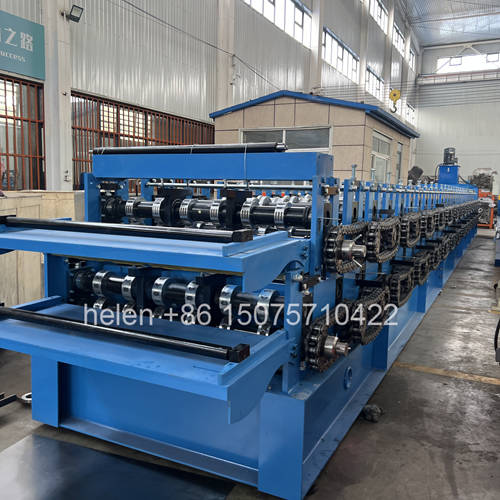
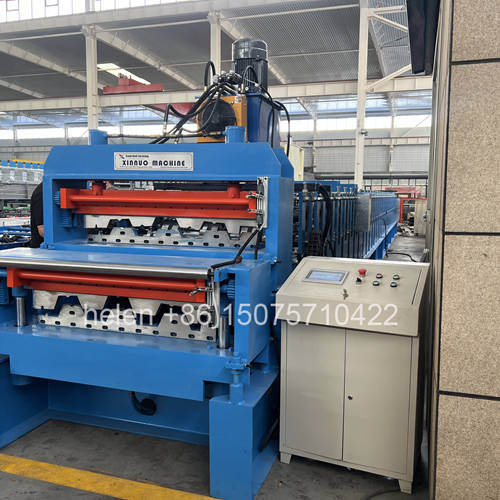
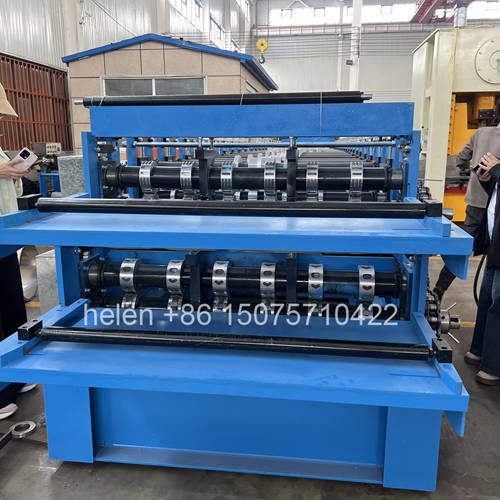
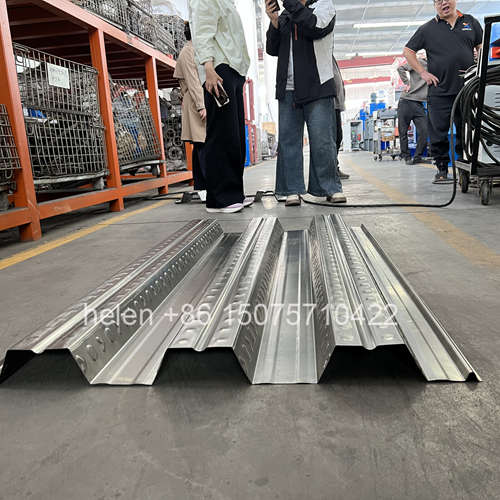
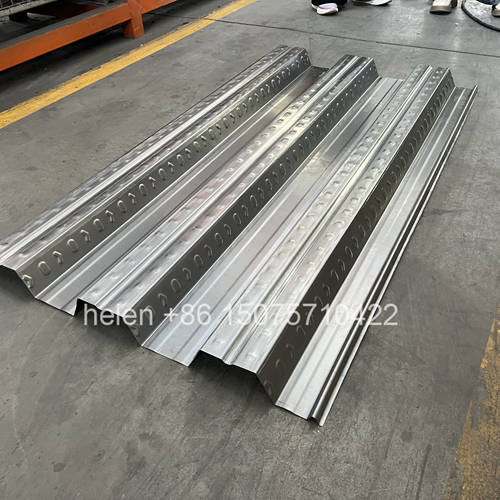
- Stacking two decks concentrates capability into one machine position
- Concentration also concentrates risk onto single shared components
- One shared drive and selector serve both decks in turn
- A failure in the shared system stops both products, not one
- The machine provides no redundancy where redundancy may matter
- Spares strategy for a shared machine differs from a dedicated one
- Risk should be quantified before the design is chosen, not after
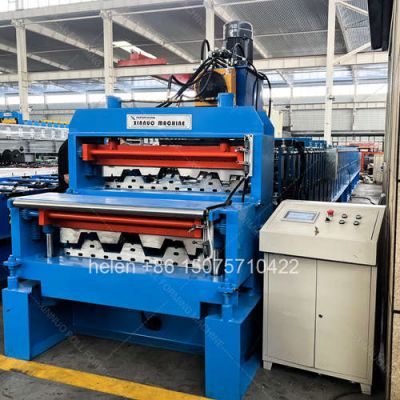
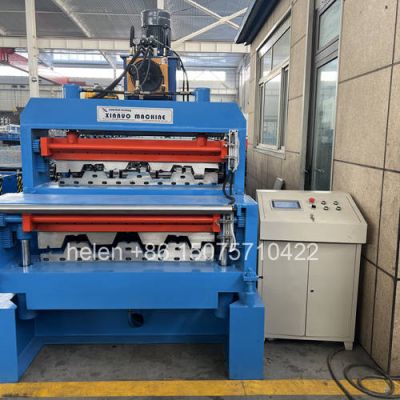
A double layer metal deck machine delivers two products from one frame, one drive, one foundation and one operating position. That concentration is the whole commercial case for the design, and it is also its principal risk. Where two separate machines would each be capable of producing their own profile independently, a stacked machine has shared elements on which both products depend — and a failure in any of those elements stops both profiles at once.
This page sets out the risk profile of a stacked deck machine in operational terms: which components are shared and what each one actually serves, which of them constitute genuine single points of failure, how the one-at-a-time constraint behaves as a production risk rather than merely an inconvenience, a risk register with practical mitigations, how a spare parts strategy has to change when one machine serves two products, how production planning and delivery commitments can be structured to absorb the exposure, and the conditions under which the risk profile argues against the stacked design altogether. The purpose is not to argue against the configuration, but to ensure the decision is made with the exposure understood and priced.
| Shared Element | What It Serves | Consequence If It Fails |
|---|---|---|
| Frame | Both deck carriages are mounted in one welded structure | A structural issue affects both products. There is no second machine to continue production while the first is repaired. |
| Transmission and selector | One chain arrangement with a selector drives whichever deck is active | Neither deck can run. This is the most consequential shared element, because it is mechanical, loaded continuously, and common to both profiles. |
| Main motors | The dual motor configuration drives the shared transmission | A motor or drive fault stops production entirely rather than halving it. |
| Shear | Both decks discharge through the same dual-cylinder shear | Panels can be formed but not cut to length, so no finished product leaves the line. |
| Control system | One PLC, one HMI, one set of stored recipes for both decks | Loss of the control system stops both profiles, and loss of stored recipes means parameters must be re-entered from records. |
| Decoiler and entry arrangement | Coil loading and strip entry serve whichever deck is active | A failure at the entry stops both products despite the forming trains themselves being sound. |
| Foundation and position | Both decks are supported by one base at one location | Any issue with the base or the position affects the whole machine, with no second position available to relocate to. |
| Operating crew | One crew runs both profiles | Absence of the trained operator stops both products, where two machines would have allowed partial cover. |
| Component | What Stops | Exposure Character | Practical Mitigation |
|---|---|---|---|
| Drive chain | Both decks | Consumable by nature, loaded continuously, and its condition degrades gradually rather than suddenly. | Replacement set held on site, with a defined replacement interval and regular tension inspection rather than running to failure. |
| Selector mechanism | The deck not currently in use, and often the active one too | Mechanically complex relative to the rest of the transmission, and exercised at every changeover. | Regular inspection and lubrication as a scheduled item, not a reaction to symptoms. |
| Main motor | Both decks | A single failure removes all forming capability. | Overload and thermal protection correctly set, and motor specification matched to the actual duty so it is not run at its limit. |
| Shear cylinders and hydraulic circuit | Both decks | Common to both profiles; a seal or hose failure halts output even though forming continues. | Full seal and hose set held on site, since these cannot be improvised locally to a matching pressure rating. |
| Encoder and length measurement | Both decks | Failure produces incorrect lengths rather than an obvious stoppage, so it can go unnoticed for a period. | Spare unit held on site; cut length checked as routine practice rather than only after a complaint. |
| PLC and control components | Both decks | Faults in the control system are the hardest to diagnose without a known-good substitution available. | Contactors, relays, switches and circuit protection held in matching ratings; recipes recorded outside the controller. |
| Trained operator | Both decks | Knowledge held by one or two people is a genuine production dependency. | Cross-training and a written changeover procedure so the capability belongs to the business rather than to an individual. |
| Coil supply | The active deck | A single blank width serving both profiles means one coil specification failure affects both. | Coil specification documented per deck, with suppliers qualified for the required width and gauge. |
| Scenario | Effect on the Business |
|---|---|
| Both profiles needed in the same week | Achievable, with changeover time paid twice. The cost is manageable but recurring, and it competes with productive hours. |
| Both profiles needed on the same day | Achievable only by running short batches and switching repeatedly, which multiplies changeover cost and pushes the line toward its practical limit. |
| A large order for one profile coincides with steady demand for the other | The long run blocks the second product for its duration. Customers of the waiting profile experience a delay that has nothing to do with their own order. |
| A breakdown occurs during a long run of one profile | Neither product is available. Two separate machines would have allowed the unaffected product to continue. |
| One profile's market softens | The machine's utilisation falls, and the capital cost is carried on a reduced output base. A second machine could have been left idle instead, but a shared machine cannot be partly idle. |
| A new competitor enters one market segment | The response is constrained by the fact that promoting the threatened profile displaces production of the other one. |
| Delivery commitments tighten without warning | Capacity cannot be added by starting a second line, because there is only one. Any temporary increase requires overtime on the single machine. |
| Risk | Exposure Character | Mitigation | Residual Position |
|---|---|---|---|
| Shared drive failure | High impact, moderate likelihood over the machine's life | Spare chain and sprocket set on site, scheduled replacement interval, disciplined lubrication | Reduced to a planned interruption rather than an indefinite stoppage, provided the spares are genuinely on site. |
| Shear failure | High impact, moderate likelihood | Spare blade set for rotation during regrinding, full seal and hose kit, hydraulic oil of the specified grade held on site | Substantially reduced. Blade and seal work can be done during planned downtime. |
| Control system fault | High impact, low to moderate likelihood | Matching contactors, relays and switches held; recipes recorded on paper and in files outside the controller | Reduced to a diagnostic and swap operation rather than a waiting period. |
| Second deck not run for months | Moderate impact, high likelihood in some operations | Run the second deck periodically even when not required for orders, to keep the tooling and mechanism exercised | Reduced. An unused deck is a deck whose first production run after months of standing may reveal avoidable problems. |
| Changeover time drifting upward | Moderate impact, high likelihood without management | Written changeover procedure, recorded changeover times, and a defined pre-changeover checklist | Reduced. Drift is a management outcome, not a machine outcome. |
| Single operator dependency | High impact, moderate likelihood | Cross-training across both decks and documented procedures | Reduced. The capability is held by the business rather than by a person. |
| Coil supply interruption | Moderate to high impact | Qualified second supplier for the blank width and gauge, and a documented coil specification per deck | Reduced but not eliminated, particularly where the blank width is not commonly stocked locally. |
| Loss of both products simultaneously | High impact, inherent to the design | Cannot be fully mitigated within a single stacked machine | Residual risk remains. This is the exposure that a second machine removes and a stacked machine cannot. |
| Category | On a Two-Deck Machine | Why It Differs From a Single Deck Line |
|---|---|---|
| Shared items | One set serves both decks, but a failure stops both. Held quantity must reflect the whole machine's exposure rather than one product's. | The consequence of a shared part failing is double what the same part failing on a dedicated machine would be. |
| Per-deck items | Bearings, rollers, guides and embedded provision exist twice, once for each deck. | Stock levels should be set per deck rather than per machine, since the two sets wear independently and are not interchangeable. |
| Embossing provision | Each deck has its own embossing row and its own speed-matching arrangement. | These are critical, difficult to source locally, and exist in two variants within the same machine. |
| Shear and blades | A single arrangement shared by both products. | Blade wear is driven by total machine throughput rather than by the volume of one profile. |
| Control components | One system serving both decks. | Holding a known-good replacement for each control component matters more than on a machine where a second line is running. |
| Documentation | Two section drawings, two recipe sets, one set of schematics. | Identifying a part for the correct deck is a real risk in itself, which is why per-deck identification in the parts list matters. |
| Practice | Effect on Exposure |
|---|---|
| Batch by profile rather than by order | Converts multiple changeovers into one and concentrates production of each profile into a defined period, which is the single largest control available. |
| Hold buffer stock of the lower-volume profile | Allows the machine to stay on the high-volume profile for longer without the second product running out, decoupling the production schedule from the sales pattern. |
| Publish honest lead times | Customers tolerate a planned wait. They do not tolerate a delay discovered at the promised delivery date, and the cause is irrelevant to them. |
| Schedule the second deck periodically | Keeps both tooling sets and both mechanisms in working condition, and means the second profile is genuinely available when it is needed rather than theoretically available. |
| Track changeover times as a production metric | Makes drift visible and keeps the recurring cost of the stacked design under control. |
| Keep a documented maintenance and inspection schedule | Shifts shared-component failures from unplanned to planned, which is the difference between an interruption and a crisis. |
| Maintain a written contingency plan | States in advance what happens when the machine stops: which customers are told, in what order production resumes, and what is outsourced or deferred. |
| Condition | Verdict |
|---|---|
| Both profiles carry contractual delivery commitments | The stacked design concentrates both commitments on one machine. Where penalties attach to delivery, the exposure has a defined cost and should be weighed against the capital saving. |
| Neither profile can be outsourced as a fallback | Without an alternative source, a shared-component failure stops supply entirely. Two machines, or one machine plus an outsourcing arrangement, limit the exposure. |
| The business cannot hold a full spares kit | The mitigation for shared-component risk is parts on site. Where that provision is not made, the risk profile of the stacked design is materially worse than the same machine with proper stocking. |
| Only one person can run the machine | A single-operator dependency on a machine producing a business's entire output is a serious exposure, and it is a training decision rather than a machine decision. |
| The two profiles are both high volume | Simultaneous production is lost and the loss is large. Two machines are the appropriate answer where both products run continuously. |
| Rapid response to market shifts is the business's advantage | A stacked machine must choose which product to run. Where the ability to switch product emphasis quickly is commercially important, that constraint has real value attached to it. |
| The capital saving is decisive and volumes are modest | In this case the stacked design is likely correct, provided the spares, training and planning mitigations are all put in place at the outset rather than after the first stoppage. |
| Question | Why It Should Be Answered Explicitly |
|---|---|
| What is the cost of one week of total stoppage? | Converts the exposure into a number that can be compared against the capital saved by choosing one machine instead of two. |
| Which customers are affected, and what do they do? | Quantifies commercial rather than operational damage, which is usually the larger figure. |
| Can either profile be outsourced at short notice? | Determines whether a fallback exists at all, and therefore whether the exposure is bounded or unbounded. |
| What is the longest realistic lead time for the shared components? | Sets the minimum spares kit, since the kit exists to cover exactly this interval. |
| How many changeovers per week are expected? | The recurring cost of the stacked design, multiplied by a realistic frequency rather than an optimistic one. |
| Who is the second trained operator? | A single-operator dependency is a risk that can be removed entirely by training, and is often left unaddressed. |
| What happens to the second profile during a long run of the first? | Forces the question of buffer stock to be answered before it is answered by a customer complaint. |
| Is the mitigation plan written down and funded? | Risk mitigation that exists only as an intention provides no mitigation. The spares kit and the training either happen or they do not. |
| Parameter | Standard Range |
|---|---|
| Machine configuration | Two complete deck forming trains stacked vertically in one welded frame, sharing one transmission with a layer selector |
| Profile type | Open trapezoidal structural deck and closed re-entrant deck, produced to the buyer's drawings |
| Effective coverage width | 688 – 1025 mm per deck across the standard families; wider by drawing specification |
| Rib height | 39 – 153 mm on the deck layer, depending on profile class |
| Forming rows per deck | 18 – 36 rows on the deck layer, with the second layer specified against the row matching rule |
| Frame | 450H welded H-section with 10 mm flange thickness |
| Mid plate | 20 – 25 mm |
| Shaft | Φ95 – 115 mm round bar, rough turned then precision ground |
| Forming wheels | 45# forged steel, quenched to HRC 45 – 50, finish turned, keyed, polished and chrome plated, supplied per deck to its own drawing |
| Shared components | Frame, transmission and selector, main motors, shear, control system, decoiler and entry arrangement, foundation |
| Per-deck components | Roller sets, bearings, guides, embossing row with clutch arrangement, bearing-mounted oversized rear wheels, reinforcement bars, gear drives |
| Transmission | 2 inch or 2.5 inch external roller chain with a layer selector and positive layer indication |
| Motor configuration | 2 × 11 kW to 2 × 22 kW, set by the deck layer's maximum thickness requirement, with overload and thermal protection |
| Feed width | Matched across layers where possible; a difference within roughly 50 mm handled by guide block adjustment |
| Layer changeover | Approximately 5 – 15 minutes to reposition the material path and verify the first panel |
| Shear | Dual-cylinder hydraulic shear at floor level, shared by both decks, with gravity-assisted discharge |
| Blade options | Three-blade for the cleanest edge with approximately 10 mm trim waste, or two-blade for zero waste with negligible edge deformation |
| Material capability | Deck layer 0.8 – 1.5 mm; second layer to its own profile requirement; galvanized, aluminium-zinc coated and pre-painted coil |
| Forming speed | 8 – 18 m/min on the deck layer, depending on profile depth and material thickness |
| Cut length tolerance | ±1.5 mm |
| Control system | PLC with colour touchscreen HMI, sheet count control, explicit active-layer indication and a separate stored recipe bank per deck |
| Recommended spares provision | Full first-year kit covering both decks, including per-deck items and shared items, supplied with the machine rather than ordered afterwards |
| Electrical supply | 380 V / 50 Hz / 3-phase standard; alternative voltages and frequencies by destination |
| Certification | CE marking and ISO 9001:2015 compliant manufacturing, with destination-market documentation arranged as required |
Coil loading on the decoiler, strip entry through the guide, selection of the intended deck at the entry path, progressive forming on that deck with embossment at its dimple row, sizing over the final passes, length measurement, dual-cylinder cutting at floor level, and gravity discharge to the stacking position follow the established sequence, with the shared elements of the machine serving whichever deck is active and the mitigation measures above applied to those shared elements specifically.
Hebei Xinnuo is a professional cold roll forming machinery manufacturer with 20+ years of experience. We specialize in C/Z purlin machines, roof panel roll formers, floor deck machines, and custom profile solutions — exported to 50+ countries worldwide.