helen@hbxinnuorollforming.com
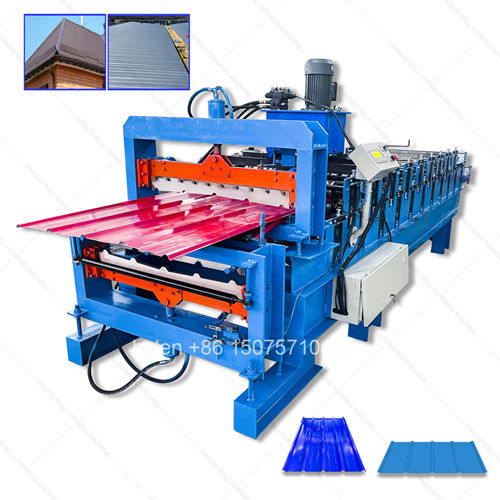
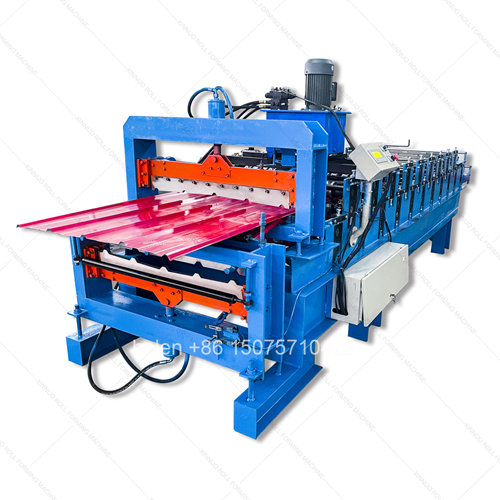
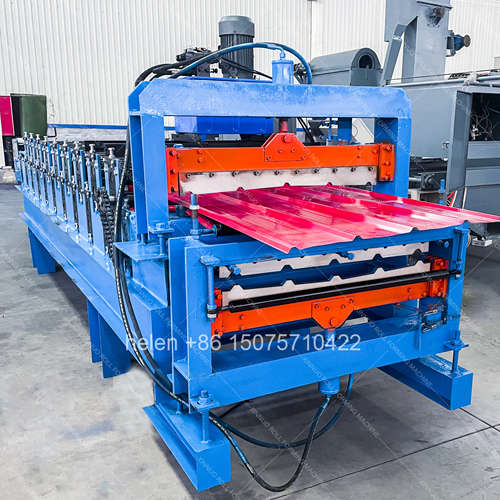
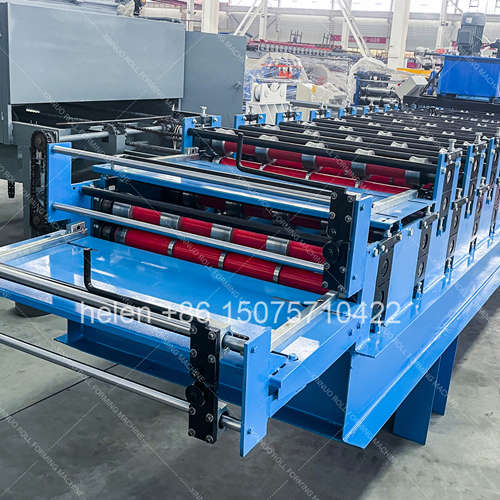
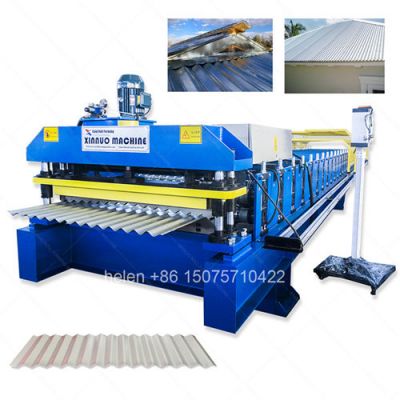
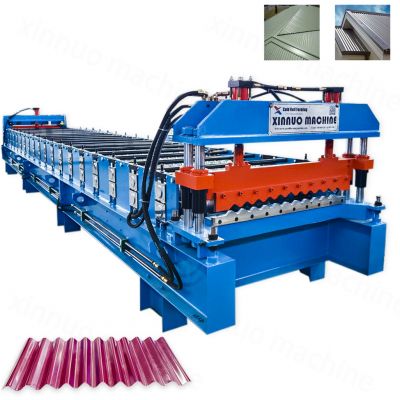
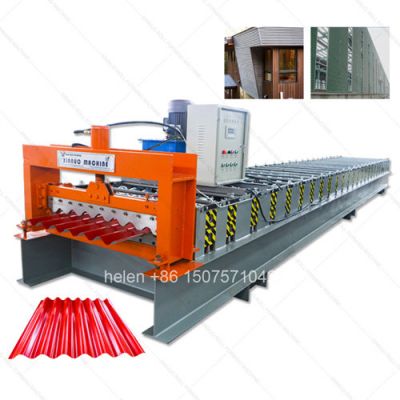
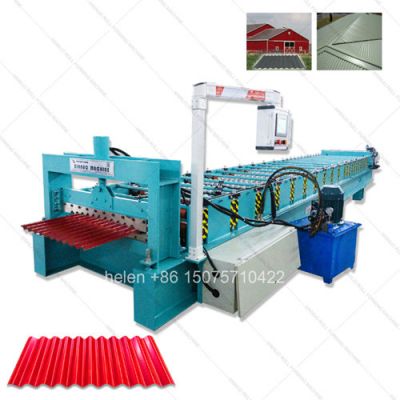
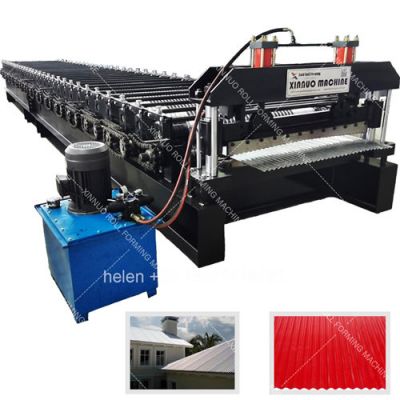
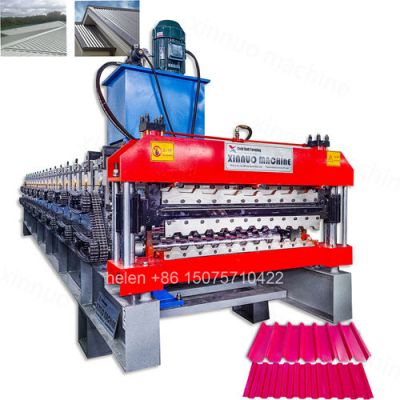
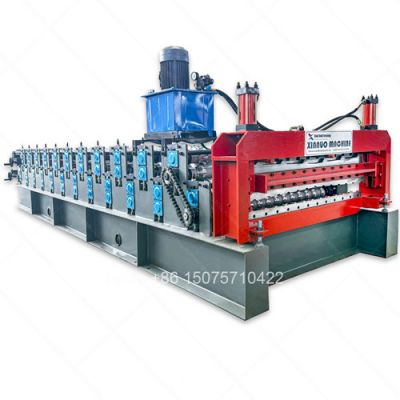
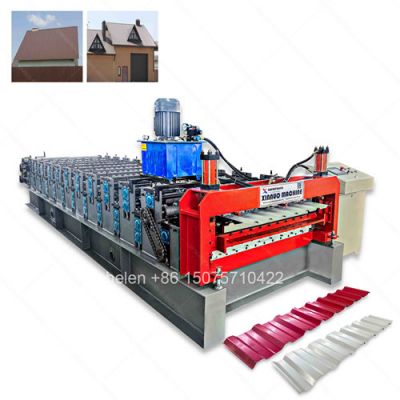
- One compact chassis houses two complete independent roll forming production units
- Upper deck shapes IBR high-tensile trapezoidal roofing for industrial construction projects
- Lower deck forms traditional corrugated wave roofing for agricultural and budget builds
- Material path flips between IBR and corrugated in under 15 minutes without tools
- Hard chrome roller surfaces protect pre-painted coil from scratches during forming
- Self-diagnostic PLC display shows real-time speed, batch count, and fault alerts
- Post-forming hydraulic guillotine shear delivers square burr-free panel end cuts
Roof sheet manufacturers face a persistent dilemma: invest in separate single-profile machines for IBR trapezoidal and corrugated wave production — doubling capital expenditure, floor space, and operating overhead — or compromise by offering only one profile type and turning away half the potential market. The double layer IBR and corrugated roof sheet making machine resolves this trade-off completely by integrating two fully functional roll forming lines into a single welded structural chassis, each accessible through a manually operated feed path selector that requires zero mechanical reconfiguration between production runs.
This machine architecture has become the preferred entry point for new roofing factories and the go-to expansion asset for established manufacturers across Africa, Southeast Asia, the Middle East, and Latin America. The logic is straightforward: IBR trapezoidal sheets and classic corrugated wave sheets together account for an estimated 70-80% of global metal roofing consumption. One double layer machine captures both segments. Two separate single-layer machines cost more, occupy more space, require more operators, and demand more maintenance — all for the same two profiles.
Understanding the physical layout clarifies why this machine achieves such dramatic space and cost savings. The main chassis — a welded H-section steel frame typically graded at 350H or 400H — supports two complete sets of forming roller carriages arranged vertically, one above the other. Each carriage set is a self-contained roll forming unit: its own entry guides, its own progressive roller stations (14-18 for IBR, 12-16 for corrugated), its own exit guides, all permanently aligned and factory-calibrated before shipment. The two carriages share a common main drive motor through a selector clutch, a common hydraulic shear station at the discharge end, and a common PLC control system — but they operate independently. Only one carriage produces sheets at any moment; the inactive carriage simply idles.
The material routing component that makes this possible is the diverter assembly mounted between the uncoiler and the forming machine entry. It consists of a pivot plate with hardened guide rollers, a manual lever with positive-lock detent positions, and adjustable side-limit guides. When the lever is in the upper position, the steel strip feeds upward into the IBR carriage. Flip the lever to the lower position, and the strip feeds into the corrugated carriage. The diversion path is approximately 300-500 mm long — short enough to avoid introducing strip twist or wandering, long enough to achieve a smooth directional transition. No rollers are removed, no dies are changed, no bolts are loosened. The operator simply moves the lever, verifies the strip centering on the side guides, and starts the machine.
The production sequence begins at the hydraulic decoiler, a floor-mounted unit that supports raw steel coils weighing up to 5 or 8 metric tons. The decoiler mandrel expands via hydraulic or pneumatic pressure to grip the coil's inner diameter (typically 450-520 mm), then the mandrel motor pays out strip material at a controlled tension matched to the forming speed. A loop control sensor between the decoiler and the forming machine regulates the payout rate — if the forming machine draws material faster than the decoiler releases it, the sensor signals the decoiler to accelerate. If material accumulates in the loop, the decoiler slows. This closed-loop tension control prevents both strip slack (which causes roller jamming) and strip over-tension (which stretches the material and distorts the final profile).
After passing through the diverter and side guides, the strip enters the selected roller carriage. The first roller station grips the flat strip and initiates the profile shape. Each subsequent station makes an incremental deformation — typically 5-15 degrees of additional bend per station — until the final station delivers the fully formed IBR or corrugated cross-section. This progressive approach prevents material stress concentration, avoids surface cracking of the metallic coating, and maintains consistent dimensional accuracy from the first sheet of a production run to the last.
The formed sheet exits the final roller station and passes directly into the hydraulic guillotine shear. A rotary encoder mounted on a precision measuring wheel positioned between the last roller station and the shear continuously reports linear travel distance to the PLC. The PLC compares this real-time count to the operator-programmed target length. When the count equals the target, the PLC energizes the hydraulic directional valve, the shear cylinder extends, and the blade set descends through the panel. The entire shear carriage rides on linear bearings and tracks with the moving sheet during the cut stroke — the panel never pauses. After the cut, the shear retracts and the carriage returns to its home position, ready for the next cycle. Finished sheets continue onto a powered run-out roller conveyor for collection.
The rollers are the single most critical component determining finished roof sheet quality, and their engineering warrants detailed attention. Each roller begins as a billet of 45# medium-carbon steel (Chinese GB standard, approximately equivalent to AISI 1045). The billet is hot-forged into a rough ring shape, normalized to relieve internal stress, then CNC-turned on a lathe to produce the precise profile contour. The contour is not simply an inverted copy of the finished sheet shape — it incorporates spring-back compensation, material thinning allowances, and transitional lead-in geometries that experienced roll forming engineers develop through iterative production testing across different material grades and thicknesses.
After CNC contouring, the roller undergoes surface grinding to achieve the specified finish, followed by industrial hard chrome electroplating. The chrome layer — typically 0.03-0.05 mm thick — is post-treated to HRC 58-62 surface hardness. This is the critical feature that prevents the most common roll forming quality defect: surface scratching on pre-painted or galvanized coil stock. A soft or rough roller surface will abrade the paint or zinc coating as the strip slides through under forming pressure, producing visible scratch lines on the finished sheet. The hard chrome surface eliminates this entirely — the roller slides against the coil without abrasion, preserving the factory-applied coating intact from coil to finished roof panel.
The rollers are mounted on solid steel shafts (Φ75 or Φ80 mm diameter, precision centerless ground) with keyway-driven sprockets. Each shaft end rides in a dual-row self-aligning spherical roller bearing housed in a split pillow block bolted to the machine frame. The self-aligning feature is particularly important in a double layer machine because the combined weight and vibration of two stacked carriages can introduce slight frame deflections over time. Self-aligning bearings compensate for these minor misalignments automatically, maintaining consistent roller gap without manual readjustment.
| IBR Model | Cover Width | Rib Ht. | Ribs | Coil W. | Roller Rows | Motor (kW) | Geographic Market Demand |
|---|---|---|---|---|---|---|---|
| IBR-686×43 | 686 mm | 43 mm | 5 | ~910 mm | 14-16 | 5.5-7.5 | Southern Africa — SANS standard residential and light commercial roofing |
| IBR-762×43 | 762 mm | 43 mm | 5 | ~1000 mm | 16-18 | 7.5-11 | East Africa & Yemen — industrial warehouse standard profile |
| IBR-840×35 | 840 mm | 35 mm | 4-5 | ~1000 mm | 14-16 | 5.5-7.5 | West Africa & SE Asia — dominant commercial and institutional building profile |
| IBR-925×38 | 925 mm | 38 mm | 5 | ~1100 mm | 16-18 | 7.5-11 | GCC / Arabian Peninsula — large-span factory and warehouse roofing |
| IBR-1050×28 | 1050 mm | 28 mm | 6-7 | ~1200 mm | 14-16 | 5.5-7.5 | Australia & NZ — wall cladding and cyclone-rated residential roofing |
| Corrugated Model | Cover Width | Wave Ht. | Pitch | Waves | Roller Rows | Motor (kW) | Geographic Market Demand |
|---|---|---|---|---|---|---|---|
| CR-665×17 | 665 mm | 17 mm | 76 mm | 11 | 12-14 | 5.5-7.5 | Central America — farm structures, grain storage, perimeter walls |
| CR-715×17 | 715 mm | 17 mm | 76 mm | 11 | 12-14 | 5.5-7.5 | West Africa — rural housing development and school building programs |
| CR-762×17 | 762 mm | 17 mm | 76 mm | 12 | 12-16 | 7.5-11 | South America — mining camp accommodation, warehouse siding |
| CR-836×17 | 836 mm | 17 mm | 88 mm | 11 | 12-16 | 7.5-11 | East Africa — low-cost mass housing and humanitarian shelter projects |
| CR-990×17 | 990 mm | 17 mm | 88 mm | 13 | 14-16 | 7.5-11 | Indian Ocean islands — resort construction, coastal residential |
| Specification Item | Details |
|---|---|
| Machine Classification | Double layer cold roll forming machine — IBR trapezoidal profile (upper tier) + corrugated wave profile (lower tier) |
| Frame Construction | Welded H-section structural steel, grade 350H (standard) or 400H (heavy-duty); internal cross-rib gusset plates at all load-transfer joints |
| Side Panel / Wall Plate Thickness | 16 mm – 20 mm CNC laser-cut steel plate; precision-bored bearing housing seats for accurate shaft alignment |
| IBR Carriage Roller Count | 14, 16, or 18 stations — selected based on rib height and total deformation required for the target IBR profile geometry |
| Corrugated Carriage Roller Count | 12, 14, or 16 stations — fewer stations needed vs IBR due to shallower sinusoidal wave geometry |
| Roller Raw Material | 45# medium-carbon forged steel (CNC contour-turned + surface ground + hard chrome plated) |
| Chrome Plating Specification | Industrial hard chrome, 0.03-0.05 mm layer thickness, HRC 58-62 post-plating hardness |
| Shaft Material & Size | Φ75 mm or Φ80 mm solid alloy steel shaft, centerless precision ground, keyway-driven sprocket mounting |
| Bearing Configuration | Dual-row self-aligning spherical roller bearings; split pillow block housing; grease-lubricated with Zerk fittings |
| Transmission Type | Duplex roller chain (6-fen / 3/4" pitch standard; 1" pitch heavy-duty option); hardened steel sprockets |
| Selector Mechanism | Manual clutch lever with positive detent lock; engages upper (IBR) or lower (corrugated) drive chain loop |
| Main Drive Motor | 7.5 kW (standard) or 11 kW (heavy IBR), 3-phase AC induction, VFD-controlled stepless speed regulation |
| Forming Speed Range | 6 – 18 meters per minute; actual speed adjusted based on material thickness, profile depth, and operator preference |
| Hydraulic Power Unit | 4.0 kW independent motor; gear-type hydraulic pump; 60-80 liter oil reservoir; air-cooled oil radiator; pressure gauge and relief valve |
| Shear Type & Blade Material | Guillotine-type flying post-cut shear; Cr12MoV (GB) / SKD11 (JIS) cold-work die steel blades; vacuum quenched, triple tempered, HRC 60-62 |
| Sheet Length Accuracy | ±1.5 mm; measured by rotary encoder on friction measuring wheel in closed-loop feedback to PLC |
| Automation Controller | Programmable Logic Controller (PLC); brand options: Siemens S7-200/S7-1200, Delta DVP series, or Mitsubishi FX series |
| Operator Interface | 7-inch color TFT-LCD touchscreen HMI; multi-language display; functions: length setting, quantity presetting, auto-count, auto-stop, fault alarm, recipe save/load |
| Recipe Memory | Up to 50 stored production configurations per tier (sheet length + batch count + speed setting) |
| Input Material Types | PPGI (pre-painted galvanized iron), PPGL (pre-painted galvalume / zinc-aluminum), HDGI plain galvanized, Al-Zn alloy coated, pre-painted aluminum |
| Material Thickness Range | 0.30 mm – 0.80 mm standard capability; 0.25 mm minimum and 1.00 mm maximum available with engineering review |
| Coil Inner Diameter | Φ450 mm – Φ520 mm (standard Asian/International coil core sizes) |
| Coil Outer Diameter | Up to Φ1250 mm maximum |
| Decoiler Capacity | 5-ton or 8-ton hydraulic expanding mandrel uncoiler; manual, pneumatic, or hydraulic mandrel expansion |
| Line Length (Assembled) | Approximately 18 – 22 meters from decoiler rear to run-out conveyor end; footprint ~22 m × 3.5 m |
| Machine Net Weight | Approximately 6,500 – 9,000 kg dependent on frame grade, roller station count, motor power, and optional attachments |
| Standard Electrical Supply | AC 380V ±10%, 50 Hz, 3-phase, 4-wire (custom voltage and 60 Hz available per destination country requirements) |
| Profile Changeover Duration | 5 to 15 minutes (manual diverter lever flip + material side-guide centering check + PLC recipe selection) |
| Certification Standards | CE Mark (European Conformity), ISO 9001:2015 Quality Management System compliant design and manufacturing |
| Standard Included Accessories | 1 set spare Cr12MoV shear blades, 1 toolkit (wrenches, hex keys, grease gun, feeler gauges), English installation and operation manual, commissioning video guide on USB |
| Optional Attachments | Automatic pneumatic sheet stacking arm, extended 4 m run-out conveyor, coil car loader, remote I/O diagnostics module, 10-inch HMI upgrade, servo-driven glazed tile pitch-stamping module |
| User Profile / Business Type | Recommended IBR Width | Recommended Corrugated Width | Rationale |
|---|---|---|---|
| Southern Africa Start-Up | IBR-686 (SANS national standard) | CR-762 (compatible feed width) | Both profiles use ~910-1000 mm coil width — single coil inventory serves both products |
| East Africa Distributor | IBR-762 (Kenya/Uganda standard) | CR-836 (Tanzania housing market) | Wide geographic coverage; IBR for urban commercial, corrugated for rural residential |
| West Africa Trader | IBR-840 (Nigeria/Ghana dominant) | CR-715 (budget housing programs) | 840 mm IBR is the West African market standard; 715 mm corrugated for government tenders |
| Middle East Manufacturer | IBR-925 (large-span factory roof) | CR-990 (resort and villa roofing) | Wide IBR for mega-projects; wide corrugated for hospitality construction |
| SE Asia General Factory | IBR-840 (Philippines/Indonesia) | CR-665 (agricultural demand) | Balanced market mix: commercial IBR + agricultural corrugated from one machine |
| Latin America New Entrant | IBR-762 (Chile/Peru standard) | CR-762 (mining camp siding) | Identical feed width across both profiles — simplifies coil procurement and inventory |
| Coil Coating Type | Coating Thickness | Forming Compatibility | Recommended Gauge | Typical End-Use Environment |
|---|---|---|---|---|
| PPGI (PE Paint) | 15-25 µm topcoat | Excellent — chrome rollers preserve paint finish | 0.30-0.60 mm | General roofing, moderate climate, residential |
| PPGI (PVDF Paint) | 25-35 µm topcoat | Excellent — high-durability coating withstands forming | 0.35-0.70 mm | Coastal areas, high-UV exposure, premium projects |
| PPGL (Galvalume) | AZ50-AZ150 | Good — harder coating, slightly higher roller wear rate | 0.30-0.70 mm | Industrial roofing, high-corrosion environments |
| HDGI (Galvanized Only) | Z90-Z275 | Good — standard zinc coating forms without issues | 0.30-0.80 mm | Budget construction, temporary structures, fencing |
| Pre-Painted Aluminum | 15-25 µm paint | Good — softer substrate, lower forming force required | 0.40-0.70 mm | Coastal luxury buildings, high-corrosion marine environments |
| Control Function | Description and Operator Benefit |
|---|---|
| Sheet Length Preset | Numeric keypad entry in millimeters or inches; machine automatically cuts each sheet at the programmed dimension with ±1.5 mm repeatability |
| Batch Quantity Counter | Operator enters the total number of sheets required; machine auto-stops when count is reached; prevents overproduction and material waste |
| Production Speed Control | Slider or numeric input for forming speed; operator can slow down for thick material or thin gauge, speed up for standard production |
| Real-Time Counter Display | Shows sheets produced vs target quantity in large font; production progress visible at a glance from across the factory floor |
| Profile Recipe Management | Save, name, and recall up to 50 complete production configurations; switch from "IBR-840 × 3.5 m × 200 pcs" to "CR-762 × 2.4 m × 500 pcs" in seconds |
| Fault Diagnostic Display | Real-time error messages with plain-language descriptions: "Emergency Stop Activated," "Hydraulic Pressure Low," "Motor Overload," "Encoder Signal Lost" — enables quick operator troubleshooting without technician call-out |
| Maintenance Reminder | Programmable hour-based alerts for chain lubrication, bearing re-greasing, hydraulic oil change, and blade inspection intervals |
| Language Selection | Switch interface language between English, French, Spanish, Arabic, Russian, Portuguese, and others without affecting stored recipes or machine parameters |
The IBR + corrugated pairing is not an arbitrary combination — it is the result of decades of global market feedback identifying these two profiles as the highest-demand, highest-volume metal roofing products across the broadest range of countries and construction types. Here is why this specific double layer configuration delivers the fastest return on investment for roof sheet manufacturers:
Hebei Xinnuo is a professional cold roll forming machinery manufacturer with 20+ years of experience. We specialize in C/Z purlin machines, roof panel roll formers, floor deck machines, and custom profile solutions — exported to 50+ countries worldwide.