helen@hbxinnuorollforming.com


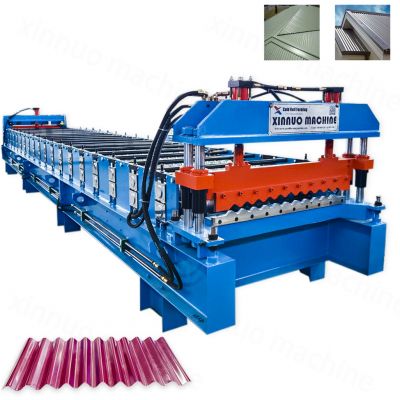
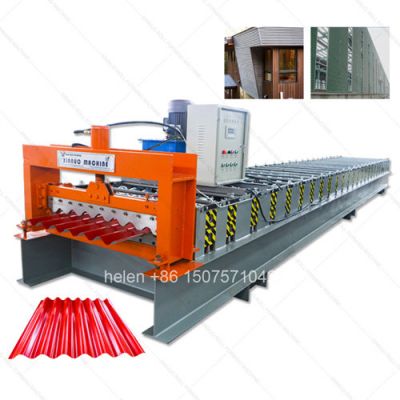
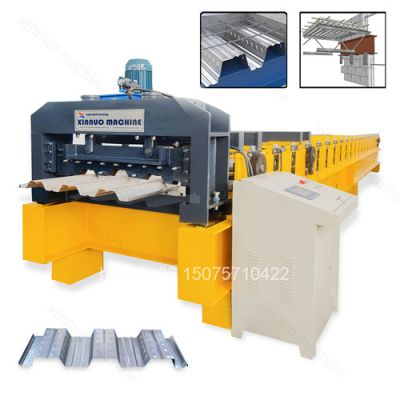
1000 type wide-coverage trapezoidal floor deck roll forming line
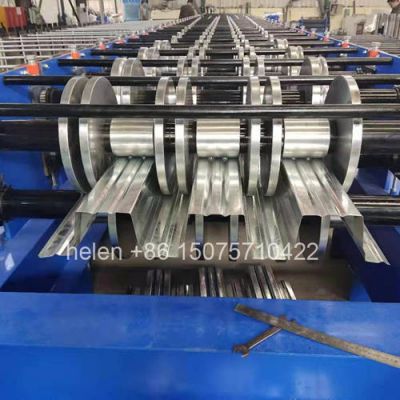
3-rib profile, 1000mm effective width, 50mm depth, 1250mm coil
Twin 11KW drive, 24-26 stations, dimple emboss, hydraulic shear
Maximum coverage efficiency — fewest panels per m² of any deck type
The 1000 type floor deck profile delivers the widest effective coverage of any standard composite floor deck — 1000mm per panel. This means fewer panels to produce, fewer bundles to transport, fewer crane lifts on site, and fewer side-lap connections to fasten per square meter of finished floor. For the deck manufacturer, the 1000 type optimizes production throughput: at the same machine speed, you produce more square meters per shift than with any narrower profile. For the contractor, wider coverage means faster installation — a 3-person crew can lay 400-500m² per shift with 1000 type deck versus 300-400m² with 750 type. The 50mm rib depth provides reliable composite action for standard commercial spans while keeping forming complexity moderate — this machine requires only 24 stations versus 30+ for deep-rib profiles. The trade-off is coil width: 1000 type requires 1250mm feed width, which carries a slight material cost premium and fewer mill supply options compared to the ubiquitous 1000mm-wide coil used for 750 type production.
| Dimension | Value | Tolerance | Measurement Reference |
|---|---|---|---|
| Effective Coverage Width | 1000mm | ±2mm | Measured across panel from overlap rib center to underlap rib center, both ends and mid-panel |
| Overall Panel Width | ~1060mm (including side lap) | ±2mm | Measured from panel outer edge to outer edge including overlap rib |
| Rib Count | 3 trapezoidal ribs | Fixed | Visual count — 3 ribs per panel, plus one side lap rib at each edge |
| Rib Depth | 50mm | ±1mm | Measured from rib crest to panel soffit with depth micrometer. 50mm is the shallow end of effective composite deck rib depth — sufficient for standard spans, lighter than deep-rib profiles |
| Rib Spacing | ~333mm center-to-center | ±1.5mm | Measured center of rib 1 throat to center of rib 2 throat. Wider spacing than 750 type (~250mm) due to larger coverage with same rib count |
| Rib Crest Width | ~38-42mm | ±1mm | Flat surface at top of each rib. Slightly wider than 750 type to maintain proportion with wider rib spacing |
| Inter-Rib Flat Width | ~115-125mm | ±1mm | Significantly wider flat area between ribs compared to 750 type (~55-60mm). Wide inter-rib flats provide generous beam bearing surface — installation is more forgiving of beam alignment |
| Rib Wall Angle | 3-5° outward from vertical | ±0.5° | Measured with digital angle gauge. Outward taper identical to 750 type for concrete flow into ribs |
| Feed Width (Coil Input) | 1250mm | +3/-0mm | Wider coil than 750 type (1000mm). 1250mm is standard width for wide-coverage deck profiles. Available from major mills — confirm supplier capability before committing to 1000 type production |
| Side Lap Overlap | ~30mm (one full rib) | ±1mm | Overlap rib of panel 2 sits on underlap rib of panel 1. Same lap detail as all standard trapezoidal decks |
| Efficiency Metric | 1000 Type | 750 Type | 600 Type | Impact on Business |
|---|---|---|---|---|
| Panels per 100m² Floor | 100 panels | 133 panels | 167 panels | 25% fewer panels than 750 type, 40% fewer than 600 type. Fewer panels = fewer bundles = fewer crane lifts = faster installation. |
| Side Lap Length per 100m² | 100 linear meters | 133 linear meters | 167 linear meters | 25% less side-lap fastening per m². Fewer screws, less installation labor, fewer potential leakage points during concrete pour. |
| Production m² per Shift (12 m/min) | ~5,400 m² (1000mm × 5,400m) | ~4,050 m² (750mm × 5,400m) | ~3,240 m² (600mm × 5,400m) | 33% more output per shift than 750 type at same machine speed. Same labor cost, same machine amortization, same overhead — 33% more revenue per shift. |
| Coil Efficiency (m of coil per m² of deck) | 1.250 | 1.333 | 1.667 | 1000 type is 6% more coil-efficient than 750 type. Less steel waste per m² of deck — better material cost ratio. |
| Truckload Capacity (m² per 12-bundle truck) | ~480 m² | ~360 m² | ~288 m² | 33% more deck per truckload — lower freight cost per m². Fewer trucks per project. |
| Beam Bearings per 100m² | 100 end conditions | 133 end conditions | 167 end conditions | Fewer panel ends to fasten to support beams. Faster deck fixing phase — beam-line work is the installation bottleneck. |
| Profile | Coverage | Rib Count | Key Distinction | Market Preference |
|---|---|---|---|---|
| 1000 Type | 1000mm | 3 ribs | True 1000mm effective coverage. Standard profile in European and Australian markets. 1250mm coil input. | Preferred in markets using metric dimensional coordination. Clean 1000mm module fits standard building grids (6m, 8m, 10m spans divide evenly into 1000mm). |
| 990 Type | 990mm | 3 ribs | Effectively the same profile with 10mm narrower coverage. Some manufacturers produce 990 type from 1250mm coil with slightly different rib spacing. Often marketing distinction rather than functional difference. | May appear in specification where 990mm is the nominal coverage from a specific manufacturer's tooling. Functionally equivalent to 1000 type for structural performance. |
| 1025 Type | 1025mm | 3 ribs | Widest coverage of all standard profiles. 51mm rib depth. 1250mm coil input — maximum coverage from standard wide coil. | Premium wide-coverage option — even fewer panels than 1000 type. Requires 2.5-inch chain and heavier drive for the wider forming forces. |
| Component | Specification | 1000-Specific Engineering Notes |
|---|---|---|
| Main Frame | 400H Laisteel I-beam, 10mm wing | Standard frame handles 50mm rib depth. 1000 profile forming forces are comparable to 750 type — rib depth is nearly identical (50mm vs. 53mm). 450H upgrade recommended only for sustained 1.5mm gauge production. |
| Mid-Plate | 22mm, CNC line-bored | Standard thickness. The 1250mm coil means rollers are slightly wider across the shaft than 1000mm-coil profiles — but the 50mm rib depth keeps forming forces moderate. |
| Forming Stations | 24 rows (standard), 26 rows (heavy gauge) | Shallow 50mm rib requires fewer forming stations than deep-rib profiles. Same station count as 750 type — the rib development is shallower but wider, balancing the forming pass count. |
| Motor Power | 2 × 11KW (8#), balanced dual drive | Wider forming zone (1250mm coil) distributes torque across longer shafts — twin motor essential for even drive force. Single motor would produce asymmetric forming. |
| Drive Chain | 2-inch pitch heavy series | Standard chain. 2.5-inch upgrade recommended for 1025 type or sustained 1.5mm gauge production. 1000 type at standard gauges operates within 2-inch chain capacity. |
| Forming Shafts | Φ95mm, 100mm round bar, chrome 0.03mm | Wider roller sets on longer shaft span. Φ95mm sufficient for 50mm rib — shaft deflection under forming load is proportional to rib depth, not coverage width. |
| Forming Speed | 12-15 m/min (0.8-1.0mm), 10-12 m/min (1.2-1.5mm) | Same speed range as 750 type. 50mm rib forms at comparable speed to 53mm rib — the extra coverage width doesn't slow the forming process because rib depth drives speed, not width. |
| Dimple Station | Clutch-controlled, 3-rib embossment pattern | Dimple pattern covers 6 rib wall faces across the wider 1250mm strip. Dimple wheel diameter is larger than 750 type to span the wider embossing zone. |
| Cutoff System | Dual-cylinder floor shear, Cr12MoV blades | Cutting width ~1060mm (overall panel width). Blade length ~1100mm. Wider cut than 750 type (~810mm) — hydraulic cylinder sizing accounts for the wider cut face. |
| Decoiler | 5-ton hydraulic, 1250mm width capacity | Must accept 1250mm coil width. Verify decoiler mandrel length and side guide range accommodate 1250mm. 8-ton upgrade recommended for high-volume production — 1250mm coils are heavier per coil at same OD. |
| Line Length | ~20m total | Same floor space requirement as 750 type. 24 stations at 500mm center spacing = 12m forming unit + decoiler + output table. |
| Slab Depth | Gauge | Single Span (Unpropped) | Single Prop at Mid-Span | Composite Imposed Load |
|---|---|---|---|---|
| 120mm | 0.8mm | 2.0m | 3.0m | 3.0 kN/m² (office) |
| 120mm | 0.9mm | 2.3m | 3.3m | 4.0 kN/m² (office/light retail) |
| 120mm | 1.0mm | 2.5m | 3.8m | 5.0 kN/m² (retail) |
| 120mm | 1.2mm | 2.8m | 4.2m | 5.0 kN/m² (retail/light industrial) |
| 130mm | 0.9mm | 2.5m | 3.8m | 4.0 kN/m² (office) |
| 130mm | 1.0mm | 2.8m | 4.0m | 5.0 kN/m² (retail) |
| 130mm | 1.2mm | 3.2m | 4.5m | 7.5 kN/m² (heavy retail/storage) |
| 150mm | 0.9mm | 2.8m | 4.0m | 4.0 kN/m² (office) |
| 150mm | 1.0mm | 3.0m | 4.3m | 5.0 kN/m² (retail) |
| 150mm | 1.2mm | 3.5m | 4.8m | 7.5 kN/m² (heavy retail/storage) |
Note: 1000 type unpropped spans are slightly shorter than 750 type for the same gauge and slab depth — the shallower rib (50mm vs. 53mm) has marginally lower section modulus. The difference is 5-10% and is easily compensated by a 0.1mm gauge increase or 10mm additional slab depth. For most standard office and retail applications, the coverage efficiency advantage outweighs the minor span reduction. Final design must be verified by a qualified structural engineer.
| Station Group | Rows | What Happens to the Steel Strip |
|---|---|---|
| Entry & Leveling | Pre-form | 1250mm wide flat strip enters through adjustable side guides. 5-roller leveler flattens residual coil curvature. Strip enters first forming station centered and flat. |
| Dimple Embossment | 1 | Wide-format dimple wheel stamps bond pattern across the 6 rib wall zones. Clutch disengages after strip entry — downstream rollers carry the strip at correct speed. Embossment depth calibrated for the target concrete bond specification. |
| Edge Forming | 2-4 | Left underlap rib and right overlap rib begin forming at strip edges. Edge ribs formed first — they act as outboard guides for the central forming zone. Critical phase: edge rib geometry must match the mating panel's edge rib exactly or side-lap fit is compromised. |
| Rib Initiation | 5-8 | Three central ribs begin lifting from the flat strip. With 1250mm strip width and wide inter-rib spacing, the rib initiation is more gradual than 750 type — each station lifts ribs 6-10mm to prevent material stress across the wider flat zones. |
| Rib Deepening | 9-16 | Ribs deepen toward the full 50mm depth. The wide inter-rib flats (115-125mm) are the distinguishing feature — these remain flat and become the beam bearing surface. Wider flats require more precise roller support to prevent sagging between ribs. |
| Final Depth & Sizing | 17-22 | Ribs reach full 50mm depth. Final rib wall angle locked at 3-5° outward. Rib crests flattened. Wide inter-rib flats sized to final dimension. Side lap geometry finalized — overlap and underlap ribs complete. |
| Straightening & Final Pass | 23-24 | Straightening rollers correct any camber across the wide 1060mm panel. Wider panels are more prone to camber — the straightening pass is more critical for 1000 type than narrower profiles. Panel exits within 2mm per 3m straightness. |
| Hydraulic Cutoff | Post-form | PLC triggers dual-cylinder shear at preset length. 1060mm cut width requires balanced cylinder force — both cylinders fire within 10ms. Panel drops to run-out table for bundling. |
| Installation Factor | 1000 Type Performance | Site Impact |
|---|---|---|
| Panel Weight per Linear Meter | ~11.9 kg/m (1.0mm gauge). Heavier than 750 type (~9.4 kg/m) due to wider coverage and 1250mm feed width. | Individual panels are heavier. 2-person manual handling limit: ~6m panel = ~71 kg — manageable. For longer panels, 3-person handling or mechanical lifting required. Heavier panels are more stable in wind during placement. |
| Panels per Floor Zone (30m × 20m = 600m²) | 600 panels (each 1m wide × span length). | Vs. 750 type: 800 panels. 200 fewer panels to handle, place, and fasten. One less truckload. Installation crew completes floor zone 2-3 hours faster. |
| Side-Lap Fastening (600m² zone) | ~600 screws at 450mm centers (assuming 3m span). | Vs. 750 type: ~800 screws. 200 fewer screws = 1-1.5 hours less fastening time per floor zone. Screw cost saving: ~$40-60 per 600m² zone. |
| Beam Bearing | Wide inter-rib flats (115-125mm) provide generous beam bearing surface. | More forgiving of beam alignment tolerance. A beam 10mm out of position still captures full bearing on the wide flat. Narrower profiles with tight rib spacing have less margin for beam misalignment. |
| Concrete Pouring | Shallower rib (50mm) = less concrete in rib cavities = slightly less concrete per m². | Vs. 915 type (76mm rib): ~26mm less concrete depth in ribs. Over 10,000m² project: ~260m³ less concrete. Approx. $25,000-35,000 concrete cost saving at typical commercial rates. |
| Mesh Chair Stability | Wide inter-rib flats provide stable base for plastic mesh chairs. | Chairs placed on wide flats are more stable than chairs balanced on narrow ribs. Mesh stays in correct position during concrete pour — consistent concrete cover to reinforcement. |
| Supply Chain Factor | 1250mm Coil Reality | Mitigation Strategy |
|---|---|---|
| Mill Availability | 1250mm is produced by fewer mills than 1000mm. Major international mills (ArcelorMittal, POSCO, BlueScope, Nippon Steel) produce 1250mm. Smaller regional mills may not — verify before committing to 1000 type production. | Qualify at least 3 mills that supply 1250mm coil to your region. Negotiate supply contracts before ordering machine. Consider import if domestic supply is limited — the 6% coil efficiency advantage partially offsets import freight cost. |
| Price Premium | 1250mm coil typically carries 3-8% price premium per ton vs. 1000mm coil from the same mill. This reflects lower production volume and fewer competing buyers. | The 6% material efficiency gain (1.250 vs. 1.333 m coil per m² deck) partially offsets the price premium. For a 1,000-ton monthly consumption: net premium is 1-2% after efficiency adjustment — acceptable for 33% higher output per shift. |
| Minimum Order Quantity | 1250mm coil often has higher MOQ than 1000mm — mills prefer longer production runs for less-common widths. 200-500 ton MOQ typical. | Consolidate orders across projects. Order in advance of production schedule. Build 1250mm coil inventory during quiet periods to bridge MOQ gaps. |
| Lead Time | May be 1-2 weeks longer than 1000mm coil from the same mill. Mill schedules less-frequent 1250mm production campaigns. | Maintain higher safety stock for 1250mm coil — 3-4 weeks vs. 2 weeks for 1000mm. The working capital cost of additional inventory must be factored into 1000 type business case. |
| Freight & Handling | 1250mm coils weigh more at the same outer diameter. A "standard" 5-ton coil of 1250mm × 0.9mm has fewer linear meters than 1000mm × 0.9mm. | More frequent coil changes — a 5-ton 1250mm coil produces fewer linear meters. Factor coil change time into production planning. Consider 8-ton decoiler to reduce changeover frequency. |
| Panel Length (m) | Panels per Hour (12 m/min) | m² per Hour | m² per 8h Shift | Coil Use (tons/shift, 1.0mm) |
|---|---|---|---|---|
| 2.0 | 360 | 720 | 5,400 | ~64 |
| 2.5 | 288 | 720 | 5,400 | ~64 |
| 3.0 | 240 | 720 | 5,400 | ~64 |
| 3.5 | 206 | 720 | 5,400 | ~64 |
| 4.0 | 180 | 720 | 5,400 | ~64 |
| 4.5 | 160 | 720 | 5,400 | ~64 |
| 5.0 | 144 | 720 | 5,400 | ~64 |
Note: 1000 type at 12 m/min produces 720 m²/hour — 33% more area per shift than 750 type (540 m²/hr). Over 250 production days per year, single-shift operation: 1,350,000 m² for 1000 type vs. 1,012,500 m² for 750 type. The additional 337,500 m² per year from the same labor, overhead, and machine amortization is the core business case for choosing 1000 type over 750 type.
| Changeover Step | Action | Time |
|---|---|---|
| 1. Coil Change | Remove 1000mm coil. Load 1250mm coil on decoiler. Adjust decoiler side guide width to 1250mm. Thread wider strip through entry guide and leveler. | 20-25 min |
| 2. Entry Guide Adjustment | Adjust side guide rollers from 1000mm to 1250mm width setting. Verify strip centering — 1250mm strip must enter first forming station centered within ±1mm. | 10-15 min |
| 3. Phase 1 Roller Change (Rows 1-16) | Swap 750 profile rollers for 1000 profile rollers. Rib initiation and deepening rollers are different due to wider rib spacing and shallower depth. Remove 750 rollers in sequence, install 1000 rollers per station marking. | 1.5-2 hours |
| 4. Phase 2 Roller Change (Rows 17-24) | Swap 750 sizing and straightening rollers for 1000 type. Final geometry rollers differ — 1000 type has wider inter-rib flats and shallower rib crest profile. | 1-1.5 hours |
| 5. Shear Width Check | Verify shear blade width accommodates 1060mm panel. 1000 type is wider than 750 type — blade must span full panel width with end clearance. Replace blade if existing is too short. | 15-30 min (if blade change needed) |
| 6. PLC Recipe Switch | Load 1000 type recipe: profile name, target dimensions, encoder calibration. Verify all parameters match the installed roller set. | 5 min |
| 7. Trial & Verification | Run test panel at 5 m/min. Measure: coverage width (both ends + mid), rib depth (all 3 ribs), inter-rib flat width, side lap fit. Adjust roller gaps if needed. Run speed ramp test. | 30-45 min |
| Total 750→1000 Changeover | 4-5.5 hours |
Hebei Xinnuo is a professional cold roll forming machinery manufacturer with 20+ years of experience. We specialize in C/Z purlin machines, roof panel roll formers, floor deck machines, and custom profile solutions — exported to 50+ countries worldwide.