helen@hbxinnuorollforming.com
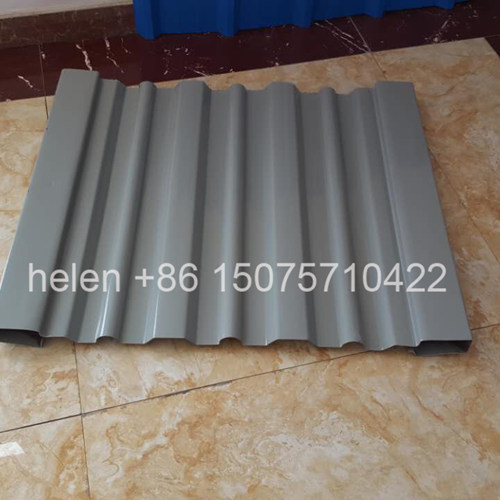
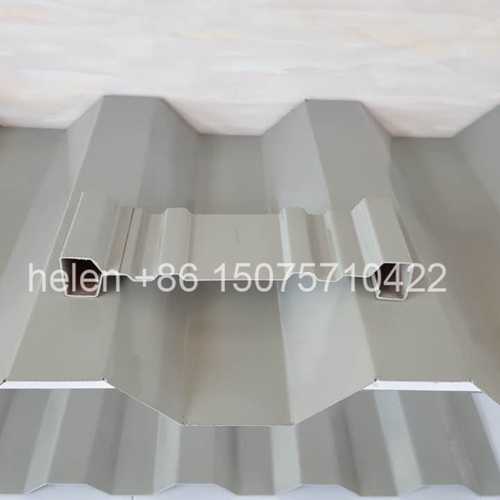
- A closed deck rib narrows at the top, unlike an open trapezoidal rib
- Concrete wraps around the rib ends and interlocks mechanically
- The interlock supplies composite action without relying on bonding
- Re-entrant geometry needs a dedicated locking roller set to form
- Forming rows rise to the highest count in the deck range
- Long-span floors and parking structures are the typical applications
- Throat dimension control is the critical quality characteristic
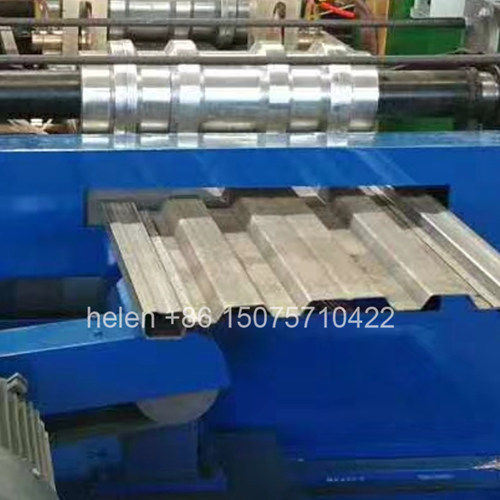
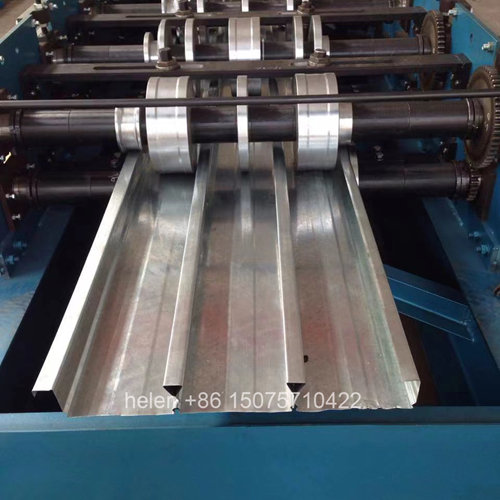
A closed deck panel differs from an open deck in one geometric characteristic and in almost every consequence that follows from it. The rib does not stay open at the top. It narrows, forming a re-entrant or dovetail section, so that concrete cast over the deck wraps around the ends of the ribs and locks mechanically into the profile. That interlock creates composite action between the steel and the concrete without depending on bonding agents or on the embossment grip that an open trapezoidal deck relies on.
For the machine, that single change in geometry is the difference between a conventional deck roll former and the most demanding configuration in the deck range. Material has to be formed back over itself to create the re-entrant return, which cannot be achieved in the same number of passes used for an open rib, requires a dedicated locking roller set positioned to form the return, and increases the forming load considerably. This page sets out what makes a deck closed, why engineers specify it, what the re-entrant geometry demands from the forming train, how the machine is configured, how open and closed decks compare, how the section is measured and verified, where closed deck is used, and what running a closed deck machine involves in production.
| Feature | Description | Purpose |
|---|---|---|
| Re-entrant rib | The rib flanks turn inward at the top, so the rib is narrower at its head than at its base | Creates a mechanical key that the concrete fills and locks around, providing composite action by geometry rather than by adhesion |
| Dovetail or re-entrant return | A formed return at the top of the rib that turns back into the rib cavity | Gives the concrete something to grip that cannot release under load, which is what sustains composite action at high shear |
| Throat dimension | The clear width at the narrowest point of the rib opening | Governs how effectively the concrete keys into the rib. It is the defining dimensional control on a closed deck section. |
| Closed rib head | The top of the rib presents a narrower, often flat-topped form rather than an open channel | Provides a continuous bearing surface for reinforcement and reduces the volume of concrete required to fill the ribs |
| Interlock between ribs | Concrete is continuous across the deck, entering each rib and joining them through the slab above | The slab and the deck act together rather than as a deck carrying a separate slab |
| Driver | Mechanism | Commercial or Design Effect |
|---|---|---|
| Composite action without bonding agents | The re-entrant geometry locks the concrete into the rib in a way that does not depend on adhesion or on embossment grip alone | Reliable composite behaviour without reliance on surface treatment or bonding, which simplifies specification and removes a variable from site practice |
| High shear transfer | The mechanical key resists slip between the steel and concrete more effectively than a plain trapezoidal interface | Suits floors carrying high shear, where an open profile would require additional shear connection |
| Reduced shear stud requirement | Composite action comes partly from the deck profile itself, so the number of studs needed to achieve the design composite action is reduced | A direct saving in material, welding time and inspection on every floor, which is often the deciding commercial argument |
| Longer spans | Fuller composite action increases the effective stiffness of the slab system | Allows spans that an open profile in the same slab depth cannot reach, or the same span with less steel or a thinner slab |
| Elevated and multi-storey floors | The system suits repeated floors where composite efficiency is multiplied across many levels | Savings accumulate over the floors rather than being a one-off benefit |
| Reduced concrete volume in the ribs | The closed rib head reduces the void that must be filled compared with an open channel of similar depth | Lower concrete consumption per unit of floor area, which is a measurable cost item on large projects |
| Established specification practice | Closed deck is a recognised system in long-span and parking structure design | Specifiers may require it by name, making its availability a market-access question rather than a purely technical one |
| Challenge | Why It Is Harder Than an Open Rib | Machine Response |
|---|---|---|
| Material must be formed back on itself | The return at the rib head reverses the direction of forming. The material that has already been formed outward must then be turned inward. | Additional forming rows dedicated to the return, so the reversal happens progressively rather than in one pass |
| Tooling access to the return | Forming an inward-facing return requires a roller that reaches into the rib cavity, which is a different tooling arrangement from forming an open flank | A dedicated locking roller set positioned within the train specifically to form and size the re-entrant return |
| Row count | Two features — the outer rib and the inward return — must each be developed progressively, and the return cannot begin until the rib is sufficiently formed | The longest forming train in the deck range, extending to the top of the row count band |
| Forming load | Deep ribs plus the re-entrant turn increase the load per pass and the total work done on the material | Heavier frame, larger shaft and higher motor rating than a comparable open profile |
| Springback at the return | The return is a tight formed feature on relatively thin material, and it relaxes after leaving the rollers | Sizing passes after the locking set, and dimensional control at the throat rather than at the outer rib face |
| Risk of tearing or thinning | Repeated forming at the return can thin or tear the material at a corner if the sequence is compressed | More passes with smaller increments, and material thickness limits that are lower for a closed section than for an open one of the same depth |
| Embossment and anti-pooling provision | The long train with a reversed forming step presents a greater pooling risk than a simple open profile | Full anti-pooling provision: embossing row with clutch arrangement, bearing-mounted oversized rear wheels, reinforcement bars and gear drives |
| Section verification | The critical dimension is inside the rib, where it is harder to measure and harder to correct | Dimensional control established against the drawing at the throat, verified on the first panel and monitored through the run |
| Parameter | Configuration |
|---|---|
| Reference profile | 820 class closed deck: 820 mm effective coverage, three closed ribs at 50 mm rib height, 1220 mm feed width |
| Forming rows | 36 rows on the reference configuration — the highest row count in the deck range, reflecting the additional passes required for the re-entrant return |
| Frame | 450H welded H-section with 10 mm flange thickness, at the top of the standard range |
| Shaft | Φ95 mm round bar on the reference configuration; the deck range extends from Φ90 to Φ115 mm |
| Motor configuration | 2 × 15 kW on the reference configuration; the deck range extends from 2 × 11 kW to 2 × 22 kW |
| Transmission | 2 inch external roller chain, with 2.5 inch on the heaviest configurations |
| Locking roller set | A dedicated set positioned within the train to form and size the inward-facing return at the rib head |
| Anti-pooling provision | Embossing row with clutch arrangement, bearing-mounted oversized wheels across the rear rows, reinforcement bars at the critical rows, gear drives at the high-resistance positions |
| Shear | Dual-cylinder hydraulic shear at floor level, sized to the section and the material thickness, with gravity-assisted discharge |
| Blade options | Three-blade for the cleanest edge with approximately 10 mm trim waste, or two-blade for zero waste with negligible edge deformation |
| Material capability | Galvanized, aluminium-zinc coated and pre-painted coil, with the thickness limit for a closed section lower than for an open section of the same depth |
| Cut length tolerance | ±1.5 mm |
| Control system | PLC with colour touchscreen HMI, sheet count control and stored recipe banks |
| Line length | Approximately 22 m overall, with a forming unit of about 14.5 m reflecting the long forming train |
| Aspect | Open Deck | Closed Deck |
|---|---|---|
| Rib section | Trapezoidal, open at the top | Re-entrant or dovetail, narrowing at the head |
| Composite mechanism | Embossments plus friction between concrete and rib flank | Mechanical interlock as concrete wraps around the rib head, in addition to embossment grip |
| Shear transfer | Moderate, adequate for standard floor spans | High, which is the reason closed profiles are specified for demanding floors |
| Shear stud requirement | Full requirement for the design composite action | Reduced, because the profile contributes to the connection |
| Span capability | Standard floor spans | Longer spans for the same slab depth, or a thinner slab for the same span |
| Concrete volume in ribs | Open channels require full filling | Reduced by the closed rib head |
| Forming rows | 20 to 28 rows for the mainstream families | Up to 36 rows, at the top of the range |
| Tooling | Conventional forming rolls plus an embossing row | Conventional rolls plus an embossing row plus a dedicated locking roller set for the return |
| Machine weight and cost | Standard deck configuration | Heavier frame, larger shaft, higher motor rating and a longer train, so materially higher cost |
| Typical applications | General commercial and industrial floors — the majority of global demand | Long-span floors, elevated parking structures, high-rise composite floors where stud quantities matter |
| Dimension | Why It Is Critical | Verification Approach |
|---|---|---|
| Throat width | Sets how effectively the concrete keys into the rib, and therefore the composite action the design assumes | Measured directly at the narrowest opening on multiple ribs and at several positions along the panel |
| Rib height | Provides the section depth on which stiffness and the construction-stage performance depend | Measured at each rib and along the panel, with uniformity across ribs being as important as the absolute figure |
| Return depth | Determines the size of the interlock key that resists slip | Measured against the drawing, since it is the feature that distinguishes the section from an open profile |
| Rib width at base and head | Confirms the re-entrant geometry rather than only the overall height | Both measured, since a section can be correct in height and wrong in taper |
| Rib pitch | Governs how panels lap and how the floor closes up | Measured between rib centres across the panel width |
| Effective cover width | The sellable figure on which floor area and pricing are based | Measured across the finished panel at several points along its length |
| Springback check | A tight re-entrant feature relaxes after forming, so the dimensions measured at the machine may differ from those measured later | Re-measured after the panel has cooled and settled, not only immediately after forming |
| Flatness and twist | Closed deck is used on demanding floors where the finished slab tolerance is tight | Panel sighted or laid on a flat surface, with twist checked as well as bow |
| Surface condition | The long forming train increases the opportunity for marking | Full panel inspection, particularly on coated material |
| Application | Why Closed Deck Fits |
|---|---|
| Long-span floor plates | Composite action from the profile allows spans that an open deck in the same slab depth cannot achieve without additional structure. |
| Elevated parking structures | Long spans and repeated floor levels suit a system where composite efficiency and reduced stud quantities save cost on every level. |
| High-rise composite floors | Where shear stud quantities are a significant cost item, the contribution from the profile reduces the number required. |
| Floors with high shear demand | The mechanical interlock resists slip more effectively than a plain trapezoidal interface, which matters where shear governs. |
| Projects minimising concrete volume | The closed rib head reduces the void that must be filled, lowering concrete consumption across a large floor area. |
| Specifications naming a closed system | Where the engineer has specified a closed profile by name, ability to produce it is a market-access requirement rather than an optional capability. |
| Consideration | Practical Implication |
|---|---|
| The forming train is long | More rows means more components, more bearings, a heavier drive and a longer machine, so maintenance effort and spares inventory are correspondingly larger. |
| Threading and setup take longer | A long train with a reversed forming step takes longer to thread and set than an open profile of similar size. |
| Material thickness limits are tighter | The re-entrant return constrains the thickness that can be formed reliably, so the maximum gauge is lower than for an open section of the same depth. |
| Pooling risk is higher | The long train and the additional forming step make anti-pooling provision more important, and less forgiving if it is neglected. |
| The critical dimension is inside the rib | Throat control cannot be judged visually from outside. The first panel must be measured properly, and measurement should be repeated through the run. |
| Changeover from another profile is not a setting change | A closed section requires its own roller set. Switching from an open profile means changing tooling rather than adjusting guides. |
| Tooling care matters more | The locking roller set forms a tight feature on relatively thin material, so wheel condition has a direct effect on whether the throat dimension holds. |
| Production rate is lower than for open profiles | The longer train, higher forming load and tighter geometry generally mean a lower achievable speed than an open profile run on a lighter machine. |
| Information | Why It Determines the Specification |
|---|---|
| Closed section drawing | The authoritative input. Throat width, return depth, rib taper, rib height and pitch all read from the drawing. |
| Effective cover width | Sets roller length, shaft length and the blank width required. |
| Feed width and coil specification | Determines the decoiler working width and the entry guide range, and what coil must be purchased. |
| Material thickness range | Closed sections have tighter thickness limits than open ones. The maximum thickness must be confirmed against what the section can be formed from reliably. |
| Design composite action required | Indicates the shear performance the section must deliver, and therefore how tightly the throat dimension must be controlled. |
| Span and slab depth | Confirms whether the closed profile is the correct system for the application or whether an open deck would serve. |
| Required production rate | Determines the drive and speed specification, and whether the configuration needs to move up the tier ladder. |
| Coating and finish | Determines the wheel and guide finish needed to protect the surface through a long forming train. |
| Panel length range | Drives run-out provision, cut length control and handling arrangements. |
| Destination market and documentation | Design standards, section conventions and documentation language differ by market and should be confirmed against the drawing before tooling is produced. |
| Parameter | Standard Range |
|---|---|
| Profile type | Closed re-entrant or dovetail deck section, produced to the buyer's drawing |
| Effective coverage width | Reference configuration at 820 mm; the deck range spans 688 – 1025 mm, wider by drawing specification |
| Rib arrangement | Three closed ribs at 50 mm rib height on the reference configuration |
| Feed width | 1220 mm on the reference configuration; established from the drawing in all cases |
| Forming rows | Up to 36 rows on the reference configuration — the highest row count in the deck range |
| Frame | 450H welded H-section with 10 mm flange thickness |
| Mid plate | 20 – 25 mm |
| Shaft | Φ95 mm on the reference configuration; Φ90 – 115 mm across the deck range |
| Forming wheels | 45# forged steel, quenched to HRC 45 – 50, finish turned, keyed, polished and chrome plated |
| Locking roller set | Dedicated set positioned within the train to form and size the re-entrant return at the rib head |
| Anti-pooling provision | Embossing row with clutch arrangement, bearing-mounted oversized rear wheels, reinforcement bars at critical rows, gear drives at high-resistance positions |
| Transmission | 2 inch external roller chain; 2.5 inch on the heaviest configurations |
| Motor configuration | 2 × 15 kW on the reference configuration; 2 × 11 kW to 2 × 22 kW across the range |
| Shear | Dual-cylinder hydraulic shear at floor level with balanced force and gravity-assisted panel discharge |
| Blade options | Three-blade for the cleanest edge with approximately 10 mm trim waste, or two-blade for zero waste with negligible edge deformation |
| Material capability | Galvanized, aluminium-zinc coated and pre-painted coil, with a lower maximum thickness than an open section of the same depth |
| Forming speed | Set by section depth, thickness and the additional forming step; generally lower than an open profile of comparable size |
| Cut length tolerance | ±1.5 mm |
| Critical section control | Throat width at the narrowest rib opening, measured on the first panel and monitored through the run, with springback re-checked after settling |
| Control system | PLC with colour touchscreen HMI, sheet count control and stored recipe banks |
| Line length | Approximately 22 m overall, with a forming unit of about 14.5 m |
| Electrical supply | 380 V / 50 Hz / 3-phase standard; alternative voltages and frequencies by destination |
| Certification | CE marking and ISO 9001:2015 compliant manufacturing, with destination-market documentation arranged as required |
Coil loading on the decoiler, strip entry through the guide, progressive forming of the outer rib form across the roll train, development of the re-entrant return at the locking roller set, sizing over the final passes, length measurement, dual-cylinder cutting at floor level, and gravity discharge to the stacking position follow the established sequence, with the throat dimension at the rib head being the critical characteristic that the tooling is produced to hold.
Hebei Xinnuo is a professional cold roll forming machinery manufacturer with 20+ years of experience. We specialize in C/Z purlin machines, roof panel roll formers, floor deck machines, and custom profile solutions — exported to 50+ countries worldwide.