helen@hbxinnuorollforming.com
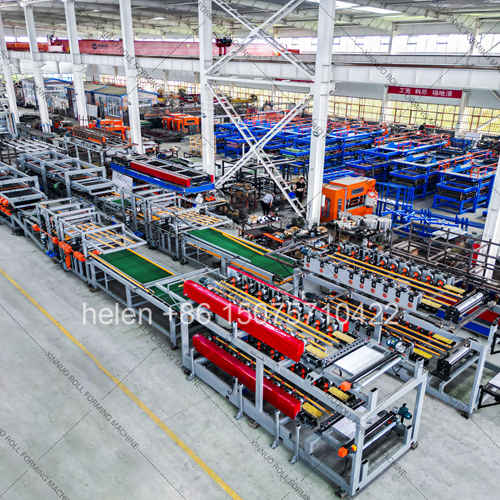
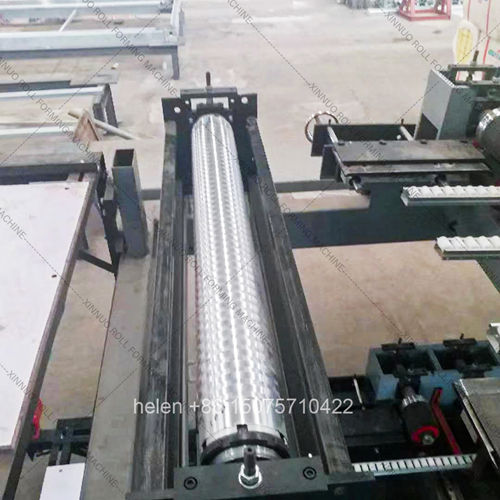
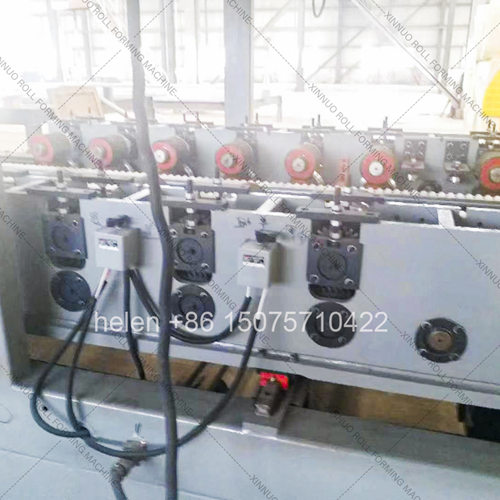
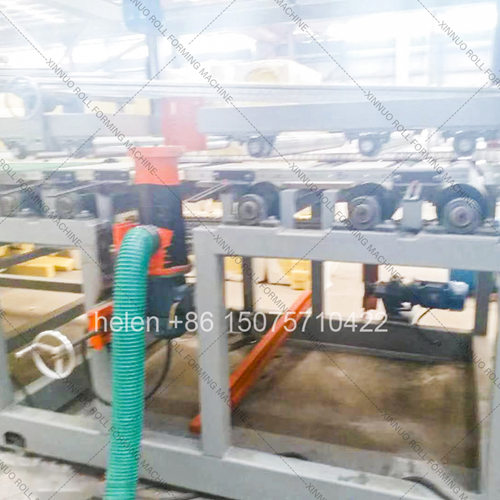
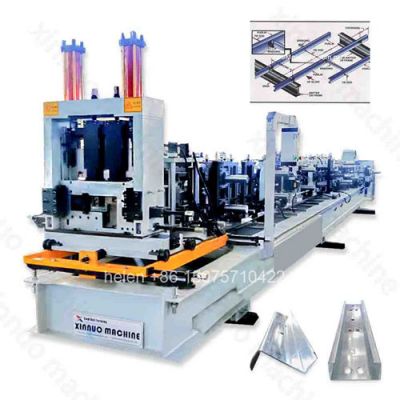
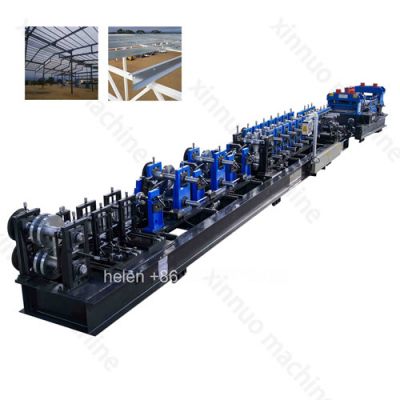
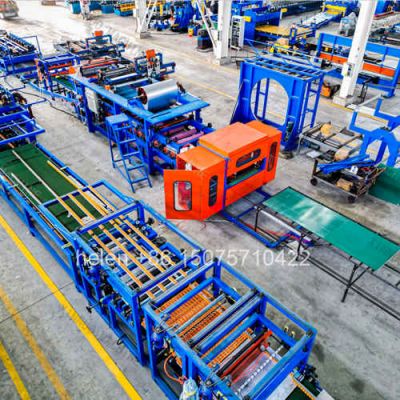
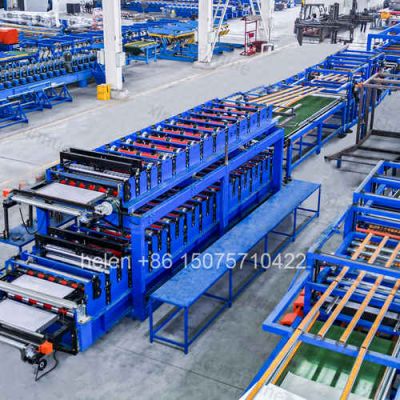
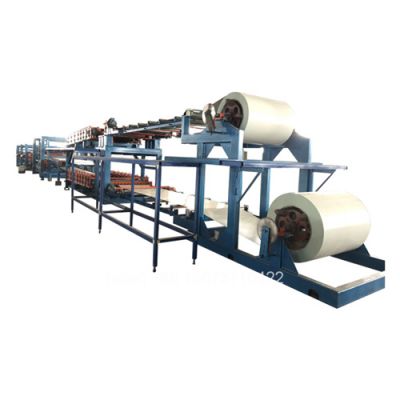
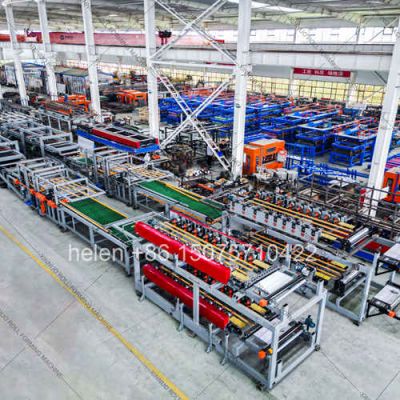
Z lock sandwich panel production line for EPS, rock wool, PU and glass wool insulated roof and wall panels. Self-locking Z-type interlocking concealed joint design. PLC touchscreen automatic control with flying shear cut. Complete continuous manufacturing system.
| Parameter | Specification |
|---|---|
| Panel Effective Width | 950 / 970 / 1000 / 1050 mm (customizable) |
| Panel Thickness | 50 – 150 mm |
| Skin Steel Thickness | 0.3 – 0.8 mm (top), 0.3 – 0.6 mm (bottom) |
| Feed Coil Width | 1200 / 1250 mm |
| Forming Stations | 14 rows per unit (upper + lower) |
| Roller Material | GCR15 bearing steel, HRC 58–62, CNC machined |
| Frame | 300H welded structural steel, 14 mm mid-plate |
| Shaft Diameter | Φ70 mm, quenched and tempered |
| Main Drive | 4 kW × 5 motor sets, chain-driven synchronized |
| Production Speed | 3 – 5 m/min continuous |
| Cutting System | Hydraulic flying shear, ±2 mm tolerance |
| Control System | PLC with touchscreen HMI, full line synchronization |
| Total Line Length | 45 – 55 meters |
| Installed Power | 25 – 35 kW, 380V / 50Hz / 3-phase |
| Feature | Z Lock Interlocking Joint | Conventional Lap Joint |
|---|---|---|
| Surface Appearance | Zero exposed fasteners, clean flush finish | Screw heads visible on panel face |
| Weather Sealing | Triple-contact mechanical seal along full edge | Single gasket seal, screw-point leakage risk |
| Thermal Performance | Continuous insulation, no metal thermal bridge | Fasteners create point thermal bridges |
| Installation Speed | Snap-fit engagement, 30% faster installation | Manual screw fastening per panel |
| Long-Term Durability | No fastener corrosion or loosening over time | Fastener fatigue and seal degradation |
| Core Type | Density Range | Thermal Conductivity | Fire Class | Recommended Use |
|---|---|---|---|---|
| EPS Foam | 12 – 18 kg/m³ | 0.038 W/m·K | B2 | General industrial workshops, warehouses, agricultural buildings |
| PU Foam | 38 – 45 kg/m³ | 0.022 W/m·K | B1 – B2 | Cold storage, freezer rooms, food processing facilities |
| Rock Wool | 80 – 120 kg/m³ | 0.040 W/m·K | A1 (non-combustible) | High-rise buildings, fire-rated partitions, public facilities |
| Glass Wool | 24 – 48 kg/m³ | 0.035 W/m·K | A1 – A2 | Acoustic walls, interior partitions, HVAC enclosures |
| Sector | Panel Application |
|---|---|
| Cold Chain Logistics | Freezer room walls and ceilings, refrigerated warehouse envelopes |
| Industrial Construction | Prefabricated steel structure factory roofs and exterior walls |
| Commercial Buildings | Office building curtain walls, shopping mall partition systems |
| Cleanroom Facilities | Pharmaceutical and electronics manufacturing controlled environments |
| Agricultural Sector | Poultry house insulation, greenhouse climate-controlled walls |
| Modular Construction | Container house wall and roof panels, portable site office units |
| Food Processing | Hygienic wash-down wall panels, temperature-controlled processing rooms |
| Stage | Operation Description | Equipment Involved |
|---|---|---|
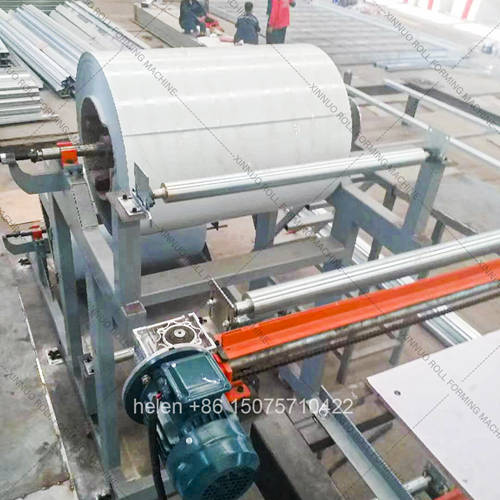
| 1. Coil Preparation | Upper and lower steel coils loaded onto dual hydraulic decoilers; pneumatic tension arms maintain constant strip feed pressure; coil edge guides align material to forming centerline | Dual 5-ton hydraulic decoilers with tension control |
| 2. Top Skin Roll Forming | Steel strip enters upper 14-station roller cascade; progressive bending shapes the panel profile including the Z lock male interlocking rib at the final forming station | Upper 14-row roll forming unit, Φ70 mm shafts |
| 3. Bottom Skin Roll Forming | Steel strip enters lower 14-station roller cascade; progressive bending shapes bottom profile with Z lock female receiving channel at the final station | Lower 14-row roll forming unit, Φ70 mm shafts |
| 4. Core Material Placement | Insulation core material — EPS sheets, rock wool batts, or injected PU foam — is automatically positioned onto the moving bottom skin surface via the core feeding conveyor | Core feeding conveyor with alignment guides |
| 5. Adhesive Application | Dual-component polyurethane adhesive is metered by independent pumps and uniformly spread onto the core-to-metal contact interfaces; flow rate digitally controlled per production speed | Dual-pump glue spreading station with flow control |
| 6. Continuous Lamination | Top and bottom formed skins converge with the core layer sandwiched between them; the composite passes through the 9-meter pressing bed where uniform pressure bonds all layers into a monolithic panel | 9-meter lamination and curing press conveyor |
| 7. Edge Finishing | Side edges are trimmed to exact effective panel width; the Z lock interlocking profile on both edges is verified for dimensional accuracy inline | Edge trimming station with profile verification |
| 8. Automatic Length Cutting | The continuous panel stream reaches the flying shear which cuts panels to the programmed length (2–12 m) without stopping the line; cut timing is synchronized with PLC encoder feedback | Hydraulic flying shear, ±2 mm cutting precision |
| 9. Panel Handling | Finished panels are conveyed onto the run-out table, inspected, stacked in bundles, and wrapped with protective film for storage or immediate shipment | Run-out conveyor table and stacking station |
The entire production process operates under centralized PLC supervision. Operators set panel length, line speed, and adhesive flow parameters on the touchscreen HMI. The flying shear enables non-stop continuous production, consistently delivering 3–5 linear meters of finished panel per minute — suitable for medium to high-volume manufacturing facilities.
Hebei Xinnuo is a professional cold roll forming machinery manufacturer with 20+ years of experience. We specialize in C/Z purlin machines, roof panel roll formers, floor deck machines, and custom profile solutions — exported to 50+ countries worldwide.