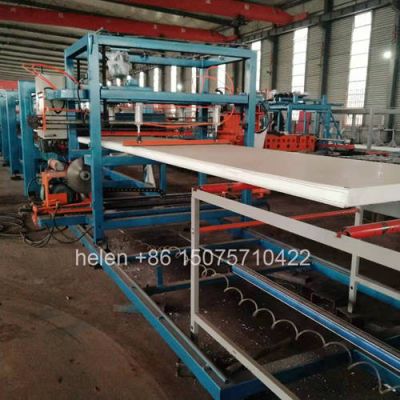
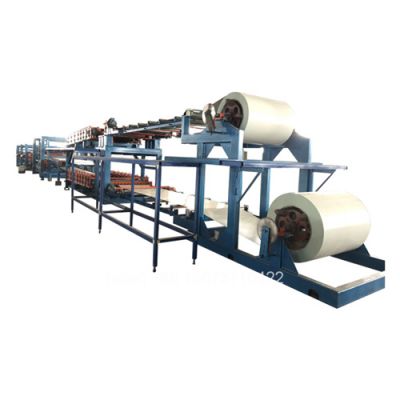
Z Lock Sandwich Panel Machine — Price Factors and Configuration Guide
What Determines Z Lock Sandwich Panel Machine Price
- Panel Width and Profile — Machine configured for 950 mm panel costs less than 1050 mm or custom-width tooling due to larger roller sets and wider frame requirements
- Core Material Handling — EPS-only foam machine is the most economical; adding rock wool feeding unit, PU high-pressure injection or multi-core quick-change capability increases investment proportionally
- Frame and Build Grade — Standard 300H frame with 14 mm mid-plate suits normal production; heavy-duty 350H frame with 16 mm plate and larger shafts costs more but delivers longer service life under high-volume operation
- Automation Level — Basic PLC with manual length setting vs. full touchscreen HMI with recipe storage, production logging, and remote diagnostics — automation tier directly impacts price and operator efficiency
- Cutting System — Hydraulic flying shear is standard; upgrading to servo-driven precision saw adds cost but achieves ±1 mm length accuracy for premium panel markets
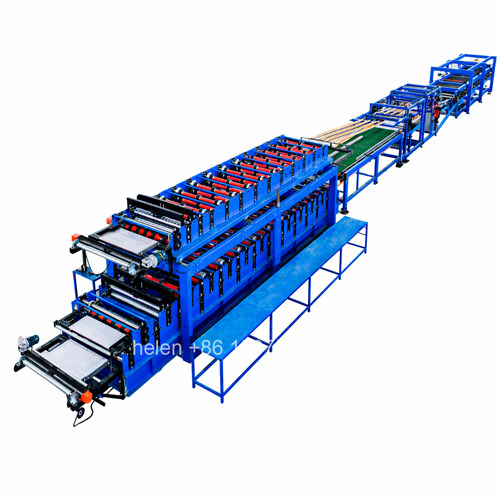
- Line Length and Throughput — Compact 45-meter layout costs less; extended 55–65 meter configuration with longer curing bed and dual stacking stations commands higher price for higher daily output
Machine Configuration Tiers and Cost Comparison
| Configuration Level |
Key Specifications |
Best For |
Relative Investment |
| Standard EPS Line |
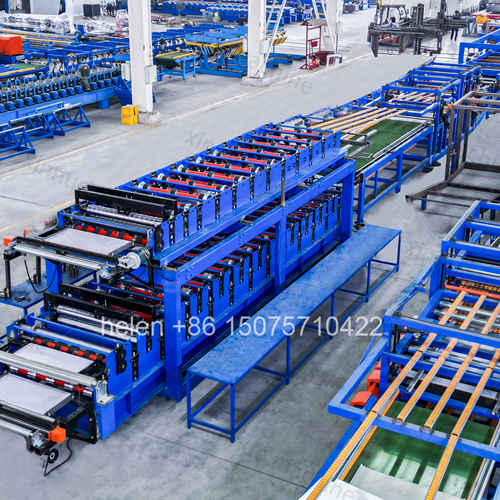
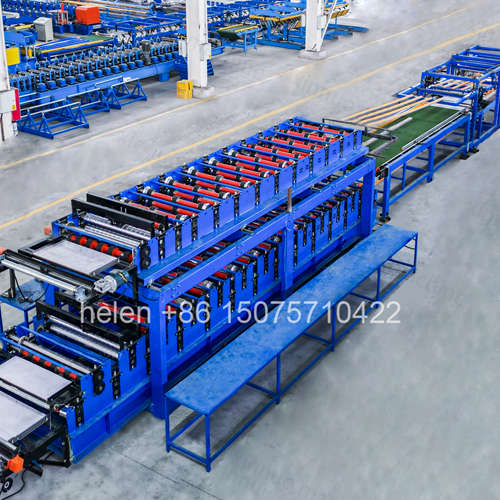
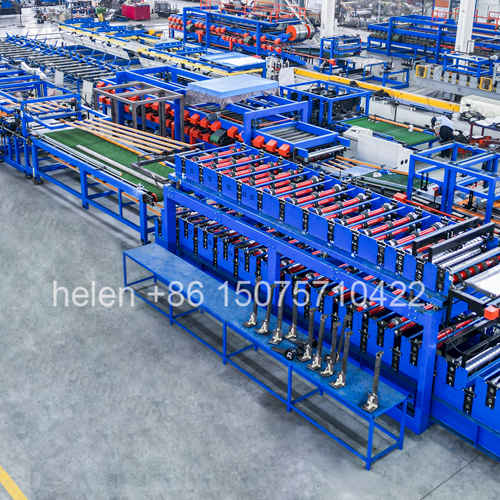
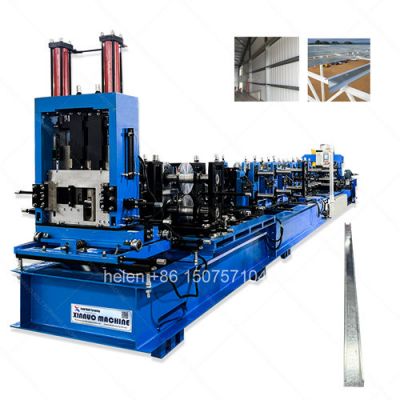
300H frame, 14 mm plate, Φ70 mm shafts, 4 kW motors, 14 forming rows, hydraulic shear, 45 m layout |
Startup manufacturers, single-core EPS production, 500–800 panels/day |
Entry level |
| Multi-Core Flexible Line |
300H frame, 14 mm plate, Φ70 mm shafts, 4 kW motors, EPS + rock wool + PU capability, dual glue pumps, 50 m layout |
Regional panel suppliers serving diverse building types and fire code requirements |
Mid-range |
| Heavy-Duty High-Volume Line |
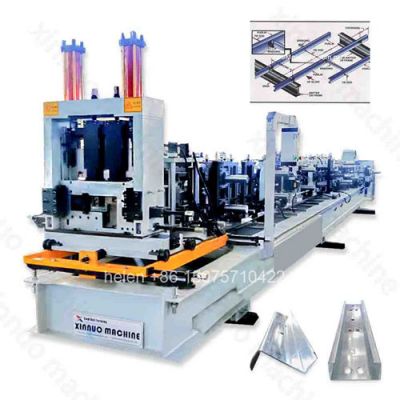
350H frame, 16 mm plate, Φ75–80 mm shafts, 5.5 kW motors, three-core quick change, 9 m curing bed, servo saw, 55–65 m layout |
Large-scale manufacturers, 1,200–1,500+ panels/day, export-grade quality requirements |
Premium |
Core Material Configuration and Price Impact
| Insulation Core Setup |
Additional Equipment Required |
Price Adjustment Factor |
Market Demand |
| EPS Foam Only |
Standard glue roller and single-component adhesive system |
Base price |
Highest volume, price-sensitive markets in Africa, South Asia, Middle East |
| EPS + Rock Wool |
Rock wool automatic feeding conveyor, dual-cutting saw (foam/wool separate blades), dust extraction hood |
+15–25% over base |
Middle East GCC, Europe (fire code), Australia, high-rise projects |
| EPS + PU Foam |
High-pressure PU foaming unit, heated curing tunnel, temperature control module, chemical storage tanks |
+20–30% over base |
Cold chain logistics, food processing, pharmaceutical cleanrooms |
| EPS + Rock Wool + PU (Full) |
All of the above plus multi-core quick-change tooling, programmable recipe switching |
+30–45% over base |
Large diversified panel manufacturers serving multiple industries |
Standard Machine Specifications
| Parameter |
Standard Build |
Upgraded Build |
| Finished Panel Width |
950 / 970 / 1000 mm |
1050 / 1120 / 1200 mm |
| Panel Core Thickness |
50 – 100 mm |
50 – 150 mm (200 mm optional) |
| Top Skin Gauge |
0.30 – 0.60 mm |
0.30 – 0.80 mm |
| Bottom Skin Gauge |
0.30 – 0.50 mm |
0.30 – 0.60 mm |
| Feed Coil Width |
1200 mm |
1250 / 1300 mm |
| Roll Forming Stations |
14 rows × 2 units |
16–18 rows × 2 units |
| Roller Material |
GCR15, HRC 58–60, CNC machined |
GCR15, HRC 60–62, hard chrome plated |
| Frame Construction |
300H steel, 14 mm plates |
350H steel, 16 mm plates, stress-relieved |
| Shaft Diameter |
Φ70 mm |
Φ75 – 80 mm |
| Drive Motors |
4 kW × 5 sets |
5.5 kW × 5 sets |
| Running Speed |
3 – 4 m/min |
4 – 5 m/min |
| Panel Length Range |
2,000 – 12,000 mm programmable |
2,000 – 14,000 mm programmable |
| Cutting Tolerance |
±2 mm (hydraulic shear) |
±1 mm (servo-driven saw) |
| Decoiler Capacity |
5 tons × 2 (hydraulic) |
7 tons × 2 (hydraulic, heavy-duty) |
| Curing Bed Length |
6 meters |
9 meters |
| Total Power |
25 – 30 kW |
35 – 45 kW |
| Line Footprint |
45 × 4 × 3.5 m |
55–65 × 4.5 × 3.8 m |
| Daily Output (8 hrs) |
~800 panels |
~1,200 panels |
What Is Included vs. Optional Upgrades
| Standard Inclusion |
Available Upgrade |
| Dual hydraulic decoilers with manual tension |
Pneumatic auto-tension loop control system |
| Single-circuit glue pump |
Dual-circuit independent metering pump with digital flow readout |
| Basic PLC with button panel |
Color touchscreen HMI with recipe storage and production data logging |
| Manual core material loading table |
Powered core feeding conveyor with automatic alignment |
| Hydraulic flying shear, ±2 mm |
Servo-driven circular saw, ±1 mm, with dust extraction |
| Single-side edge trimmer |
Dual-side automatic edge trimmer with inline profile gauge |
| Open run-out table |
Enclosed run-out table with pneumatic stacking assist |
| Standard 6 m curing bed |
Extended 9 m heated curing tunnel with temperature zones |
| One set of forming rollers (one profile) |
Additional roller sets for second panel width or joint type |
| Standard industrial paint finish |
Shot-blast + two-coat electrostatic powder coating |
Return on Investment — Why Z Lock Panels Command Higher Market Price
- Z lock concealed fastener panels sell at 15–25% price premium over standard lap-joint panels in most markets — the machine pays for itself faster through higher product margin
- Snap-fit installation reduces on-site labor by 30–40% compared to screw-fixed panels — this labor saving is a strong selling point to contractors and building developers
- Triple-seal weather integrity eliminates call-backs for water leakage — lower warranty claims and stronger reputation lead to repeat orders
- Architectural-grade flush appearance opens access to commercial and high-end residential projects where standard exposed-screw panels are rejected on aesthetic grounds
- One machine produces panels for cold storage, industrial, commercial, agricultural and modular housing sectors — diversified revenue streams reduce business risk
Panel Applications and Target Markets
| Application |
Recommended Core |
Typical Panel Spec |
Market Price Segment |
| Cold storage warehouse |
PU foam (rigid) |
100–150 mm thick, 1000 mm wide |
Premium pricing, high margin |
| Factory roofing and walls |
EPS foam |
50–75 mm thick, 950–1000 mm wide |
Volume pricing, competitive |
| High-rise fire-rated facade |
Rock wool (A1) |
80–120 mm thick, 1000 mm wide |
Premium, fire-code driven |
| Food processing cleanroom |
PU foam + stainless skin |
80–100 mm thick, 1000 mm wide |
Highest margin, niche |
| Poultry house insulation |
EPS or glass wool |
50 mm thick, 950 mm wide |
Cost-sensitive, high volume |
| Modular container home |
EPS or rock wool |
50–75 mm thick, 950–1000 mm wide |
Mid-range, growing market |
Manufacturing Workflow — From Raw Coil to Finished Panel
| Step |
Process Detail |
Time per Panel |
| 1. Coil Setup |
Upper and lower galvanized steel coils mounted on powered decoilers. Strip is fed through guide rollers and tension arms to the forming section entry. Coil change takes approximately 15 minutes with overhead crane |
Setup only |
| 2. Dual Forming |
Both steel strips enter their respective 14-station roller banks simultaneously. Progressive forming bends shape the Z lock profile edges — male rib on top skin, female channel on bottom skin. No heat or lubrication required; forming is purely mechanical cold roll bending |
Continuous flow |
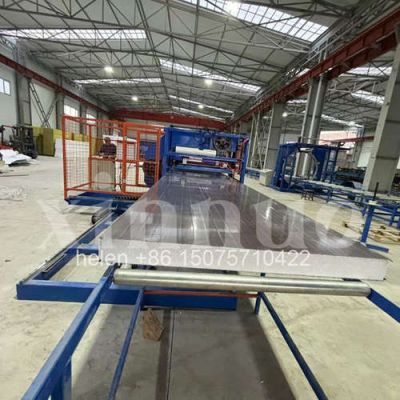
| 3. Core Lay-Up |
Pre-cut insulation sheets are placed onto the bottom skin as it exits the lower forming unit. For EPS, rigid boards are conveyor-fed; for rock wool, compressed batts expand to fill the cavity; for PU, liquid chemicals are injected and foam in place |
Continuous flow |
| 4. Adhesive Bonding |
Two-component polyurethane adhesive is applied to both skin-to-core interfaces via separate pump circuits. Flow rate is synchronized with line speed via the PLC to maintain consistent gram-per-square-meter coverage regardless of running speed |
Continuous flow |
| 5. Pressure Curing |
The three-layer assembly enters the curing tunnel where upper and lower pressure belts apply uniform compression. For PU systems, heated zones accelerate the exothermic curing reaction. Total dwell time: 3–5 minutes depending on panel thickness |
3 – 5 min |
| 6. Edge Processing |
Excess material trimmed from both sides. The Z lock interlocking geometry is verified with a pass-through gauge. Any edge burr or profile deviation is corrected before the panel reaches the cutting station |
Inline, no added time |
| 7. Flying Cut |
The moving panel triggers the shear when the encoder count matches the preset length. The shear carriage accelerates to match line speed, clamps the panel, executes the cut in under one second, and returns to home position for the next cycle |
< 1 sec per cut |
| 8. Inspection and Stacking |
Each panel is visually checked for surface flatness, edge straightness, and joint fit before stacking. Bundles of 10–20 panels are wrapped and labeled with production date, batch number, and panel specification |
2 – 3 min per bundle |
The production cycle runs without interruption — material enters as coil at one end and exits as finished, cut-to-length panels at the other. Panel length changes are entered on the touchscreen and take effect on the next cut cycle without stopping production. A full 8-hour shift with one operator and two loaders typically yields 600–1,200 finished panels depending on machine configuration and panel thickness.