helen@hbxinnuorollforming.com
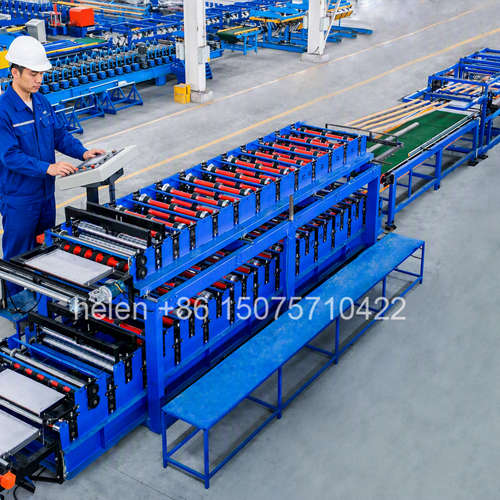
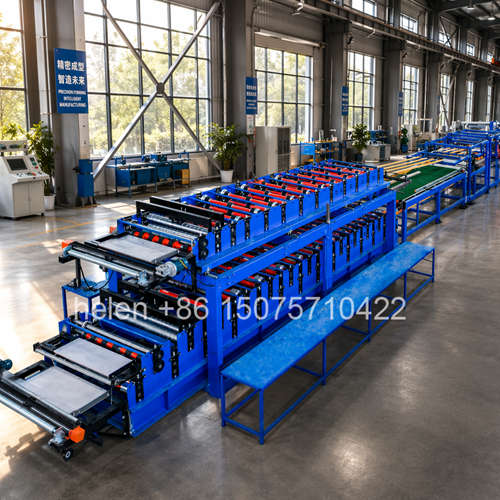
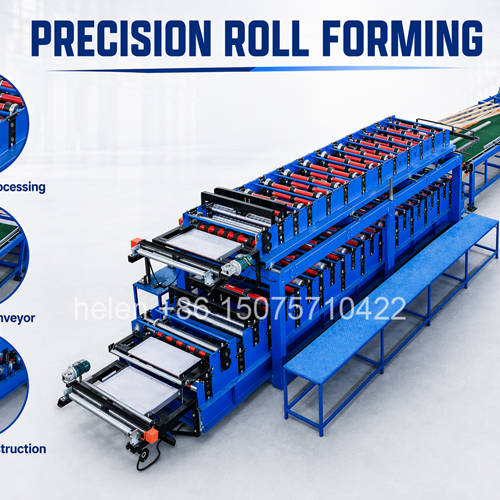
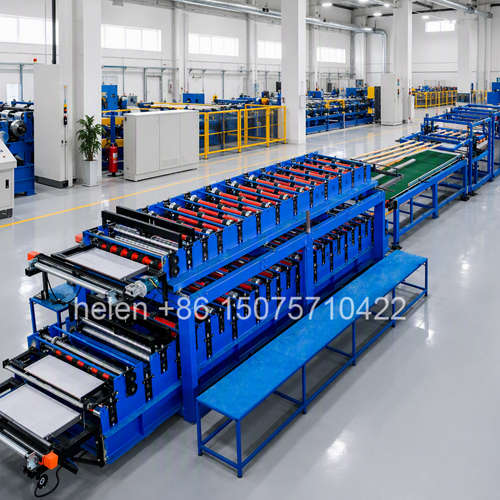
Z lock mineral wool sandwich panel production line for non-combustible A1 fire-rated insulated roof and wall panels. Automatic continuous manufacturing with rock wool core feeding, dual-skin roll forming, glue lamination and inline cutting. Meets international building fire codes.
| Region / Country | Applicable Standard | Mineral Wool Panel Status | Typical Project Type |
|---|---|---|---|
| European Union | EN 13501-1 — A1, S1, d0 | Highest classification achieved | High-rise residential and commercial facades |
| United Kingdom | BS 476 Parts 6/7/20/22 — Class 0 | Fully compliant, Class 0 surface spread of flame | Post-Grenfell cladding replacement, schools, hospitals |
| Middle East GCC | UAE Fire & Life Safety Code, Saudi SBC 801 | Required for buildings above 15 meters | Dubai tower facades, Doha metro stations, Riyadh malls |
| Australia / NZ | AS 1530.1 / AS 1530.3 — non-combustible | Deemed-to-satisfy for NCC Type A & B construction | Apartment towers, aged care facilities, public buildings |
| North America | ASTM E119 / NFPA 285 / CAN/ULC S101 | 1–4 hour fire resistance rating achievable | Commercial curtain walls, firewall assemblies, data centers |
| Southeast Asia | SS 332 (Singapore), MS 1074 (Malaysia) | Approved for fire-rated compartmentation | Semiconductor fabs, airport terminals, mixed-use towers |
| Parameter | Mineral Wool Configuration |
|---|---|
| Finished Panel Width | 950 / 970 / 1000 / 1050 mm |
| Panel Core Thickness | 50 – 150 mm (200 mm for fire-rated walls) |
| Top Skin Steel Gauge | 0.40 – 0.80 mm galvanized / pre-painted steel |
| Bottom Skin Steel Gauge | 0.40 – 0.60 mm galvanized / pre-painted steel |
| Rock Wool Density Range | 80 – 120 kg/m³ (standard); up to 150 kg/m³ for acoustic panels |
| Rock Wool Fiber Orientation | Vertical lamella (perpendicular to panel face) for maximum compressive strength |
| Raw Coil Width | 1200 mm / 1250 mm |
| Forming Stations | 14 rows upper + 14 rows lower (28 total) |
| Roller Material | GCR15 bearing steel, HRC 58–62, hard chrome surface option |
| Frame Structure | 300H welded steel, 14 mm wall plate, shot-blast + powder coated |
| Shaft Diameter | Φ70 mm, induction hardened |
| Drive System | 5 × 4 kW motors, heavy-duty chain drive, synchronized upper/lower |
| Rock Wool Feeding | Powered conveyor with compression pre-rollers and lateral alignment guides |
| Adhesive System | Dual-component PU, independent dual-pump metering, 200L tank capacity |
| Curing Tunnel | 9-meter heated bed with adjustable pressure rollers |
| Cutting Station | Dual saw (separate blades for mineral wool and steel skin), enclosed with dust extraction |
| Production Speed | 3 – 4 m/min (slightly slower than EPS to ensure full core compression) |
| Panel Length Range | 2,000 – 12,000 mm, programmable via PLC |
| Cutting Tolerance | ±2 mm (hydraulic flying shear) |
| Dust Management | HEPA-filtered extraction at cutting, trimming and stacking stations |
| Total Line Length | 50 – 55 meters |
| Installed Power | 28 – 35 kW, 380V / 50Hz / 3-phase |
| Daily Output (8 hrs) | 600 – 900 panels (mineral wool production is slower than EPS) |
| Property | Mineral Wool (Rock Wool) | EPS Foam | PU Foam |
|---|---|---|---|
| Fire Classification (EN 13501-1) | A1 — no contribution to fire at any stage | E / B2 — combustible, melting droplets | C–D / B1–B2 — limited combustibility |
| Melting / Decomposition Point | >1,000°C — retains structural integrity | ~100°C — shrinks and melts rapidly | ~200°C — chars and decomposes |
| Smoke Production (EN 13501-1) | S1 — virtually no smoke | S3 — heavy black smoke | S2–S3 — dense toxic smoke |
| Fire Resistance Duration | 30–240 minutes (thickness dependent) | 0–15 minutes before core collapse | 15–60 minutes (char layer slows burn) |
| Acoustic Reduction (Rw) | 30–45 dB (excellent sound insulation) | 15–22 dB (poor acoustic performance) | 18–25 dB (moderate) |
| Thermal Conductivity (λ) | 0.040 W/m·K | 0.038 W/m·K | 0.022 W/m·K |
| Panel Weight per m² (100 mm thick) | ~18–22 kg | ~12–14 kg | ~15–18 kg |
| Vapor Permeability | High — breathable, reduces condensation | Low — vapor barrier required | Very low — vapor barrier required |
| Building Type | Fire Requirement | Panel Specification |
|---|---|---|
| High-rise residential towers (>18 m) | A1 non-combustible cladding mandated post-Grenfell (UK, EU, GCC, AU) | 80–100 mm rock wool, 1000 mm Z lock, 0.5/0.5 mm steel |
| Hospital and healthcare facilities | 2-hour fire compartment walls, smoke control essential | 100–120 mm rock wool, 1000 mm Z lock, 0.6/0.5 mm steel |
| Data centers and server rooms | Fire separation between zones, non-combustible construction | 80–100 mm rock wool, 970 mm Z lock, 0.5/0.5 mm steel |
| Schools and educational buildings | Class 0 surface spread of flame, low smoke toxicity | 50–80 mm rock wool, 950–1000 mm Z lock, 0.5/0.4 mm steel |
| Airport terminals and metro stations | Strict smoke emission limits, evacuation route protection | 80–100 mm rock wool, 1000 mm Z lock, 0.6/0.6 mm steel |
| Cold storage with fire safety | Combined thermal insulation + fire compartment requirement | 150–200 mm rock wool, 1000 mm Z lock, 0.6/0.5 mm steel |
| Industrial firewall separation | 4-hour fire barrier between process zones | 120–150 mm rock wool, 1000 mm Z lock, 0.7/0.6 mm steel |
| Stage | Operation | Mineral Wool Specific Detail |
|---|---|---|
| 1. Coil Loading | Pre-painted galvanized steel coils mounted on dual hydraulic decoilers; strip threading through entry guides to forming section | Heavier gauge steel (0.5–0.8 mm) typically used for fire-rated panels — decoiler tension set higher than foam panel lines |
| 2. Top Profile Forming | Steel strip passes through 14-station upper roller bank; progressive cold forming shapes the panel face profile and the Z lock male rib on the right edge | GCR15 rollers with hard chrome surface preferred — mineral wool dust is mildly abrasive over long production runs |
| 3. Bottom Profile Forming | Steel strip passes through 14-station lower roller bank; Z lock female channel formed on the left edge; bottom profile may include stiffening ribs for panel span strength | Additional ribbing compensates for mineral wool's higher weight compared to foam cores (18–22 kg/m² vs. 12–14 kg/m²) |
| 4. Rock Wool Feeding | Pre-cut mineral wool batts (vertical lamella orientation) are automatically fed from the loading conveyor onto the moving bottom skin; compression rollers pre-press the batt to 90% of target thickness | Lamella-cut batts essential — random fiber batts collapse under panel weight. Compression pre-rollers prevent spring-back delamination |
| 5. Adhesive Application | Two-component PU adhesive metered via independent pumps; applied to both skin-to-core contact faces through precision nozzle bars spanning the full panel width | Higher adhesive volume required than EPS — mineral wool's porous surface absorbs 20–30% more glue for equivalent bond strength |
| 6. Lamination and Curing | Top and bottom skins converge with the compressed mineral wool core; the sandwich enters the 9-meter heated curing tunnel where pressure rollers maintain uniform compression throughout the adhesive cure cycle | Longer dwell time than EPS — mineral wool acts as a heat sink, slowing the exothermic PU cure; heated tunnel zones compensate for this thermal lag |
| 7. Edge Trimming and Joint Verification | Dual-side edge trimmers cut excess core material and steel overhang; Z lock profile passes through a go/no-go gauge to confirm male-female interlocking fit | Mineral wool fiber protrusion at panel edges checked and cleaned — loose fibers can interfere with Z lock snap-fit on site |
| 8. Panel Cutting | Flying saw with separate carbide (steel) and abrasive (mineral wool) blades cuts panels to programmed length without stopping the line; enclosed cutting booth with HEPA dust extraction | Dual-blade system essential — single-blade cutting of mineral wool generates excessive dust and rapid blade wear. Extraction system runs continuously during production |
| 9. Quality Inspection and Packing | Finished panels checked for dimensional accuracy, surface flatness, Z lock fit, and core density uniformity; stacked in protective bundles with edge guards and labeled with batch traceability data | Each bundle weighed as a secondary check — mineral wool panels have predictable weight per linear meter; weight variance flags core density issues |
The mineral wool production line operates at 3–4 meters per minute — approximately 20% slower than an equivalent EPS line due to the longer curing dwell time and dual-blade cutting cycle. The slower pace is offset by the significantly higher market value of A1 fire-rated panels, which command a 30–50% price premium over standard EPS panels in regulated construction markets. A single 8-hour shift produces 600–900 finished panels, sufficient to supply cladding for approximately 200–300 square meters of high-rise facade per day.
Hebei Xinnuo is a professional cold roll forming machinery manufacturer with 20+ years of experience. We specialize in C/Z purlin machines, roof panel roll formers, floor deck machines, and custom profile solutions — exported to 50+ countries worldwide.