helen@hbxinnuorollforming.com
For manufacturers and fabricators entering the steel structure market, selecting the right purlin roll forming machine is one of the most critical equipment decisions. The choice between a C, Z, CZ integrated, or U channel machine directly affects your product range, production efficiency, floor space requirements, and return on investment. This guide breaks down each machine type, its applications, and how to match the right equipment to your business needs.
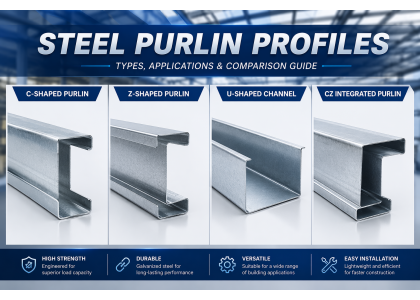
C purlins have a symmetrical C-shaped cross-section with equal flanges on both sides. The profile is named for its resemblance to the letter "C" when viewed from the end.
Z purlins have an asymmetrical Z-shaped cross-section with flanges pointing in opposite directions. This profile allows sections to nest and overlap at supports, creating continuous structural spans.
The CZ integrated machine is a dual-profile system that can produce both C and Z purlins on a single production line. By adjusting the forming rollers and shear mechanism, operators can switch between C and Z profiles — and across multiple sizes — without changing the entire tooling set.
U channels (or U-shaped channels) have a U-shaped cross-section with two equal vertical flanges and a flat base. They differ from C purlins in that C profiles typically have inward returns (lips) on the flange edges, while U channels have straight flanges.
| Feature | C Machine | Z Machine | CZ Machine | U Machine |
|---|---|---|---|---|
| Profile Range | C only | Z only | C + Z | U only |
| Market Demand | High | High | Very High | Moderate |
| Upfront Cost | $$ | $$ | $$$ | $ |
| Floor Space | 8–12m | 8–12m | 10–14m | 6–10m |
| Production Speed | 20–30 m/min | 20–30 m/min | 25–35 m/min | 15–25 m/min |
| Size Change Time | Manual / Semi-auto | Manual / Semi-auto | <1 min (servo) | Manual |
| Best For | Wall framing, small buildings | Large-span roofs | Full-service suppliers | Framing, channels, niche markets |
Survey your target customers. If 80% of inquiries are for C purlins, a dedicated C machine may be the most cost-effective start. If you receive a healthy mix of C and Z requests, the CZ integrated machine pays for itself through broader market coverage.
A single-profile C or Z machine offers the lowest entry cost. A U channel machine is even more affordable but addresses a narrower market. The CZ machine represents a higher upfront investment but delivers the widest product capability per dollar spent — and typically the fastest payback period for manufacturers supplying the construction industry.
Measure your available production floor. A C or Z line needs roughly 8–12 meters of length plus material handling space at both ends. A CZ line adds 2–4 meters. U channel machines are the most compact. Factor in coil storage, finished product stacking, and forklift access when planning your layout.
For low to medium output (under 10 tons/day), a standard mechanical or semi-automatic machine is adequate. For high-volume production (15+ tons/day), invest in a servo-driven CZ machine with automatic size change — the time saved on changeovers alone can increase daily output by 30% or more.
If your long-term strategy includes adding new profiles, consider starting with a CZ integrated machine. Upgrading from a C-only to a CZ later means buying a second machine — and sacrificing additional floor space. Starting with CZ gives you room to grow without duplicate investment.
There is no single "best" purlin machine — only the best machine for your business. A local fabricator serving small agricultural projects may thrive with a dedicated C purlin machine. A regional steel service center supplying diverse construction projects will almost certainly need a CZ integrated line. A manufacturer specializing in door frames and industrial channels may find the U channel machine perfectly matched to their niche.
The key is aligning the machine's capabilities with your market demand, budget, space, and growth plan. With the right equipment choice, a purlin roll forming line can become the highest-margin asset in your factory.
Hebei Xinnuo is a professional cold roll forming machinery manufacturer with 20+ years of experience. We specialize in C/Z purlin machines, roof panel roll formers, floor deck machines, and custom profile solutions — exported to 50+ countries worldwide.