
helen@hbxinnuorollforming.com
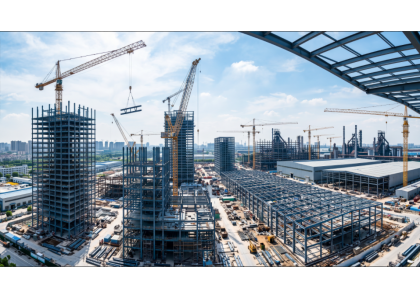
The global steel structure industry enters 2026 with cautious optimism. After a mixed 2025 that saw regional divergence and supply chain recalibration, forecasters project a return to steady growth — driven by infrastructure investment, industrial expansion, and accelerating adoption of pre-engineered steel building systems. Here is a data-driven look at where the market stands, where it is heading, and what it means for the cold roll forming sector.
According to the World Steel Association's Short Range Outlook (April 2026), global steel demand is projected to grow by 0.3% in 2026 to reach 1,724 million tonnes, with an accelerated 2.2% growth forecast for 2027. Within this total, the structural steel segment — beams, columns, purlins, and fabricated sections used in building frames — represents a significant and growing share.
Grand View Research values the global structural steel market at approximately USD 115 billion in 2025, with a projected compound annual growth rate (CAGR) of 6.7% through 2033, targeting USD 202.1 billion by the end of the forecast period. The pre-engineered metal building (PEB) segment — where cold roll formed purlins and panels are the dominant materials — reached an estimated USD 47.9 billion in 2025, with sustained high-single-digit growth ahead.
| Key Metric | Value | Source |
|---|---|---|
| Global Steel Demand 2026 | 1,724 Mt (+0.3%) | worldsteel |
| Steel Demand 2027 (forecast) | +2.2% | worldsteel |
| Structural Steel Market (2033) | USD 202.1 Bn (6.7% CAGR) | Grand View Research |
| PEB Market 2025 | USD 47.9 Bn | Grand View Research |
| PEB Market CAGR | ~8.3% through 2030 | The Business Research Company |
Asia Pacific remains the largest and fastest-growing regional market for structural steel, accounting for over 50% of global consumption. China, while moderating from its historic construction boom, continues to drive demand through infrastructure renewal and industrial upgrading. India stands out as the strongest growth story: the country's construction sector is expanding at an estimated 15.7% CAGR, powered by government initiatives such as the Smart Cities Mission, Make in India, and large-scale warehousing and logistics park development. Southeast Asian markets — Vietnam, Indonesia, and the Philippines — are also posting double-digit growth in steel-intensive industrial construction.
Saudi Arabia's Vision 2030, the UAE's urban expansion, and pan-African infrastructure programs are generating sustained demand for steel structures. Pre-engineered buildings are the format of choice for the region's logistics hubs, industrial zones, and affordable housing projects, creating reliable demand for purlins, panels, and cold roll formed components.
The United States structural steel market benefits from reshoring of manufacturing capacity, data center construction, and federal infrastructure spending. The PEB segment in North America is projected to grow at a healthy pace, with cold-formed steel framing gaining share in mid-rise commercial construction as developers seek faster build times and lower labor costs.
European growth is driven less by new-build volume and more by renovation, energy-efficiency retrofits, and sustainability regulation. The EU's push toward low-carbon construction is accelerating the shift from hot-rolled to cold-formed steel in secondary structures, where material efficiency and precision reduce both cost and embodied carbon.
Speed and cost are the twin engines of PEB adoption. A pre-engineered steel warehouse can be designed, fabricated, and erected in half the time of a conventional concrete structure, at 20–30% lower total cost. As e-commerce, cold-chain logistics, and manufacturing continue to expand globally, PEB demand — and with it, demand for cold roll formed purlins and panels — is locked into sustained growth.
The logistics real estate sector is one of the largest consumers of steel-framed buildings. Amazon, Alibaba, JD.com, and regional logistics operators are building fulfillment centers at an unprecedented pace across Asia, the Middle East, and the Americas. In parallel, the global data center construction market — projected to exceed USD 300 billion by 2030 — relies heavily on steel-frame construction for its large-span, heavy-load requirements.
The shift from conventional G300/G350 grades to G550 and beyond is accelerating. As detailed in our earlier analysis on high-strength steel, engineers are specifying thinner, stronger cold-formed sections to reduce weight, lower cost, and achieve longer spans — trends that directly benefit roll forming equipment manufacturers capable of processing advanced steel grades.
The roll forming machines of 2026 are not the machines of 2016. Servo-driven size change, automatic gauge adjustment, IoT-enabled production monitoring, and predictive maintenance are becoming competitive requirements rather than premium upgrades. The machines that win orders today combine mechanical robustness with intelligent control — delivering higher throughput, less downtime, and more consistent product quality.
Carbon-conscious construction is no longer optional. Cold roll formed steel — with its high material utilization rate, recyclability, and compatibility with galvanized coatings that extend service life — is increasingly specified in green building projects. As embodied carbon regulation tightens in Europe, North America, and parts of Asia, cold-formed steel's efficiency advantage over hot-rolled alternatives becomes a hard compliance advantage.
For roll forming equipment manufacturers, the 2026–2030 outlook translates into several actionable priorities:
The 2026 global steel structure market is not in a speculative boom — it is in a steady, structurally supported expansion. Urbanization in developing economies, infrastructure renewal in mature markets, and the relentless growth of logistics and industrial construction create a durable demand base for steel-framed buildings and the roll forming equipment that supplies them.
For fabricators, the message is clear: invest in capacity, invest in automation, and invest in machines built for the steel grades of tomorrow. For equipment manufacturers, the opportunity is equally clear: the companies that deliver reliable, high-speed, G550-capable roll forming lines to the world's fastest-growing markets will define the next decade of the industry.
Hebei Xinnuo is a professional cold roll forming machinery manufacturer with 20+ years of experience. We specialize in C/Z purlin machines, roof panel roll formers, floor deck machines, and custom profile solutions — exported to 50+ countries worldwide.