
helen@hbxinnuorollforming.com
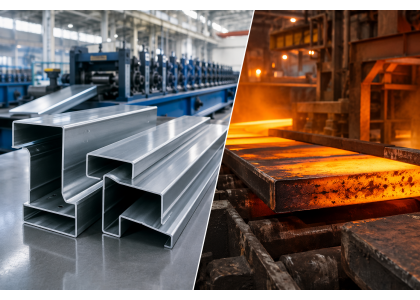
In modern steel construction, the choice of structural components has a direct impact on project cost, build speed, and long-term durability. For secondary structural elements such as purlins, girts, and wall framing, two manufacturing methods dominate the market: cold roll forming and hot-rolled steel. While both have their place, cold roll forming has emerged as the clear winner for the vast majority of light to medium steel structure applications. Here is why.
Cold roll forming is a continuous bending process in which flat steel strip or coil is passed through a series of roller stations at room temperature. Each station progressively shapes the steel until the desired cross-section — typically a C, Z, U, or custom profile — is achieved. The process does not involve heating, which preserves the steel's original metallurgical properties.
C and Z purlins produced by cold roll forming are widely used as roof and wall support members in steel-framed buildings, warehouses, factories, and agricultural structures. Their dimensional accuracy and consistent quality make them the preferred choice for pre-engineered steel buildings.
Hot-rolled steel is formed at temperatures above 1,700°F (approximately 930°C), where the steel becomes malleable and easier to shape. After rolling, the steel cools at ambient temperature, which causes slight shrinkage and dimensional variation. Hot-rolled sections such as I-beams, H-beams, channels, and angles are primarily used as primary structural members where load-bearing capacity is the top priority.
Cold Roll Forming: Achieves tight tolerances of ±0.5 mm or better. The room-temperature process eliminates thermal expansion and contraction, resulting in highly consistent cross-sections from the first meter to the last.
Hot-Rolled Steel: Suffers from thermal shrinkage during cooling, leading to dimensional variation of ±1.5 mm or more. This makes on-site fitting less predictable and often requires additional adjustment.
Winner: Cold Roll Forming
Cold Roll Forming: The raw material used is typically galvanized or Galvalume-coated steel coil. Cold roll forming preserves this protective coating intact, delivering a smooth, uniform surface that resists rust immediately after installation. No secondary painting or galvanizing is required in most cases.
Hot-Rolled Steel: The high-temperature process burns off any pre-applied coating, leaving behind mill scale — a rough, dark oxide layer. Hot-rolled sections almost always require post-processing: shot blasting, priming, and painting, which adds labor, time, and cost.
Winner: Cold Roll Forming
Cold Roll Forming: The cold-working effect increases the steel's yield strength by 15–30%, allowing engineers to specify thinner gauges without sacrificing structural performance. C/Z purlins are typically punched, notched, and cut to exact lengths in one automated line, minimizing waste.
Hot-Rolled Steel: Heavier by nature. Standard hot-rolled channels and angles often carry excess weight for secondary framing applications, increasing the total steel tonnage — and the project cost.
Winner: Cold Roll Forming
Cold Roll Forming: Modern purlin roll forming machines can produce at speeds of 25–35 meters per minute. Advanced systems with servo-driven quick-change technology can switch between C and Z profiles and adjust sizes in under one minute. A single machine can output over 15 tons of finished purlins per day.
Hot-Rolled Steel: Hot rolling mills are massive, capital-intensive facilities designed for bulk output of standard sections. They lack the flexibility to produce small-batch, custom-length orders economically. Lead times are measured in weeks, not hours.
Winner: Cold Roll Forming
Cold Roll Forming: Lighter weight per meter means easier manual handling, faster crane cycles, and reduced foundation load. Pre-punched bolt holes eliminate on-site drilling. Nestable C-sections maximize truckload efficiency and reduce transport cost.
Hot-Rolled Steel: Heavier, bulkier sections require more lifting equipment, larger foundations, and more labor hours for cutting, drilling, and painting on site.
Winner: Cold Roll Forming
This is not to say hot-rolled steel has no role. For primary structural frames — columns, rafters, and heavy-load beams in multi-story buildings or long-span bridges — hot-rolled H-beams and I-beams remain the industry standard. Their thicker webs and flanges provide the cross-sectional area needed for extreme loads. The key is matching the material to the application: hot-rolled for the primary frame, cold-formed for the secondary structure.
For secondary framing — purlins, girts, wall rails, and eave struts — cold roll formed C and Z profiles outperform hot-rolled alternatives on every metric that matters: precision, surface quality, material efficiency, production speed, and total installed cost. As the construction industry continues to demand faster project timelines, lower costs, and higher quality, the adoption of cold roll forming technology will only accelerate.
For builders, contractors, and steel structure manufacturers looking to improve their supply chain, investing in high-speed C/Z purlin roll forming equipment — or partnering with a supplier who operates it — is no longer an option. It is a competitive necessity.
Hebei Xinnuo is a professional cold roll forming machinery manufacturer with 20+ years of experience. We specialize in C/Z purlin machines, roof panel roll formers, floor deck machines, and custom profile solutions — exported to 50+ countries worldwide.