
helen@hbxinnuorollforming.com
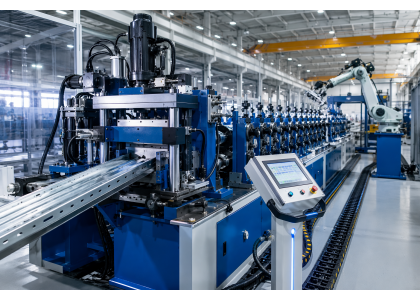
Walk into a roll forming factory in 2016, and you would likely see operators manually adjusting roller spacers with wrenches, measuring profile dimensions with calipers between runs, and logging production counts on a clipboard. Walk into the same factory in 2026, and the operator is more likely to be standing at a touch screen, loading a pre-programmed batch order, while servo motors automatically reposition rollers, adjust cutting length, and switch profiles — all in under a minute. This is the automation revolution in roll forming, and it is reshaping the economics of purlin and panel production worldwide.
Understanding automation in roll forming is not about a single technology. It is about a progression — a ladder that every manufacturer climbs at their own pace. Here is how the industry has evolved, level by level.
The baseline. Still common in entry-level markets and small workshops.
| Feature | Description |
|---|---|
| Size change | Manual adjustment of roller spacers and guides using hand tools. A full size changeover can take 30–60 minutes. |
| Cutting | Mechanical shear triggered by a limit switch or foot pedal. Length accuracy depends on operator skill. |
| Profile switching | Not possible without changing the entire roller set — a half-day job. |
| Quality control | Manual measurement with calipers and tape. Inconsistent between operators and shifts. |
| Production tracking | Paper log or whiteboard. No real-time data. |
Manual machines remain viable for low-volume operations producing a single profile in long runs. But in an industry where customers demand mixed orders, short lead times, and consistent quality, the limitations are increasingly costly. Every hour of changeover is an hour of zero output. Every manual measurement is an opportunity for error.
The first significant step up. Widely adopted in medium-scale production.
Semi-automatic machines introduce a Programmable Logic Controller (PLC) with a basic human-machine interface (HMI) touch screen. The operator enters production parameters — profile dimensions, quantity, cutting length — and the PLC manages the execution.
Key upgrades over manual operation include:
Size change on a semi-automatic machine is still largely manual — rollers must be adjusted by hand. But the production run itself is significantly more efficient, with fewer operators needed and higher throughput per shift.
The current industry benchmark for competitive manufacturers.
Servo-driven machines replace manual roller adjustment with electric servo motors that reposition forming stations automatically. This is the single most impactful automation upgrade in modern roll forming — and the one that directly translates into profit.
| Feature | Manual / Semi-Auto | Servo-Driven |
|---|---|---|
| Size changeover time | 30–60 minutes | Under 1 minute |
| Profile switch (C ↔ Z) | Not available or hours | Under 1 minute |
| Cutting accuracy | ±2–3 mm | ±0.5 mm |
| Daily size changes (practical) | 2–4 | 10–20+ |
| Production speed | 15–20 m/min | 25–35 m/min |
Servo-driven machines use AC servo motors with precision ball screws to adjust the gap between roller stations, the forming width, and the flange height. The entire setup for a new profile size is recalled from memory — the operator selects the profile on the HMI, and the machine reconfigures itself in seconds.
For CZ integrated purlin machines, the same automation extends to switching between C and Z profiles. The forming rollers rotate, spacers adjust, and the shear mechanism repositions — all under servo control, all in under a minute. A machine that can produce 15+ tons per day with frequent size changes is a fundamentally different asset from one that produces 8 tons with long setup times.
The frontier. Early adopters are building it now.
Smart production lines integrate servo-driven hardware with IoT sensors, cloud connectivity, and AI-powered analytics. The machine is no longer just a machine — it is a data-generating node in a connected factory.
Elements of a smart roll forming line include:
The most common objection to upgrading to a servo-driven or smart line is cost. A servo-driven CZ machine costs more upfront than a manual or semi-automatic equivalent. But the payback math is compelling when you measure the right metrics:
| Metric | Manual | Servo-Driven | Impact |
|---|---|---|---|
| Operators required | 3–4 | 1–2 | 50% labor savings |
| Productive hours/day | 5–6 | 7–8 | 30%+ more output |
| Material waste | 3–5% | <1% | Significant savings |
| Order turnaround | 3–5 days | Same day | Competitive advantage |
| Product consistency | Operator-dependent | Machine-guaranteed | Fewer rejects, fewer returns |
For a mid-sized purlin manufacturer producing 10 tons per day, switching from manual to servo-driven automation can increase daily output by 30–50% while reducing labor cost by half. At typical market rates for finished purlins, the additional margin often recovers the machine's price premium within 12–18 months.
Not all "automated" machines are created equal. When evaluating equipment, ask these questions:
The roll forming industry's automation journey is well underway, but it is far from complete. The gap between a manual line and a servo-driven smart line is not just a matter of technology — it is a matter of competitiveness. In 2026, the manufacturers who invest in automation are the ones who can say "yes" to mixed orders, short lead times, and demanding quality standards. Those who do not are increasingly limited to commodity production at commodity margins.
The question is no longer whether to automate, but how fast — and how far — to go. The data is clear: the machines pay for themselves, the customers notice the difference, and the window for early-mover advantage in smart production is open now.
Hebei Xinnuo is a professional cold roll forming machinery manufacturer with 20+ years of experience. We specialize in C/Z purlin machines, roof panel roll formers, floor deck machines, and custom profile solutions — exported to 50+ countries worldwide.