
helen@hbxinnuorollforming.com
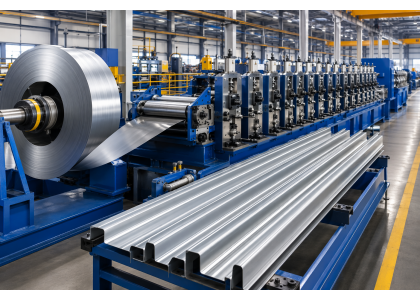
If you have ever seen a steel warehouse, a factory roof, or a metal-framed building under construction, you have seen the output of a cold roll forming machine. These machines are the backbone of modern steel construction — transforming flat metal coils into precision structural profiles used in buildings worldwide. But what exactly is a cold roll forming machine, how does it work, and why is it so important? This guide answers all of those questions.
Cold roll forming is a continuous metal forming process in which a flat strip of steel (or other metal) is progressively bent into a desired cross-sectional shape by passing it through a series of roller stations — all at room temperature. Unlike hot rolling, which heats the metal to over 900°C, cold roll forming shapes the material without applying heat, preserving its metallurgical properties and surface coating.
The result is a long, uniform profile — such as a C purlin, Z purlin, roof panel, floor deck, or wall cladding — that is cut to exact lengths as it exits the machine.
The process can be broken down into five key stages:
A steel coil — typically galvanized, Galvalume, or cold-rolled steel — is mounted on a decoiler (uncoiler) at the entry end of the line. The decoiler feeds the strip into the machine at a controlled tension.
The strip passes through a leveling unit that removes coil curvature (residual bend from being wound) and side guides that keep the material centered as it enters the first roller station. Accurate guiding is critical — even a 1 mm misalignment compounds with every station.
This is the heart of the machine. The strip passes through a series of roller stations — typically 12 to 30 stations, depending on profile complexity. Each station contains a pair of upper and lower rollers (also called tooling or dies) that bend the strip a few degrees at a time. By the time the strip exits the final station, it has been formed into the complete cross-sectional shape — without any cutting, heating, or material removal.
Key principle: each bend is small, incremental, and cold. This preserves the steel's zinc coating (no burn-off), avoids micro-cracking, and produces a uniform profile from the first meter to the last.
Many profiles require holes, slots, or notches — for bolted connections, drainage, or interlocking. These are added by a hydraulic or servo-driven punching press positioned either before the forming stations (pre-punching) or after the final station (post-punching). Modern machines synchronize punching with the line speed, so holes are placed at precise intervals without stopping production.
The finished profile exits the last roller station and is cut to the programmed length by a flying shear — a cutting mechanism that moves with the profile during the cut, then returns to its starting position. Cutting accuracy in modern servo-driven machines is typically ±0.5 mm. The cut pieces are collected on a run-out table, ready for stacking and packaging.
| Component | Function |
|---|---|
| Decoiler / Uncoiler | Holds and feeds the steel coil. Available in manual, hydraulic, and motorized versions. Capacity ranges from 3 to 10 tonnes. |
| Leveling Unit | Flattens the strip and removes coil set before forming. Essential for profile consistency. |
| Roll Forming Stations | The core of the machine. Each station has upper and lower rollers mounted on shafts driven by the main motor via a gearbox and chain or gear transmission. Rollers are typically made from GCr15 bearing steel, heat-treated and chrome-plated for wear resistance. |
| Punching / Notching Unit | Hydraulic or servo-driven press that punches holes, slots, or notches into the profile at programmed positions. |
| Flying Shear / Cutting Unit | Cuts the finished profile to length without stopping the line. Hydraulic or servo-driven. |
| Run-Out Table | Collects cut pieces for manual or automatic stacking. |
| PLC Control System | The brain of the machine. Controls line speed, cutting length, punching position, batch quantity, and — in servo-driven machines — automatic roller adjustment for size changeover. |
| Hydraulic Power Unit | Powers the shear and punching press. Sized according to the material thickness and profile being produced. |
Cold roll forming machines are categorized by the product they produce. The most common types include:
| Machine Type | Product Produced | Primary Use |
|---|---|---|
| C Purlin Machine | C-shaped steel purlins | Wall girts, roof purlins |
| Z Purlin Machine | Z-shaped steel purlins | Continuous-span roof systems |
| CZ Integrated Machine | Both C and Z profiles | Full-service purlin supply |
| Roof Panel Machine | Trapezoidal / corrugated sheets | Roof and wall cladding |
| Floor Deck Machine | Composite floor deck profiles | Multi-story steel buildings |
| Glazed Tile Machine | Decorative antique tile profiles | Residential, heritage buildings |
| Double Layer Machine | Two profiles from one machine | Space-saving, multi-product production |
| Composite Panel Machine | Insulated sandwich panels | Cold storage, prefab buildings |
The most commonly cold roll formed materials are:
Material thickness typically ranges from 0.3 mm to 4.0 mm for steel, with high-strength grades like G550 requiring heavier-duty machine frames, higher motor power, and specialized roller tooling to handle increased forming resistance and springback.
Why choose cold roll forming over other manufacturing methods? Here are the key advantages:
| Advantage | Explanation |
|---|---|
| High Material Utilization | Over 99% of the coil is converted into finished product. Almost zero material waste — no chips, no offcuts beyond the start and end of each coil. |
| Preserved Coating | Room-temperature forming does not burn off galvanized or painted coatings. Products are ready to install immediately — no secondary painting required. |
| Consistent Quality | Every meter of profile is identical. Dimensional tolerances of ±0.5 mm are achievable with modern servo-driven machines. |
| High Production Speed | Typical line speeds of 15–35 m/min. A single machine can produce 10–20 tonnes of finished product per day. |
| Complex Profiles in One Pass | Profiles with lips, bends, ribs, and stiffeners are formed in a single continuous pass — no secondary operations needed. |
| Energy Efficient | No heating required. The machine runs on electric motor drives, consuming far less energy than hot rolling or extrusion processes. |
| Increased Yield Strength | The cold working process increases steel yield strength by 15–30%, enabling thinner gauges to achieve the same structural performance — reducing material cost and weight. |
Cold roll formed steel profiles are everywhere in modern construction and manufacturing:
If you are in the market for a cold roll forming machine, here are the key factors to evaluate:
A cold roll forming machine is not just a piece of equipment — it is a complete production system that converts raw steel coil into finished structural components with remarkable speed, precision, and material efficiency. From the decoiler at the entry end to the flying shear at the exit, every component plays a role in delivering consistent, high-quality profiles that the construction industry depends on.
Whether you are producing C purlins for a warehouse, roof panels for a factory, or floor decks for a high-rise, understanding how cold roll forming works — and how to choose the right machine — is the first step toward building a competitive, profitable manufacturing operation.
Hebei Xinnuo is a professional cold roll forming machinery manufacturer with 20+ years of experience. We specialize in C/Z purlin machines, roof panel roll formers, floor deck machines, and custom profile solutions — exported to 50+ countries worldwide.