Roll Forming Machine Maintenance Guide: 10 Essential Tips
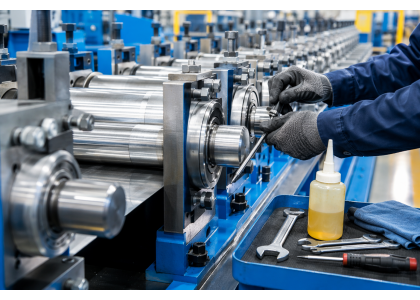
A cold roll forming machine is a significant capital investment. Like any precision industrial equipment, its productivity, product quality, and service life depend directly on how well it is maintained. Neglecting routine maintenance does not just risk breakdowns — it causes gradual profile inaccuracy, surface defects, and premature roller wear that erodes your margins long before anything visibly fails.
This guide covers 10 essential maintenance practices that every roll forming machine operator and factory manager should follow.
1. Daily Roller Inspection and Cleaning
Why it matters: Rollers are the heart of the machine. Any debris, zinc residue, or surface damage on a roller will transfer directly onto the profile — causing scratches, dents, or dimensional drift.
What to do:
- At the end of each shift, visually inspect all roller surfaces under good lighting. Look for zinc buildup (galvanized coating transfer), scratches, pitting, or uneven wear patterns.
- Clean rollers with a soft brass brush or non-abrasive cleaning pad. Never use steel brushes or scrapers — they will scratch the chrome plating and create new surface defects.
- For stubborn zinc deposits, use a commercial zinc-removal solvent designed for roll forming tooling. Apply sparingly and wipe clean.
- Check that no loose bolts, offcuts, or debris have fallen into the roller stations.
Frequency: Every shift, without exception.
2. Lubrication: The Most Underrated Maintenance Task
Why it matters: Roll forming machines have dozens of moving parts — bearings, chains, gears, shafts, and slide mechanisms. Inadequate lubrication is the leading cause of premature bearing failure and chain wear.
What to do:
- Follow the manufacturer's lubrication schedule exactly. Each lubrication point has a specified grease type, quantity, and interval.
- Use high-quality lithium-based grease for bearings (operating temperature range typically -20°C to +120°C).
- Apply gear oil to the main gearbox according to the recommended grade and level. Check the oil sight glass daily.
- Lubricate chain drives weekly with chain-specific lubricant. Wipe off excess to prevent dust accumulation.
- For servo-driven machines, the ball screws that adjust roller spacing require regular greasing — every 200–300 operating hours or per manufacturer specification.
Frequency: Daily oil check, weekly chain lubrication, monthly bearing greasing (or per manufacturer schedule).
3. Hydraulic System Maintenance
Why it matters: The hydraulic power unit drives the flying shear and punching press. Contaminated or degraded hydraulic oil causes sluggish cutting, inconsistent punching force, and eventual pump or valve failure.
What to do:
- Check the hydraulic oil level daily. Top up with the same grade of oil if low — never mix different oil types.
- Inspect hydraulic hoses and fittings weekly for leaks, cracks, or abrasion. A small leak today becomes a burst hose tomorrow.
- Replace the hydraulic oil filter every 500–1,000 operating hours or per manufacturer specification.
- Replace the hydraulic oil completely every 2,000–3,000 operating hours or annually, whichever comes first.
- Monitor oil temperature during operation. If the oil exceeds 60°C, check for restricted flow, clogged filters, or inadequate cooling.
Frequency: Daily level check, weekly hose inspection, scheduled oil and filter changes.
4. Shear Blade Inspection and Sharpening
Why it matters: A dull shear blade crushes the profile edge instead of cutting it cleanly. This causes burrs that are sharp and dangerous, and profiles that do not fit properly at the job site.
What to do:
- Inspect the cut edge of sample profiles daily. A clean cut shows a smooth, perpendicular edge with no burr. A dull blade produces a rolled-over or jagged edge.
- Check blade clearance (gap between upper and lower blade). Incorrect clearance accelerates wear and causes poor cut quality. The correct clearance is typically 5–10% of material thickness.
- Sharpen or replace shear blades when cut quality deteriorates — typically every 3–6 months in high-volume production.
- Keep a spare set of sharpened blades on hand. The downtime waiting for blade sharpening costs more than the spare set.
Frequency: Daily cut quality check, blade replacement based on cut quality, not a calendar.
5. Alignment and Leveling Verification
Why it matters: A misaligned roller station or unlevel machine frame causes the strip to drift, producing profiles that curve (camber), twist, or have uneven flange lengths. These defects are often subtle — until the customer rejects the batch.
What to do:
- Check machine frame level every 3 months using a precision spirit level. Anchor bolts can loosen, and factory floors can settle.
- Verify roller station alignment every 6 months. Use a laser alignment tool or a straightedge to confirm that all stations are on the same centerline.
- Check roller gap (the space between upper and lower rollers) on each station. The gap should match the material thickness exactly. Uneven gaps cause profile distortion.
- After any major maintenance or machine relocation, perform a full alignment check before restarting production.
Frequency: Level check quarterly, full alignment check semi-annually.
6. Electrical System and PLC Maintenance
Why it matters: Dust, moisture, vibration, and heat are the enemies of electrical and electronic components. A loose connection or a dust-clogged cooling fan can cause intermittent faults that are difficult to diagnose.
What to do:
- Keep the electrical cabinet door closed and sealed. Inspect the door gasket for damage.
- Clean the cabinet interior every 6 months using a low-pressure air duster. Do not use compressed air above 2 bar — it can force dust deeper into components.
- Check that all cooling fans (cabinet fans, motor fans) are running. A single failed fan can cause a servo drive to overheat and shut down.
- Tighten terminal connections annually. Thermal cycling loosens screw terminals over time.
- Back up the PLC program and parameter settings to a USB drive or cloud storage. If the PLC fails, a backup saves days of reprogramming.
- Keep the HMI touch screen clean with a microfiber cloth. Do not use solvents — they damage the screen coating.
Frequency: Monthly visual inspection, semi-annual cleaning, annual terminal tightening and backup.
7. Chain and Sprocket Maintenance
Why it matters: Chains transmit power from the main motor to each roller station. A worn or loose chain causes roller speed variation between stations, which stretches or compresses the profile and creates surface marks.
What to do:
- Check chain tension weekly. A chain that is too loose jumps teeth. A chain that is too tight accelerates sprocket and bearing wear.
- Inspect sprocket teeth for wear — a hooked or pointed tooth profile indicates the sprocket needs replacement.
- Replace chains and sprockets as a set. A new chain on worn sprockets wears out prematurely.
- Check chain guards are intact and secure. A broken chain at speed is dangerous.
Frequency: Weekly tension check, monthly wear inspection.
8. Decoiler and Coil Handling Maintenance
Why it matters: The decoiler feeds the machine. If the coil unwinds unevenly, jerks, or binds, the forming process is disrupted from the very first station.
What to do:
- Lubricate the decoiler mandrel expansion mechanism monthly.
- Check the decoiler brake or tension control system. Inconsistent tension causes strip wandering and profile camber.
- Inspect the coil car or loading mechanism for smooth operation. Hydraulic cylinders should move without judder.
- Keep the coil staging area clean. Dirt on coil edges transfers into the roller stations.
Frequency: Monthly.
9. Keep a Maintenance Log
Why it matters: An unlogged maintenance program is guesswork. Without records, you cannot track wear patterns, predict failures, or prove due diligence to equipment insurers and warranty providers.
What to do:
- Record every maintenance activity: date, task performed, parts replaced, lubricant used, and operator name.
- Track consumable replacements: shear blades, hydraulic filters, chains, bearings. The replacement interval tells you when to order spares in advance.
- Note any unusual observations — a new noise, a slight vibration, a minor oil leak. These are early warnings. Investigating them before they become breakdowns is the whole point of preventive maintenance.
- Use a simple spreadsheet, a maintenance app, or the machine's own PLC data logging — whatever format your team will actually use.
Frequency: Every maintenance activity, every shift.
10. Annual Professional Service and Overhaul
Why it matters: Daily and weekly maintenance covers routine wear. But once a year, the machine needs a thorough professional inspection that goes beyond what operators can do during production.
What to do:
- Schedule an annual service visit from the machine manufacturer or a qualified technician.
- Full roller removal, cleaning, and dimensional inspection. Replace any roller showing measurable wear beyond tolerance.
- Bearing replacement on high-wear stations (typically the first and last forming stations, where forming force is highest).
- Full alignment check and recalibration of all stations.
- Hydraulic system flush and refill.
- PLC and drive system health check, firmware updates if available.
- Operator refresher training — one day of training prevents a year of small mistakes.
Frequency: Annually.
Maintenance Schedule at a Glance
| Task |
Daily |
Weekly |
Monthly |
Quarterly |
Semi-Annual |
Annual |
| Roller cleaning & inspection |
✓ |
|
|
|
|
|
| Oil level check |
✓ |
|
|
|
|
|
| Cut quality check |
✓ |
|
|
|
|
|
| Chain lubrication |
|
✓ |
|
|
|
|
| Hydraulic hose inspection |
|
✓ |
|
|
|
|
| Bearing greasing |
|
|
✓ |
|
|
|
| Decoiler maintenance |
|
|
✓ |
|
|
|
| Frame level check |
|
|
|
✓ |
|
|
| Electrical cabinet cleaning |
|
|
|
|
✓ |
|
| Full alignment check |
|
|
|
|
✓ |
|
| Hydraulic oil & filter change |
|
|
|
|
|
✓ |
| Professional service visit |
|
|
|
|
|
✓ |
Conclusion
A well-maintained cold roll forming machine produces better profiles, uses less energy, breaks down less often, and lasts longer — all of which flow directly to your bottom line. The 10 practices in this guide are not complicated, but they do require consistency. Build them into your daily, weekly, and monthly routines. Train your operators to treat maintenance as part of the job — not an interruption of it.
The best time to start a maintenance program is the day the machine is commissioned. The second-best time is today.